EN



Custom Dinosaur Baby Sleeper Manufacturer | OEM ODM Infant Zip Romper Private Label Supplier


- Overview
- Custom Dinosaur Print Baby Sleeper for OEM & ODM Brands
- Recommended Products
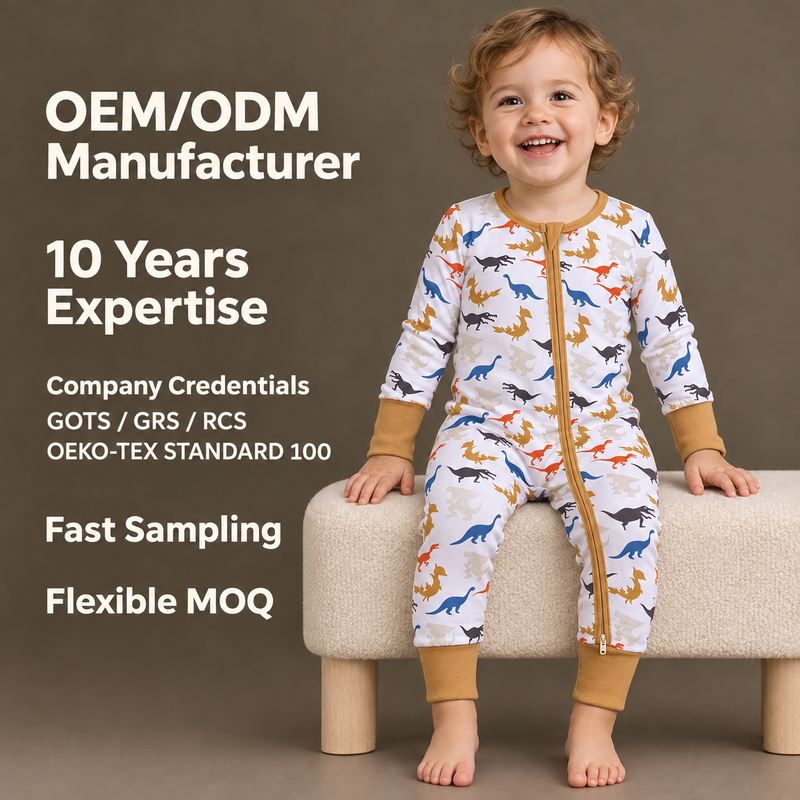
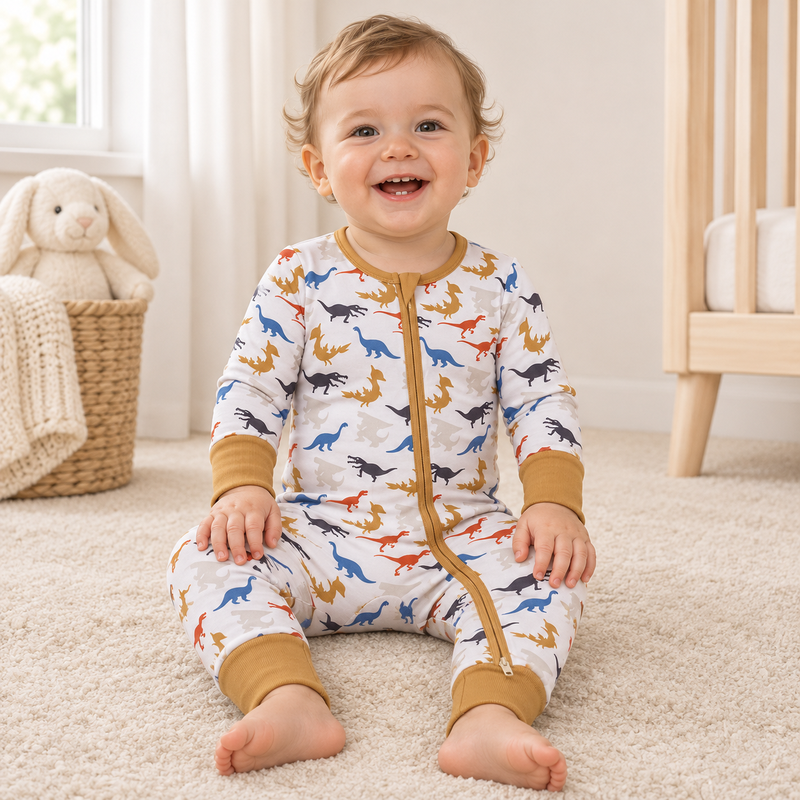
A long-sleeve footless sleepsuit in a 220 gsm printed knit: white ground with an allover dinosaur print, camel binding at the neck, a full-length zip from the neck down one leg, camel folded rib cuffs and contrast ankle cuffs. Quoted in bamboo viscose for 0-12M.
| Item | Item | |
| Product type | Long-sleeve zip sleepsuit, footless | |
| Age range | 0-12M, five sizes; wholly under 36 months | |
| Fabric | 220 gsm bamboo viscose jersey, allover print | |
| Fibre label | Viscose (EU) / rayon (US) | |
| Zip | Full-length zip, guard at neck, backing behind | |
| Cuffs | Camel rib cuffs, folded; contrast neck binding | |
| Dinosaur allover, water-based pigment | ||
| Certification | OEKO-TEX 23.HCN.45112 - Class I scope to confirm | |
| MOQ |
|
1. Fibre: 220 gsm bamboo viscose, and the name on the label
- "Bamboo" is a source, not a fibre. Almost all bamboo textile is viscose made from bamboo pulp - a regenerated cellulose fibre. EU Regulation 1007/2011 requires it to be declared viscose; the US FTC requires rayon. Only mechanically processed bamboo may carry "bamboo" as a fibre name, and that is a different, coarser product. A label reading "100% bamboo" is a labelling failure in both markets.
- The eco-story has to be kept factual. Regenerated cellulose is not "chemical-free", and the antibacterial claims attached to bamboo textiles are not supported by the fibre. What can be said is true: a soft cellulose fibre from a fast-growing plant - and that is all this page claims.
- 220 gsm is a winter weight. At this weight a viscose knit drapes heavily and insulates; it is the right cloth for a cold nursery and the wrong one for summer, where the same style would be quoted at roughly 150-180 gsm. Weight is a merchandising decision before it is a technical one.
- Viscose has low wet strength. Wet, the fibre loses much of its strength, which is why this cloth is washed cool, dried flat and never wrung - and why seams are built for a weak fibre: no stretched allowance, no heavy stitch on a narrow margin.
- Shrinkage is the quiet risk. Viscose relaxes and shrinks more than cotton, depending on the finishing route. The fabric is pre-shrunk and the pattern cut from a washed-off sample; skip that step and the sleepsuit is a size short after one wash.
2. Construction: the zip is the decision
- Full-length zip, opened from the neck down one leg. It is the nappy-access feature and the weakest point at once: a failed zip scraps the sleepsuit, and it fails at the slider or the bottom stop.
- Guard at the neck. A zip garage or a fabric tab over the top of the zip, so the slider does not sit against a chin. Without it, the hard part of the garment is exactly where a baby tucks its head.
- Backing behind the zip. A self-fabric facing runs behind the teeth so nothing metal or moulded touches skin, and so a nappy cannot catch in the teeth. The facing is the part that gets missed in a cheap build and noticed immediately in use.
- Zip specification. Nylon coil, not metal, for a baby garment: lighter, no nickel question, no cold metal at the neck. The pull is plain moulded - no ribbon, charm or loop, because a long pull is a cord in the neck area.
- Cuffs and binding. Camel folded rib cuffs at the sleeve and ankle, cut with negative ease so they stay on a wrist without marking it, and a contrast binding at the neck that is cut on the cross so it follows the curve. Rib is pre-shrunk with the body.
- Seams. Four-thread overlock pressed flat, nothing exposed against skin; knit seams at 10-12 per inch. On viscose, density matters more than on cotton: too loose and the seam grins white at the fold, too tight and the cloth perforates along the stitch line.
- Needle control. 100% needle detection on finished pieces; one-for-one needle exchange at every break with the machine stopped, work in progress within 2.5 m re-screened twice; needle-free area enclosed, 2 m deep, single entry. A zip line plus a print run makes breakage likelier than on a plain body.
3. Size: 0-12M in five sizes
Five bands: 0-3M, 3-6M, 6-9M, 9-12M and a 12M top band.
The whole range is under 36 months, so every size is assessed as Class I - lower limit values plus the extra fastness against saliva. There is no Class II portion and no split.
Fit is not free here. Sold as sleepwear, the US route has two paths: a flammability test on the finished garment, or a tight-fitting construction meeting specified measurements with the required snug-fitting warning. The second constrains the fit - a snug sleepsuit is not a roomy grow - so fit and compliance are one decision, taken at sampling.
Length grades faster than width. A sleepsuit is outgrown at the ankle first; leg and zip length grade together, because a zip short for its size pulls at the crotch.
Age labelling is merchandising, not measurement. The graded table ships with the quotation and is signed off on the pre-production sample.
4. Customization scope
- Cloth. 220 gsm bamboo viscose as quoted; a 150-180 gsm version for summer; a cotton/viscose blend for more body; organic cotton under GOTS or recycled content under GRS where specified.
- Print. Allover placement as shown, a smaller repeat, a chest-only print, or a solid with contrast cuffs; number of colours in the artwork is the cost driver.
- Zip. Nylon coil as quoted, two-way zip, or a snap placket instead of a zip for buyers who will not carry a zip.
- Cuffs and binding. Camel as shown, or self-colour; folded rib cuff or a plain hem; footed option with a sole print.
- Neckline. Round with binding as shown; a envelope neck is not compatible with a full zip and is quoted as a separate style.
- Details. A zip garage, a chin tab, a leg gusset for a larger nappy, a back neck patch, a side-seam label.
- Branding. Woven label, printed care label with the fibre content in the legal name, size label, hangtag; polybag, header card or a gift box.
MOQ: 300 pcs for a custom development - custom fabric, print, wash, colour or trim; 50 pcs for a decorative process added to a stock body; 100 pcs for stock fabric with your own logo and label. Mixed colour and size orders are quoted per order. These are standing programme terms, confirmed against the current quotation.
5. Compliance: fibre name, sleepwear route, zip
- Fibre naming. Viscose in the EU, rayon in the US, with the percentage declared. "Bamboo" may appear as a marketing description only where the rules of the destination market allow it, and never as the fibre name on the care label. This is the first thing a customs or retail audit checks on a bamboo product.
- Chemical class. 0-12M is wholly under 36 months, so Class I applies across the range. OEKO-TEX Standard 100 certificate 23.HCN.45112 is held for the fabric; the class and the specific article - including print, zip tape and cuffs - are confirmed against the certificate scope before a claim is listed.
- Sleepwear. Sold as a sleepsuit, the garment is children's nightwear: in the US that is 16 CFR 1615/1616, in the EU EN 14878. The route - flame test or tight-fitting construction - and the cost of it are confirmed per order with the testing laboratory. We do not carry a flammability report for this article, and this page makes no flammability claim.
- Zip and small parts. Nylon zip, moulded pull, no attached charm or ribbon. The slider and pull are checked for attachment and for pinch points; the neck guard is part of that check, not a styling extra.
- Print fastness. Viscose prints crock more than cotton prints: fastness to wet rub, wash, saliva and perspiration at grade 3-4 or better, tested on the printed panel after finishing rather than on the greige.
- Labelling. CPSIA children's product certificate where the US route applies, with a tracking label; care and origin per market rules; Regulation (EU) 1007/2011 for fibre names.
6. Sampling, MOQ and lead times
The terms below are the standing programme terms for this product type; your order's figures are confirmed in the quotation.
- Sampling. 3-7 days from confirmed tech pack and fabric availability, including one print strike-off and a zip approval. A new print repeat adds a round. Rush sampling at a surcharge.
- Sample cost. USD 30-100 per set, refunded against a bulk order of USD 5,000. Development fee USD 50-200, refunded at USD 5,000.
- Bulk lead time. 30-60 days from approval, depending on quantity, finishing and trim lead time. Rush production shortens this and is quoted per order.
- Quality standard. AQL 2.5 for major defects, AQL 1.0 for critical; third-party inspection accepted.
- Payment. New customers 50% deposit, 50% before shipment; repeat customers can move to 30% deposit, 70% against the bill of lading.
Production runs with our production partner, Suzhou Shelmin Trade Co., Ltd.: 7,200 m2 workshop, 8 lines, 200 staff, 6,000 pieces per day. We hold design confidentiality under NDA and do not re-use buyer patterns or colourways.
7. What we need from you to quote
- Target market, so the fibre name and the sleepwear route are right.
- Weight: 220 gsm as quoted, or a summer weight.
- Print: artwork, repeat size and colour count.
- Closure: full zip, two-way zip, or snap placket.
- Whether the garment is sold as sleepwear, and which route you intend to take.
- Branding, packaging, and whether certification runs in your brand name.
Send the tech pack and a print reference; we return a costed quotation with a graded measurement table, a zip specification, a fibre-naming note for each market and the certificate set.