EN


Custom Dinosaur Baby Blanket Manufacturer | OEM ODM Infant Swaddle & Receiving Blanket Supplier


- Overview
- Custom Dinosaur Baby Blanket for OEM & ODM Babywear Brands
- Recommended Products
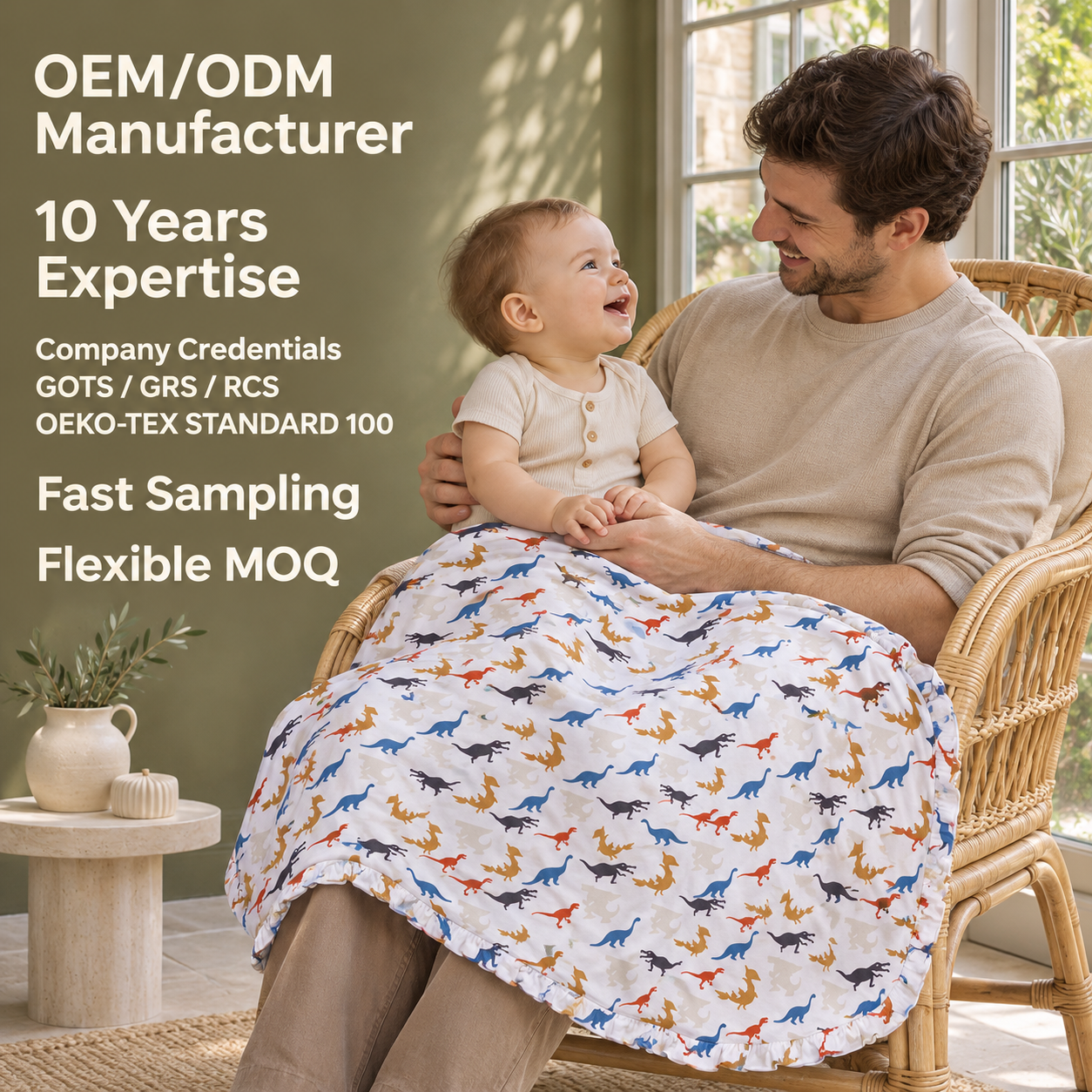
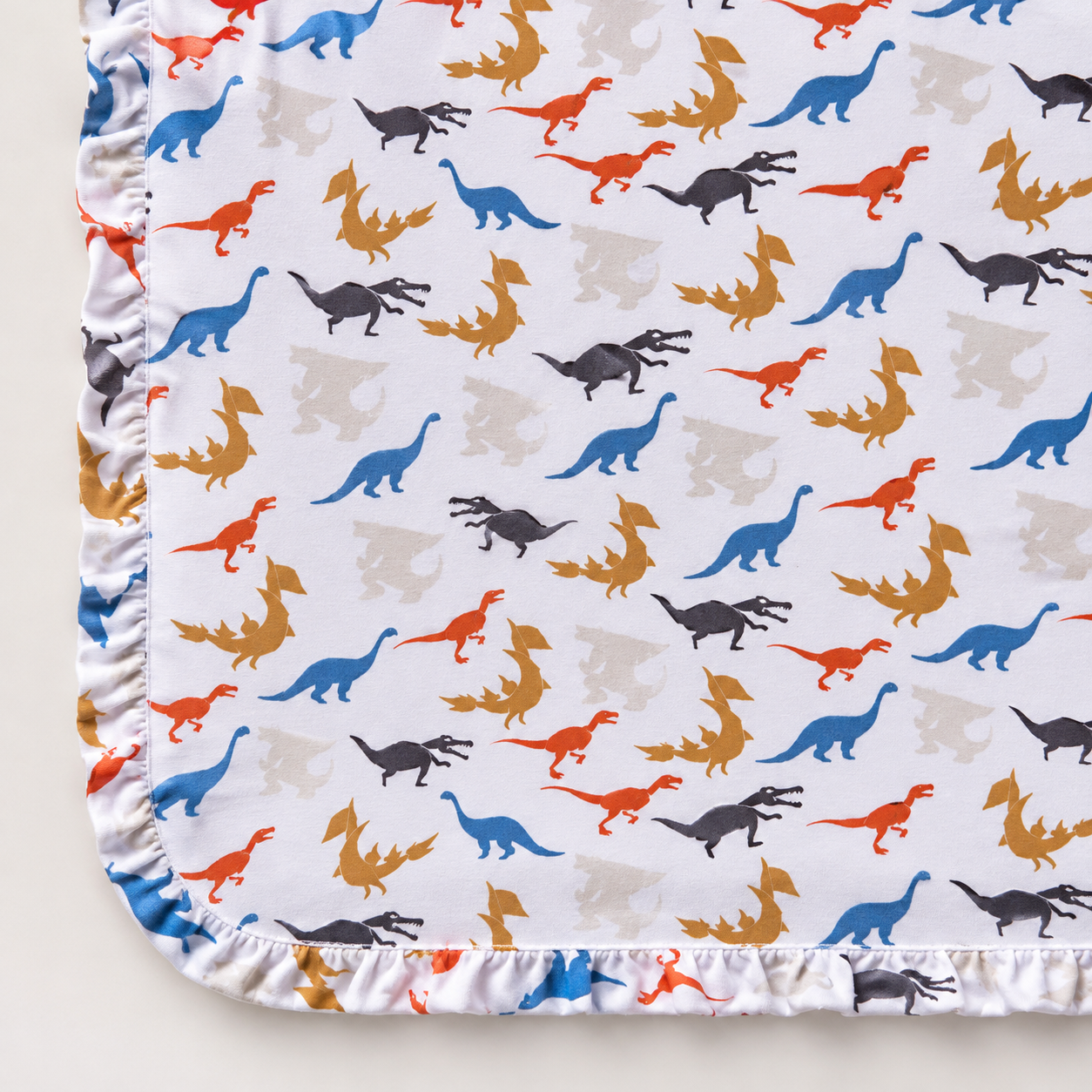
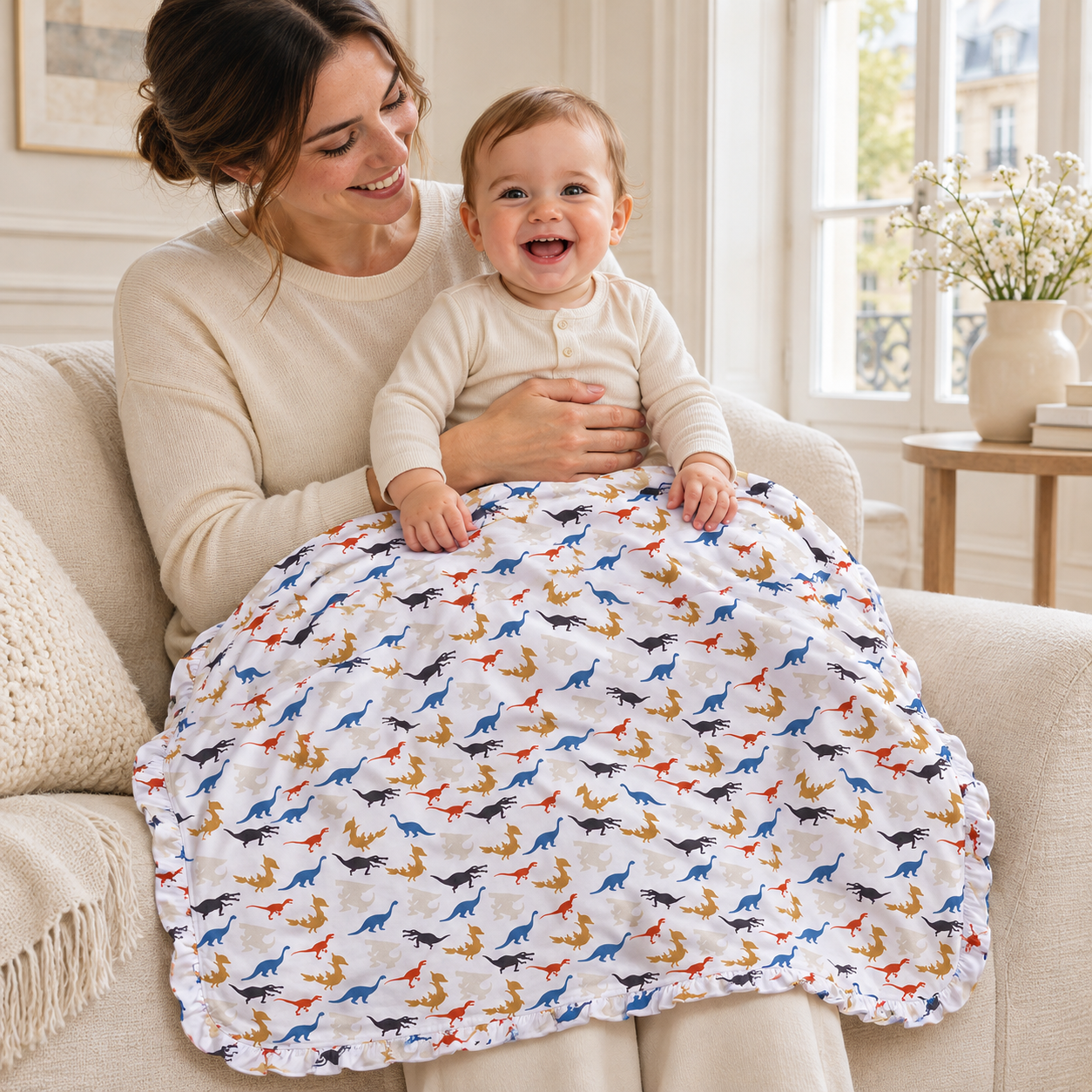
A square baby blanket in a 220 gsm printed knit: white ground with an allover dinosaur print in blue, brick and camel, finished with a gathered self-fabric ruffle on all four sides. Quoted at 80 × 80 cm in bamboo viscose.
Three numbers decide what this blanket is. 220 gsm sets the warmth and the wash behaviour. 80 × 80 cm sets what it is for — pram, car seat, receiving wrap — and rules out the cot.
At a glance
1. Fibre: 220 gsm bamboo viscose, and the name on the label
- "Bamboo" is a source, not a fibre. Almost all bamboo textile is viscose made from bamboo pulp, a regenerated cellulose fibre. EU Regulation 1007/2011 requires it declared viscose, the US FTC requires rayon. Only mechanically processed bamboo, a coarser and stiffer product, may carry "bamboo" as a fibre name. "100% bamboo" on a care label is a labelling failure in both markets.
- Keep the eco-story factual. Regenerated cellulose is not "chemical-free", and the antibacterial reputation around bamboo textiles is not a property of the fibre. What is defensible: a soft cellulose fibre from a fast-growing plant.
- 220 gsm in context. Muslin swaddles run roughly 110–140 gsm, jersey baby blankets about 180–250 gsm, padded quilts 300 gsm and up in two layers. At 220 gsm single layer this is a light pram blanket: warmer than muslin, not a winter quilt, and no finishing will make it one.
- Heavy when wet, weak when wet. 0.64 m² of 220 gsm knit holds a lot of water, and wet viscose loses much of its strength — an agitator twists the square out of shape and a wring cycle marks the folds. Wash cool, dry flat, reshape while damp.
- Shrinkage follows the finishing route, not a constant. That is why 80 × 80 cm must be specified as a finished, after-wash measurement; the cut size is larger. A blanket arriving at 78 cm is a chargeback, not a rounding error.
- It will fuzz. A viscose knit pills at the ruffle and along compressed fold lines. Managed by finish, not eliminated.
2. Size: 80 × 80 cm is a pram size, not a cot size
- The size defines the use. Cot blankets run about 75 × 100 cm to 100 × 150 cm. At 80 × 80 cm this is a pram and pushchair blanket, a car-seat blanket, a receiving wrap. Buyers who order it for a cot return it, so state the use on the listing.
- Square is an efficient cut. 0.64 m² with no panel waste, nothing to match beyond the print repeat.
- Loose bedding is the safe-sleep question. Major paediatric bodies advise against loose blankets in a cot under twelve months, so this is a pram and supervised-use blanket by positioning, and the copy should say so. If the brief is a sleep product, a sleep bag tested to EN 16781 is a different article.
- Tolerance belongs in the purchase order. On an 80 cm square, ±2 cm shows when blankets are stacked for a shelf photo, so the figure is agreed in writing. The sample is approved after one wash, so the approved size is what the customer sees after their first wash.
3. Construction: the ruffle is where the cost and the risk sit
- Single layer, one panel, one ruffle strip. The simplest honest build: a 220 gsm panel, a gathered self-fabric ruffle on four sides, a narrow hem on the ruffle's free edge.
- The gather ratio is the design decision. A fuller ruffle uses more fabric and more labour, and on a knit it carries risk: gathered too tightly for the cloth, the edge cups, the corners flare, the blanket will not lie flat. The ratio is fixed on the sample.
- The corners take the gather from two directions at once — where a ruffle blanket looks homemade, with puckers, a wave, or a lifted corner. Corner photographs belong in the bulk inspection report, not only flat-lay shots.
- The seam shows on the back. On a single-layer build the ruffle seam is visible on the reverse. Most buyers accept it; a bound or self-turn finish removes it and is quoted as a different construction.
- Nothing attached. No corner loop, no ribbon trim, no pom-pom, no toy. A loop on a baby blanket is a catch point and a strangulation argument.
- Needle control. 100% needle detection on finished pieces; one-for-one exchange at every break with the machine stopped; work within 2.5 m re-screened twice; needle-free area enclosed, 2 m deep, single entry. A ruffle line means more handling per piece than a plain panel.
4. Print: white ground, and what it has to survive
- The print route is decided at strike-off, not by price. A reactive print sits in the fibre and keeps the soft hand this cloth is bought for; a pigment print sits on the surface and can stiffen a 220 gsm knit, most visibly at the ruffle.
- A blanket gets mouthed. Fastness to saliva, perspiration and wet rub at grade 3-4 or better, tested on the finished printed panel rather than the greige.
- Heavy metals in pigment. Lead is screened on substrate and coating separately because the CPSIA limits differ: 100 ppm in the substrate, 90 ppm in a surface coating.
- White is unforgiving, and five colours are five chances to drift. Register shift and tint marks show on small motifs, so the strike-off runs on the actual 220 gsm cloth; every colourway is lab-dipped, and the camel is the one that goes muddy first.
5. Compliance: a children's product, and not sleepwear
- Fibre naming. Viscose in the EU, rayon in the US, percentage declared. "Bamboo" may appear as marketing copy where the destination allows it, never as the fibre name on the care label. It is the first thing a customs or retail audit checks.
- Children's product, not nightwear. A blanket is not a garment, so 16 CFR 1615/1616 and EN 14878 do not apply to it. What applies is children's product safety: lead, phthalates where a plasticized part exists, a children's product certificate and a tracking label.
- Chemical class. An infant blanket is Class I. OEKO-TEX Standard 100 certificate 23.HCN.45112 is held for the fabric; the class and the specific article — print, ruffle, trim — are confirmed against the certificate scope before a claim is listed.
- Flammability. No route is asserted and no report is held. US buyers often ask for 16 CFR 1610 on a blanket even though bedding is not apparel; the applicable test and cost are confirmed with the laboratory per destination.
- If it becomes a sleep bag, with a closure and a shaped bag, it is a different product under EN 16781 and should not be sold as one on this file.
- Labelling and documents. Care label with the fibre content in the legal name, origin and size; tracking label where the US route applies; reports in the buyer's name where requested.
6. Customization scope
- Size. 80 × 80 cm as quoted; 100 × 100 cm; 75 × 100 cm cot; 120 × 120 cm play mat.
- Weight and build. 220 gsm single layer as quoted; 150–180 gsm summer; 220 gsm double layer bagged or bound; 300 gsm and above for winter.
- Edge. Gathered self ruffle as shown; plain narrow hem; binding; scalloped edge.
- Reverse. Self fabric as quoted; brushed back for warmth; terry back for a bath version.
- Print. Allover as shown, a smaller repeat, a large panel motif, or solid with a contrast ruffle; a name embroidered with the reverse covered by a soft patch, because an exposed embroidery back is a scratch point.
- Branding and packing. Woven or printed label, satin care and size label, hangtag, ribbon band, gift box, polybag with header card.
MOQ: 300 pcs for a custom development — custom fabric, print, colour or trim; 50 pcs for a decorative process added to a stock body; 100 pcs for stock fabric with your own logo and label. Mixed colour and size orders are quoted per order. These are standing programme terms, confirmed against the current quotation.
7. Sampling, lead times and what we need to quote
- Sampling. 3–7 days from a confirmed tech pack and fabric availability, including one print strike-off and ruffle ratio approval. A new print repeat adds a round; rush sampling is quoted at a surcharge.
- Wash the sample before approving it. Ruffle behaviour and the finished 80 × 80 cm only appear after one wash; approving a flat, unwashed sample is how a size complaint starts.
- Sample cost. USD 30–100 per set, refunded against a bulk order of USD 5,000; development fee USD 50–200, refunded at USD 5,000.
- Bulk lead time. 30–60 days from approval by quantity, print and trim lead time; rush production is quoted per order.
- Quality standard. AQL 2.5 for major defects and AQL 1.0 for critical; third-party inspection accepted.
- Payment. New customers 50% deposit and 50% before shipment; repeat customers can move to 30% / 70% against the bill of lading.
Production runs with our production partner, Suzhou Shelmin Trade Co., Ltd.: 7,200 m² workshop, 8 lines, 200 staff, 6,000 pieces per day. Design confidentiality is held under NDA; buyer patterns and colourways are not re-used.
To quote, we need: target market, so the fibre name and test set are right; size and the tolerance you will hold; weight and whether it is single or double layer; print artwork with repeat size and colour count; edge treatment; packaging; whether certification runs in your brand name; and how the blanket will be positioned — pram and supervised use, or a sleep product, which would be a different article.