EN


Custom Baby Knot Hat Manufacturer | OEM ODM Infant Printed Beanie Supplier


- Overview
- Custom Printed Baby Knot Hat for OEM & ODM Babywear Brands
- Recommended Products
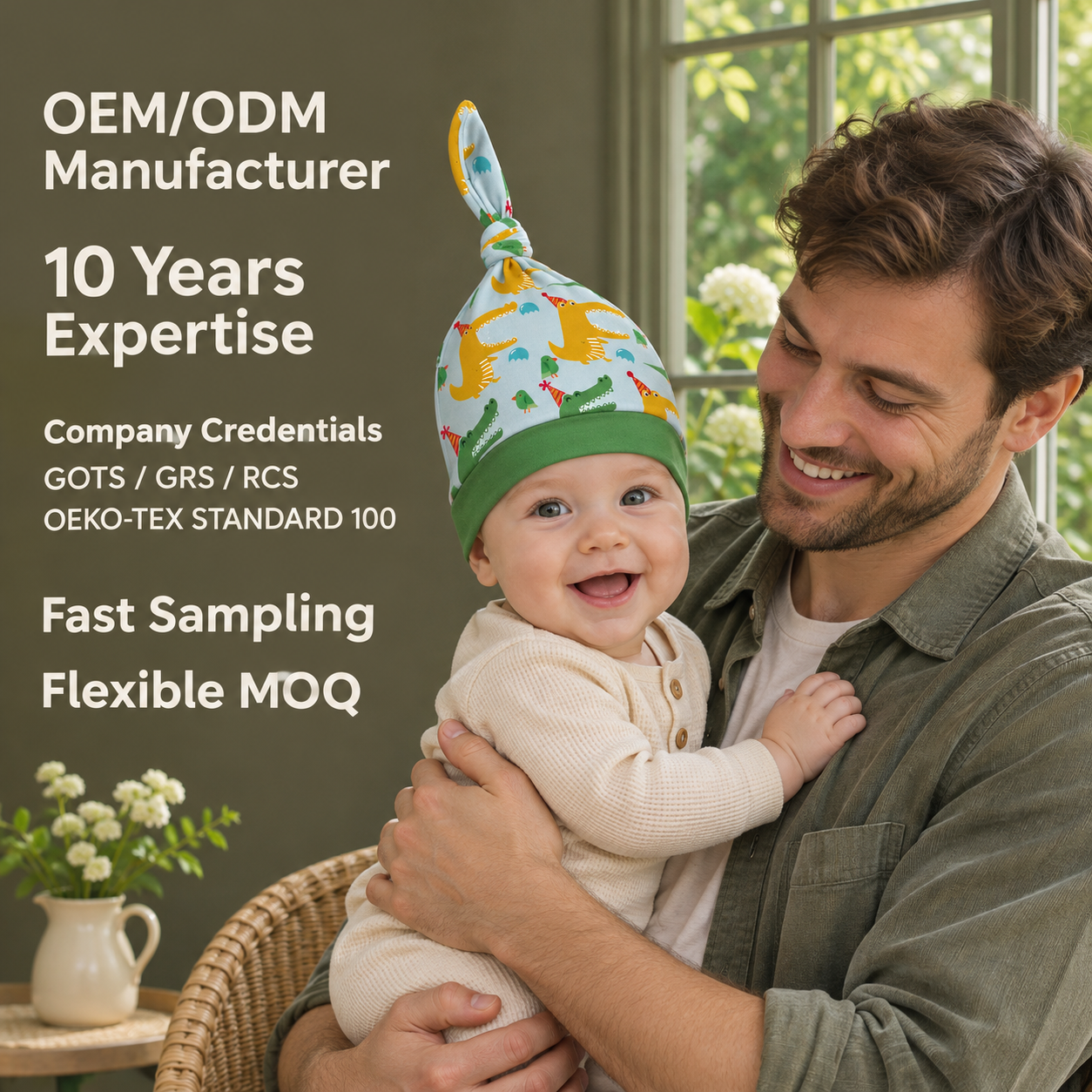
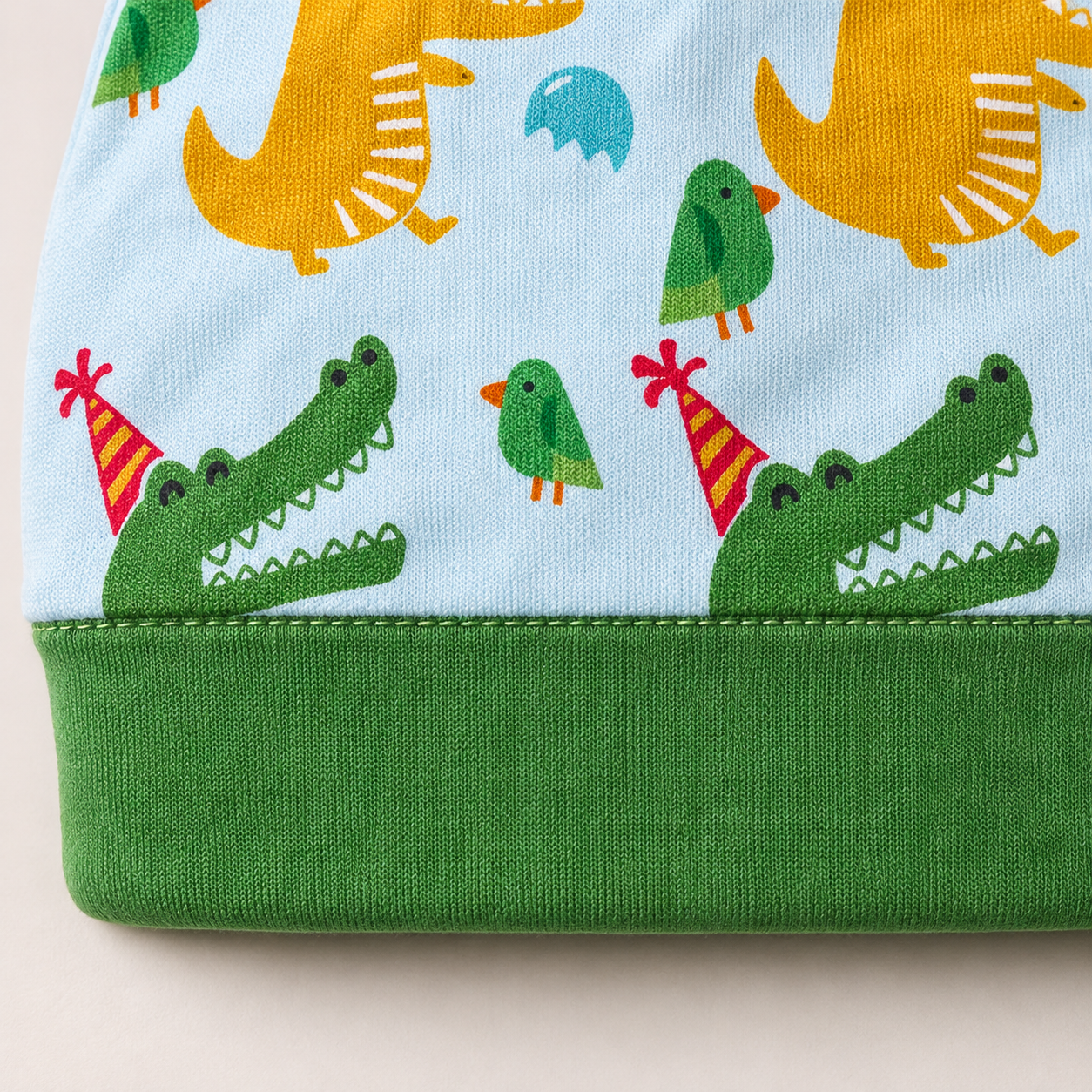
A knotted baby hat in a 220 gsm printed knit: pale aqua ground with an allover crocodile print in yellow, red party hats and green birds, a solid green wide cuff at the brim, and the crown gathered and tied into a knot.
At a glance

1. Fibre: 220 gsm bamboo viscose, and the name on the label
- "Bamboo" is a source, not a fibre. Almost all bamboo textile is viscose made from bamboo pulp, a regenerated cellulose fibre. EU Regulation 1007/2011 requires it declared viscose, the US FTC requires rayon. Only mechanically processed bamboo, a coarser and stiffer product, may carry "bamboo" as a fibre name.
- 220 gsm is heavy for a hat. Weight is normally discussed on bodywear; on a hat the cloth is doubled over a small, warm, high-friction surface. At 220 gsm this is a cold-weather hat — 160–180 gsm is the spring version, and it lies flatter on a newborn head.
- Jersey stretches, but it does not recover like rib. A single jersey tube will pull over a head and then stay stretched; the cuff is what brings it back. Whether the cuff is a rib with elastane or a self-fabric band is therefore a fit decision, not a trim decision.
- Viscose is weak when wet and shrinks by finishing route. On a 15 cm hat a centimetre of shrinkage is a visible change in crown depth and cuff depth — proportionally far larger than on a blanket or a sleepsuit. The fabric is pre-shrunk and the sample approved after one wash.
- It pills where it rubs. The cuff edge and back seam fuzz first, and a hat is washed more often than it is worn.
2. One size: what it actually covers
- "One size" is a range, not a size. A knotted hat at this depth is normally sold as 0–6M, which corresponds to roughly 35–43 cm of head circumference. The figure that goes on the label and the listing is agreed on the graded spec, not left as the words "one size".
- The knot is what buys the range. Tied high, the hat sits shallow and snug on a newborn; tied lower, the extra length covers a larger head. That adjustability is the entire reason one size is offered — and it only works if the tail is long enough to tie twice.
- The cuff holds the hat on. A hat that slips off is the first complaint in this category, and it is a cuff problem, not a knot problem: depth, tension and recovery after wash decide it.
- Newborn heads vary more than garment sizes suggest. A three-week-old and a twelve-week-old can share a label; a hat that fits one is tight on the other, so offer a second size rather than defending one.
- Be explicit about what it is not. Not a preemie hat, not a 12M hat; buyers who assume otherwise leave a review, not a message.
3. Construction: the knot, and then the cuff
- A tube with one seam. A knitted tube closed at the crown and gathered into a tail; the seam is flat-locked and kept off the centre front, where it would sit on a newborn's forehead.
- The knot has to be a real knot. The crown is gathered, twisted into a tail and tied, then back-tacked so it cannot work loose in the wash. A knot that is only a pleat with a stitch through it looks correct in a photo and unties in use.
- It is a hand operation, so it varies. Two pieces from one run will not tie identically: fix the tail length and tie point on the sample and check it at inspection, or the shelf looks uneven.
- Cuff specification. A wide band, either a rib with elastane for recovery or a self-fabric band for a softer, less elastic fit, folded and joined with a coverstitch or flat seam so there is no ridge against the forehead.
- Nothing hangs free. No chin strap, no ties, no pom-pom, no button. The knotted ends are trimmed short and secured: a long tail in the head area of a newborn hat is a hazard, not a design feature.
- Needle control. 100% needle detection on finished pieces; one-for-one exchange at every break with the machine stopped; work within 2.5 m re-screened twice; needle-free area enclosed, 2 m deep, single entry. Tight curves make a hat a higher-risk sew than a flat panel.
4. Print: pale aqua ground, five colours, one seam
- Small motifs expose registration. The crocodile's eye, teeth and party-hat tip fail first when a print is a millimetre off-register, on a curved surface read close up.
- The tube seam breaks the repeat. Either the artwork allows a break at the back or the repeat is sized so the join falls in a gap in the motif — settled at strike-off, not at bulk.
- The knot distorts what it gathers. No critical motif belongs at the crown: the gather pulls the print into a fan, and whatever was centred there arrives crooked on every piece.
- A pale ground shows drift. Aqua and light grounds show tint variation between lots more than a dark ground; each colourway is lab-dipped and the strike-off runs on the actual 220 gsm cloth.
- Fastness to saliva, perspiration and wet rub at grade 3-4 or better, tested on the finished printed panel: a hat sits against a head that sweats and gets chewed at the brim.
5. Compliance: headwear, and not sleepwear
- Fibre naming. Viscose in the EU, rayon in the US, percentage declared. "Bamboo" may appear as marketing copy where the destination allows it, never as the fibre name on the care label.
- A hat is not nightwear. 16 CFR 1615/1616 and EN 14878 do not apply to headwear, and no flammability route is asserted here. What applies is children's product safety: lead, phthalates where a plasticized part exists, a children's product certificate and a tracking label.
- Chemical class. An infant hat is Class I. OEKO-TEX Standard 100 certificate 23.HCN.45112 is held for the fabric; the class and the specific article — print, cuff, any trim — are confirmed against the certificate scope before a claim is listed.
- No cords, ties or straps. The design carries none, and the knotted ends are trimmed and secured. This is checked at inspection as a safety item, not as a styling detail.
- No UPF and no antibacterial claim. Bamboo hats are often sold with both; neither is supported by this fibre or held on file for this article.
- Labelling. Care label with fibre content in the legal name, size range and origin; tracking label where the US route applies.
6. Customization scope
- Sizing. One size as quoted; preemie, newborn, 0–3M, 3–6M and 6–12M bands on the same block.
- Crown. Hand-tied knot as shown; a plain beanie crown with a folded band; a double knot for a softer top.
- Weight. 220 gsm as quoted; 160–180 gsm for spring; a double-layer crown for winter.
- Cuff. Solid contrast as shown, rib or self fabric, wide or narrow, coverstitched or flat-seamed.
- Print. Crocodile allover as shown, a smaller repeat, a solid with contrast cuff, or a placement print kept clear of the crown. Colour count drives cost.
- Sets and packing. Three-pack in a band, gift box, polybag with header; woven or printed label, satin care label, hangtag.
MOQ: 300 pcs for a custom development — custom fabric, print, colour or trim; 50 pcs for a decorative process added to a stock body; 100 pcs for stock fabric with your own logo and label. Mixed colour and size orders are quoted per order. These are standing programme terms, confirmed against the current quotation.
7. Sampling, lead times and what we need to quote
- Sampling. 3–7 days from a confirmed tech pack and fabric availability, including a print strike-off and the knot tie-off approval. A new repeat adds a round; rush sampling is quoted at a surcharge.
- Wash the sample before approving it. Crown depth, cuff recovery and the finished head range only appear after one wash.
- Sample cost. USD 30–100 per set, refunded against a bulk order of USD 5,000; development fee USD 50–200, refunded at USD 5,000.
- Bulk lead time. 30–60 days from approval by quantity, print and trim lead time; rush production is quoted per order.
- Quality standard. AQL 2.5 for major defects and AQL 1.0 for critical; third-party inspection accepted, with the knot and cuff checked as safety and fit items.
- Payment. New customers 50% deposit and 50% before shipment; repeat customers can move to 30% / 70% against the bill of lading.
Production runs with our production partner, Suzhou Shelmin Trade Co., Ltd.: 7,200 m² workshop, 8 lines, 200 staff, 6,000 pieces per day. Design confidentiality is held under NDA; buyer patterns and colourways are not re-used.
To quote, we need: target market; the head circumference range you will print on the label; cuff type, rib or self fabric, and its depth; weight; print artwork with repeat size and colour count; packaging; and whether certification runs in your brand name.