EN


Custom OEM/ODM Baby Girls Floral Print Shorts - Soft Breathable Cotton Summer Shorts for Toddlers & Infants


- Overview
- co-Friendly Toddler Apparel OEM Service
- Recommended Products
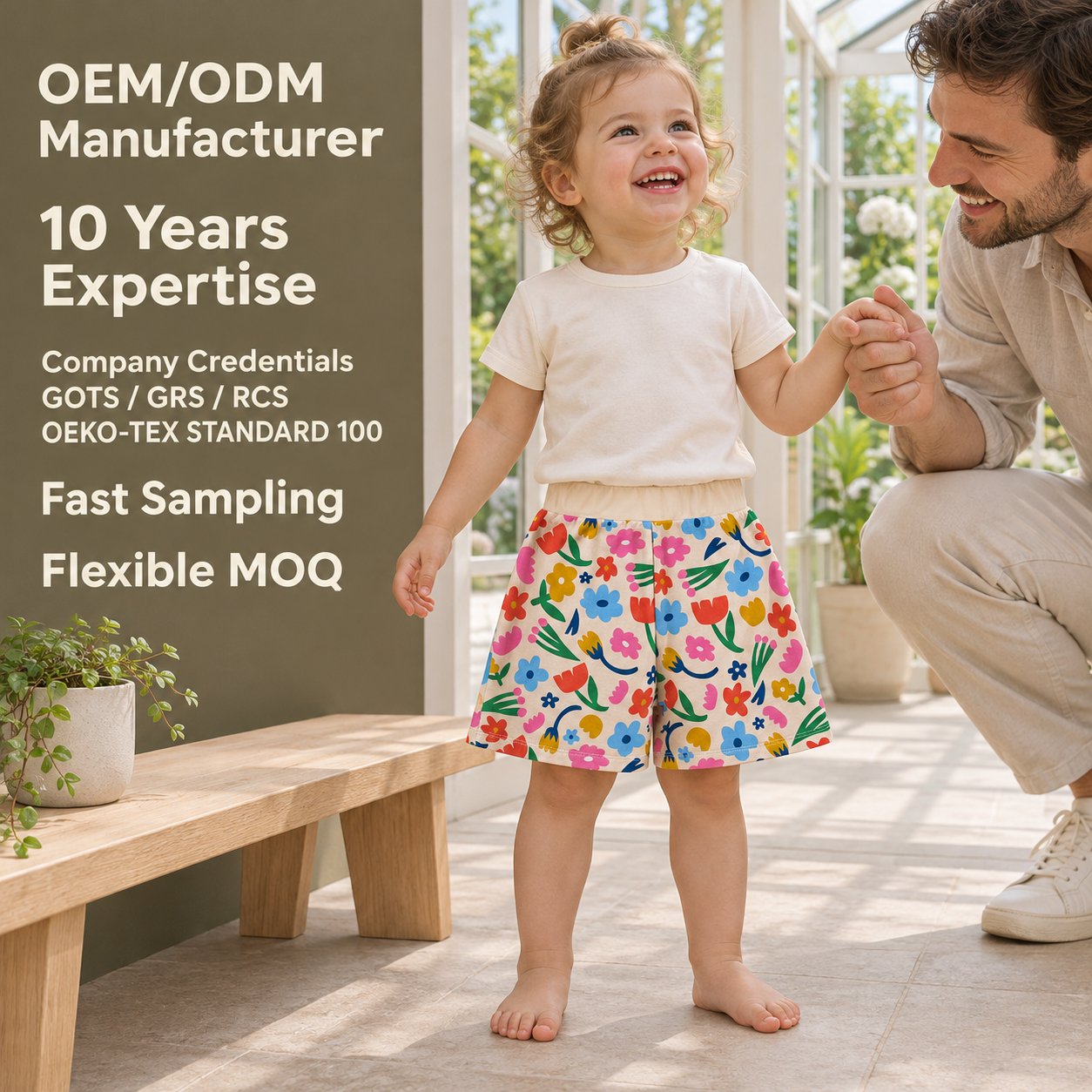
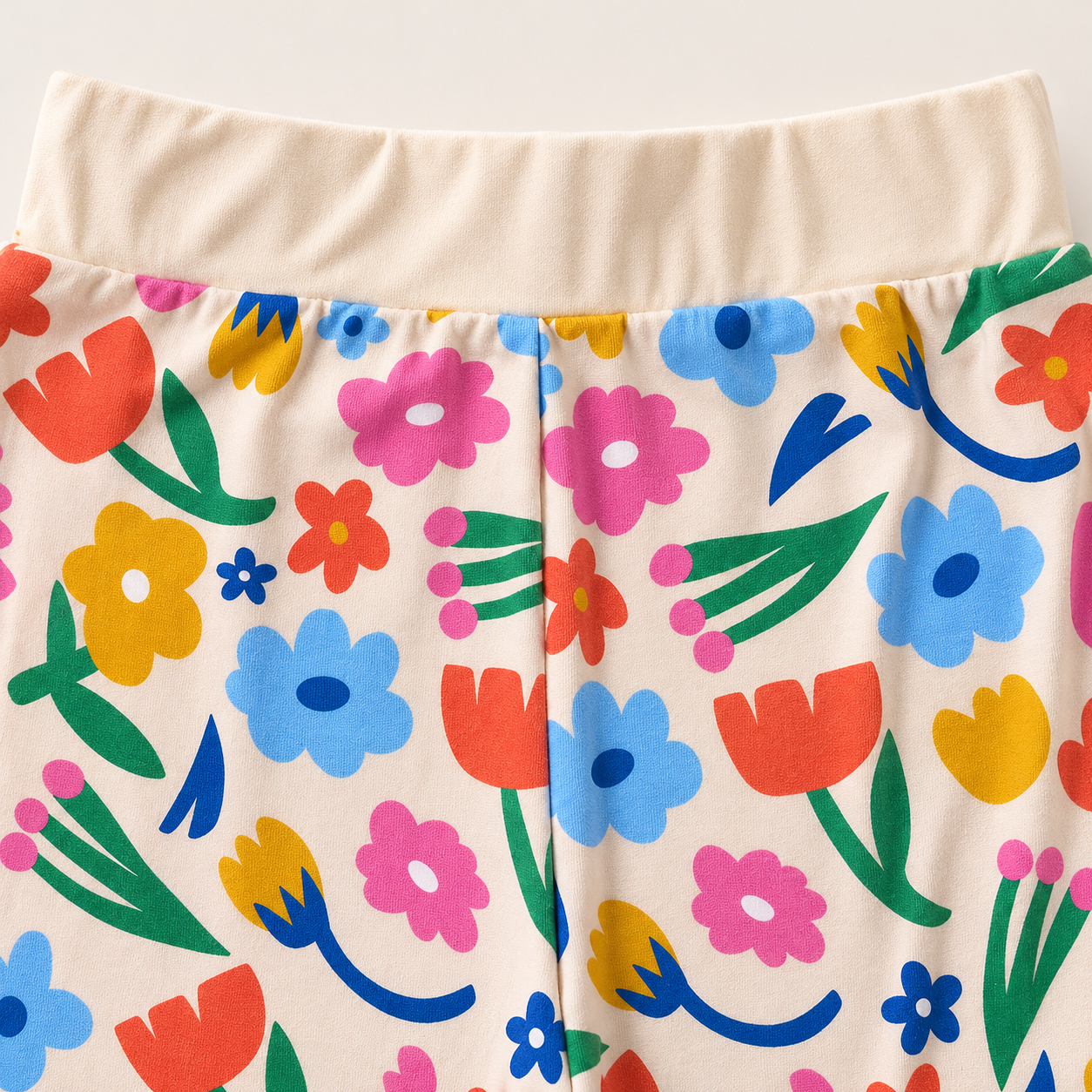
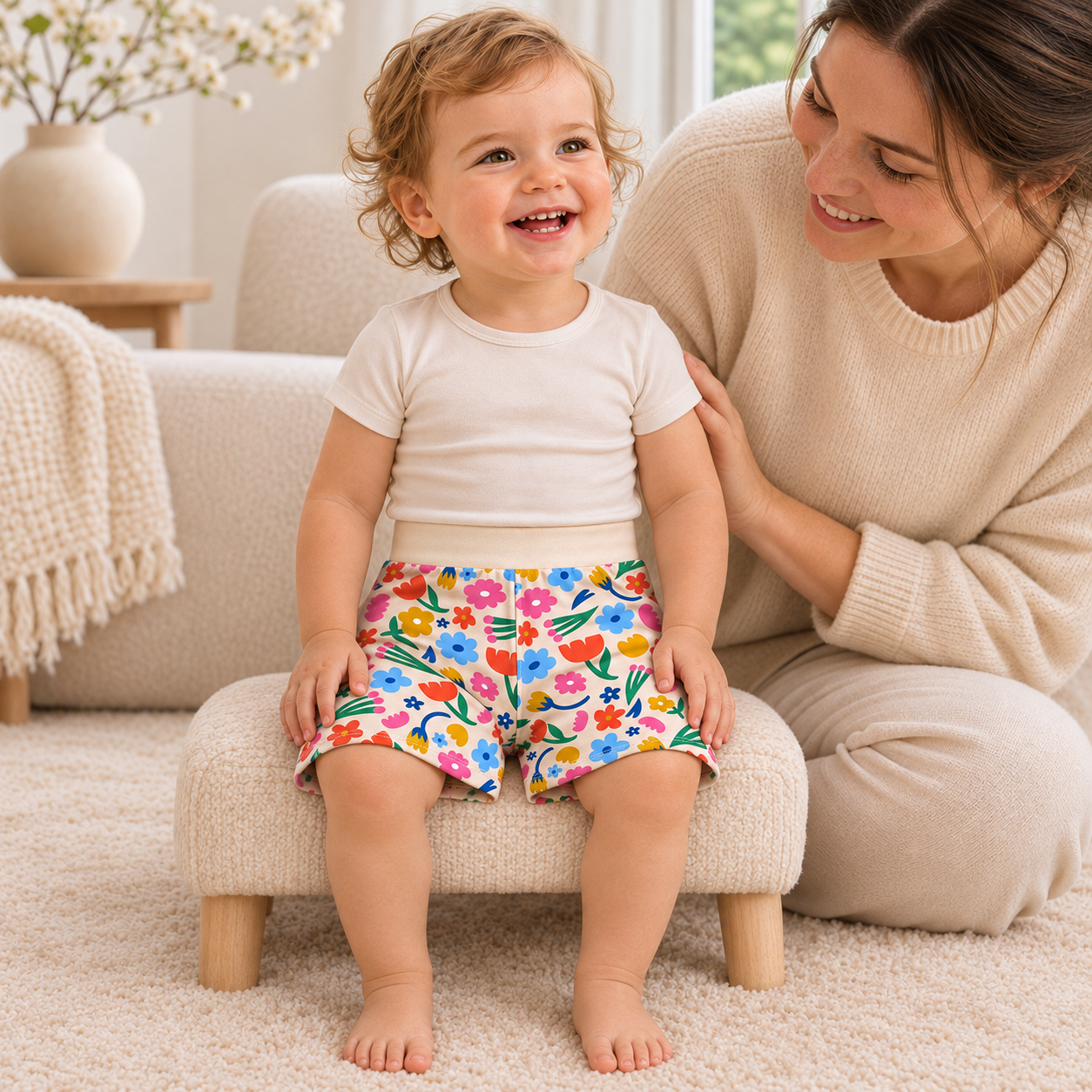
A pull-on short in a 220 gsm printed knit: cream ground with an allover floral print in pink, red, blue, yellow and green, a solid cream waistband, and a wide leg finished with a coverstitched hem.
At a glance
1. Fibre: 220 gsm bamboo viscose, and the name on the label
- "Bamboo" is a source, not a fibre. Almost all bamboo textile is viscose made from bamboo pulp, a regenerated cellulose fibre. EU Regulation 1007/2011 requires it declared viscose, the US FTC requires rayon. Only mechanically processed bamboo, a coarser and stiffer product, may carry "bamboo" as a fibre name.
- 220 gsm gives a short body, not cling. At this weight the jersey holds its shape and does not stick to a nappy, which is why it looks structured in a photo. It is also a spring and autumn short: the same block at 160–180 gsm is the summer version.
- Heavier jersey stretches less. At 220 gsm without elastane the cloth has less give than a 160 gsm knit, so pulling the short over a nappy loads the waistband rather than the fabric — which makes the elastic the load-bearing part of the garment.
- Shrinkage shows in the inseam. A 4 cm inseam that loses 2 mm is a 5% change and the first thing a buyer sees on a returned sample. Fabric is pre-shrunk and the sample is approved after one wash.
- It pills at the crotch seam and inner thigh, the two places a short rubs on a nappy and a crawling leg. Finish reduces it; nothing removes it at this weight.
2. Fit: 0–12M is measured over a nappy
- The rise is the number that gets missed. A short cut to a child's body measurement pulls at the crotch the moment a nappy is full, and the child is photographed sitting. The rise is measured over a nappy, with the allowance written into the spec rather than added by feel.
- The waist is a nappy measurement too. Taking it on bare skin understates it by a centimetre or more, which is the difference between a waistband that sits flat and one that rolls.
- Four bands, not one size. 0–3M, 3–6M, 6–9M and 9–12M. The whole range is under 36 months, so every size is assessed as Class I — no split, no Class II portion.
- The leg opening is a two-way failure. Too narrow and it grips a nappy thigh; too wide and the short rides up as soon as the baby crawls. A wide leg with a stable coverstitched hem is the compromise, and it is why the leg looks generous in the photo.
- Length is a crawling decision. An 8–10 cm inseam stays put on a crawler; a shorter leg looks closer to the reference photo and rides up. Both are quotable — the buyer should choose knowingly.
3. Waistband and hem: where the garment succeeds or fails
- Covered elastic, not exposed. A narrow exposed elastic leaves a mark on a baby's tummy within an hour; the elastic belongs inside a self-fabric casing wide enough to spread the pressure.
- The elastic has to be anchored. A free-floating elastic ring twists inside the casing after two washes and the waistband never lies flat again. It is stitched through at the side seams or fixed in a channel, and that is a construction line in the tech pack.
- Band width buys the size range. A wider casing covers more waist variation within one band and marks less; a narrow band is cheaper and less forgiving.
- Elastic quality, not just width. Heat and chlorine resistance decide whether the waist survives a 40 °C wash cycle and a swimming bag. It is specified by the supplier and confirmed on the washed sample.
- The hem carries the stretch. A coverstitch, as shown, extends with the knit; a plain lockstitch or a twin needle without stretch thread cracks at the seam when the leg is pulled over a nappy.
4. Print: cream ground, seven colours, small panels
- Seven colours means seven registration points. On a panel this small, a millimetre of drift shows at the flower centres and the leaf tips, which are exactly where the eye goes.
- Scale the repeat to the panel. A repeat sized for a dress cuts motifs at the side seam of a short; either the repeat is reduced or the seam is placed through a gap in the design. This is settled at strike-off.
- Cream is the least forgiving ground. Tint drift between fabric lots shows more on cream than on white with a heavy print, and cream plus a bright print is where a cheap lot is obvious on a shelf.
- The crotch panel is the real test. Fastness to saliva, perspiration, wet rub and repeated washing at grade 3-4 or better, tested on the finished printed panel — a printed short sits against a nappy, and that is where colour comes off.
- Strike off on the actual cloth. A 220 gsm ground takes pigment and reactive prints differently from a lighter test fabric; approve on the production weight or the hand-feel decision is guesswork.
5. Compliance: daywear, and the drawstring question
- Fibre naming. Viscose in the EU, rayon in the US, percentage declared. "Bamboo" may appear as marketing copy where the destination allows it, never as the fibre name on the care label.
- Apparel, so the apparel route. As a worn garment the US general wearing-apparel flammability rule, 16 CFR 1610, is the relevant test and its scope is confirmed per order with the laboratory; no claim is made on this page and no report is held for this article.
- No drawcord, and that is deliberate. A cord with free ends at a child's waist is a hazard and a standard audit failure; this style has none, in the waist or the hem. Where a buyer wants the look of a tie, it is a stitched-down flat tie, not a functional cord.
- Small parts. No buttons, toggles or trims as quoted. If a decorative button is added, it is attachment-tested — 70 N is the figure worked to — and it enters the small-parts control plan.
- Chemical class and labelling. Class I across 0–12M. OEKO-TEX Standard 100 certificate 23.HCN.45112 is held for the fabric; the class and the specific article — print, waistband, elastic — are confirmed against the certificate scope before a claim is listed. Care label with fibre content in the legal name, size and origin; tracking label where the US route applies.
6. Customization scope
- Sizing. Four bands as quoted; preemie and 12–18M on the same block.
- Length. Short as shown; bloomer length with a gathered leg; a longer Bermuda cut.
- Waist. Covered elastic as quoted; a wide smocked or shirred band; a rib waistband for more stretch; a paperbag waist with a stitched-down tie.
- Leg finish. Coverstitched hem as shown; banded cuff; lettuce edge.
- Print. Floral allover as shown, a smaller repeat, a placement print, or a solid with a contrast waistband. Colour count drives cost.
- Sets. Matching tee, bodysuit, headband or bib; three-pack in a band; gift box; polybag with header. Woven or printed label, satin care label, hangtag.
MOQ: 300 pcs for a custom development — custom fabric, print, colour or trim; 50 pcs for a decorative process added to a stock body; 100 pcs for stock fabric with your own logo and label. Mixed colour and size orders are quoted per order. These are standing programme terms, confirmed against the current quotation.
7. Sampling, lead times and what we need to quote
- Sampling. 3–7 days from a confirmed tech pack and fabric availability, including a print strike-off and waistband approval. A new repeat adds a round; rush sampling is quoted at a surcharge.
- Wash the sample before approving it. Shrinkage in the inseam and the elastic recovery of the waistband only show after one wash, and both are the numbers a buyer argues about later.
- Sample cost. USD 30–100 per set, refunded against a bulk order of USD 5,000; development fee USD 50–200, refunded at USD 5,000.
- Bulk lead time. 30–60 days from approval by quantity, print and elastic lead time; rush production is quoted per order.
- Quality standard. AQL 2.5 for major defects and AQL 1.0 for critical; third-party inspection accepted, with waistband recovery and the absence of drawcords checked as fit and safety items.
- Payment. New customers 50% deposit and 50% before shipment; repeat customers can move to 30% / 70% against the bill of lading.
Production runs with our production partner, Suzhou Shelmin Trade Co., Ltd.: 7,200 m² workshop, 8 lines, 200 staff, 6,000 pieces per day. Design confidentiality is held under NDA; buyer patterns and colourways are not re-used.
To quote, we need: target market; the size bands and the nappy allowance you work to; waistband type and elastic width; leg finish and inseam; print artwork with repeat size and colour count; whether the short is sold alone or in a set; packaging; and whether certification runs in your brand name.