EN

Girls Recycled Polyester Pleated Skirt | Navy Blue Kids A-Line Skirt with Double Stripe Hem | Custom Sustainable Girlswear Manufacturer for OEM & ODM Private Label


- Overview
- Girls Recycled Polyester Pleated Skirt
- Recommended Products
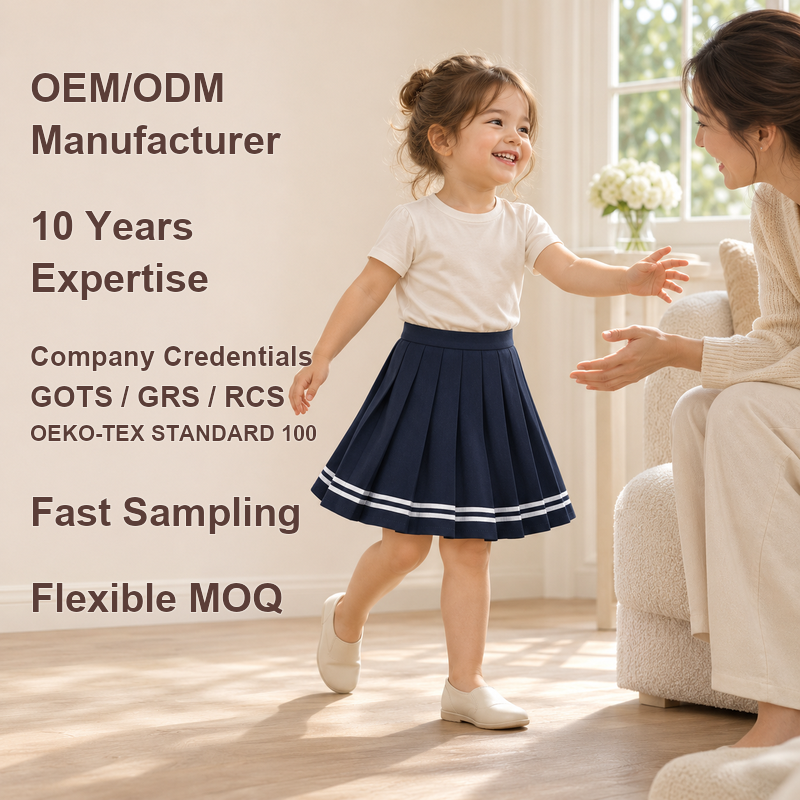
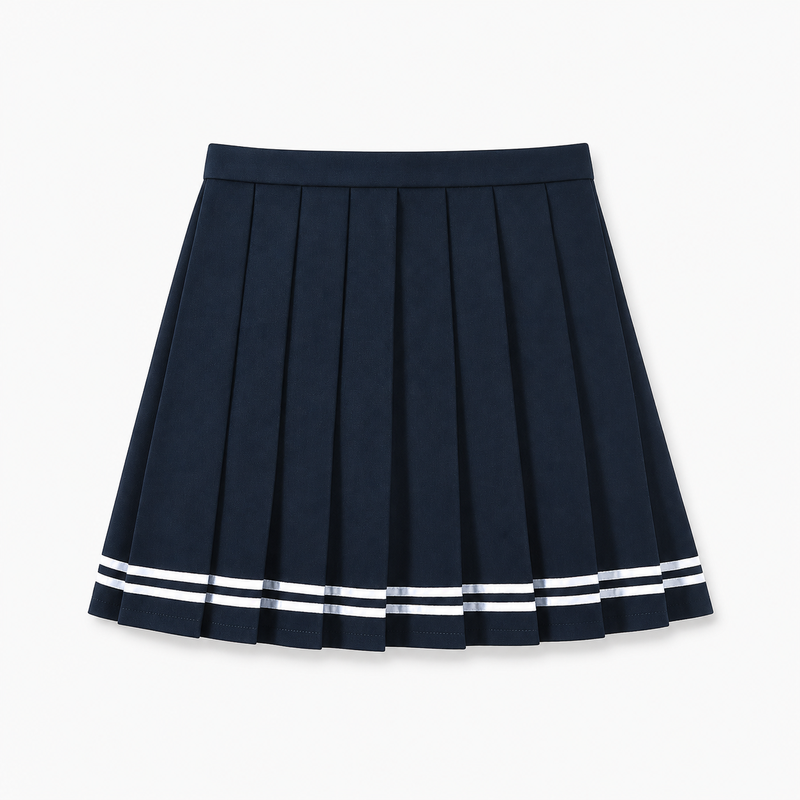
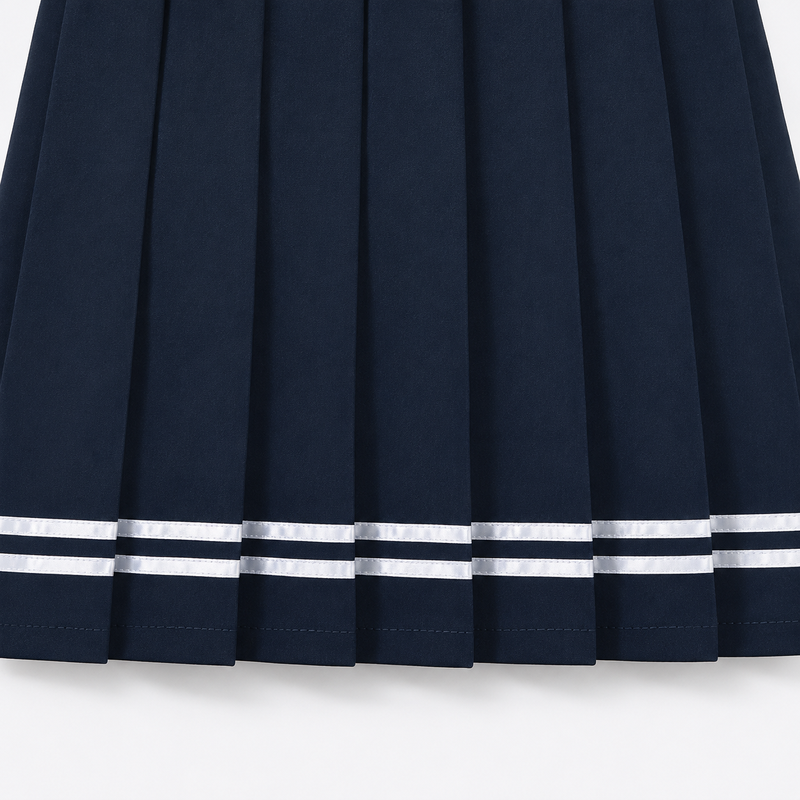
A school-style pleated skirt in a 100% recycled polyester twill: knife pleats set around the waist, a flat waistband, and a striped band running above the hem. Navy ground, two white stripes with a silver line between them.
A pleated skirt is decided before it is sewn. The pleat is a heat-set property of a thermoplastic cloth, the stripe has to be in the cloth before the pleat exists, and the number of pleats has to divide evenly into the waist or the last pleat will not meet the first. Everything else — the waistband, the hem, the fit — is ordinary skirt work. Those three are what this page is about.
At a glance

1. Fibre: polyester is the pleat-friendly fibre
- Pleats are held by the fibre, not by the stitch. Polyester is thermoplastic: fold it, hold it under heat and pressure, and the fold is set into the filament. Cotton and wool pleats are held by mechanical and chemical means and relax over time; a heat-set polyester pleat does not.
- rPET behaves as polyester under heat. The recycled feedstock is the same polymer, so the setting window, the hand after setting and the pleat memory are those of polyester. Nothing about the recycled route changes how the pleat is made.
- The percentage is a chain-of-custody claim. GRS covers recycled content with processing controls and chemical limits, RCS covers the recycled content alone, and both run on transaction certificates, so the claim holds only while the certificate names the seller, the article and the percentage.
- Twill gives the pleat a line to follow. A twill ground has a direction, and the pleats are set so the diagonal runs consistently across the skirt; on a plain weave the pleat edge is softer and the crease is less crisp after washing.
- A pleated skirt uses more cloth than it looks. The pleats double the circumference at the waist, so the metreage — and the price — is set by pleat depth rather than by skirt length.
2. Pleat engineering: you cannot hold both width and count
- Three numbers define a pleat set: pleat width, pleat depth, and the number of pleats. The waist is their product, so on a graded range something has to give — and which one gives is a design decision, not a technical detail.
- Holding the count and letting the depth grow keeps the skirt looking the same across the range and makes the larger sizes fuller, which is also what a growing child needs for movement.
- Holding the width and adding pleats keeps the pleat identical to the eye but changes the rhythm of the skirt from size to size, and adds cost at the upper end of the range.
- The count has to divide the waist evenly. If the pleats do not close evenly, the last pleat meets the first at a visible mismatch, usually at the centre back where it is hardest to hide.
- Pleat depth is what the skirt is judged on in motion. A shallow pleat opens flat and disappears when the child moves; the depth is set so the fold still reads as a fold at full stride.
- Pleats are set before the waistband goes on, because the setting process shrinks the pleated panel slightly and the waistband has to be cut to the finished measurement, not the flat one.
3. The hem stripe: it has to be in the cloth
- A stripe sewn on after pleating fights the pleat. A tape applied over a pleated panel bridges the folds, puckers the pleat underneath and pulls the stripe out of parallel the first time the skirt is worn; the stripe has to be created in the cloth before the pleat exists, so the fold carries the stripe with it.
- Stripe spacing must be a multiple of the pleat pitch. Where it is not, the stripe walks relative to the folds across the skirt — parallel at one side, crossing the fold at the other — and the eye reads that as a badly made garment even when every seam is correct.
- Yarn-dyed and printed routes behave differently at the fold. A yarn-dyed stripe is unaffected by the crease; a printed stripe sits on the surface and is the one that cracks or fades along the fold. A silver line is the most exposed of the three, because metallic effects are usually a surface treatment rather than a dyed yarn.
- White next to navy is a fastness question, not just a design one. The white stripe is where navy dye transfer shows first, and it shows in the wash rather than at the counter, so fastness is tested on the assembled skirt.
- The hem follows the pleat, so the stripe band is cut to the finished pleat length, not to a flat measurement: a band cut flat will be short once the pleats open.
4. Heat setting: the crease is also the risk
- The setting window is narrow. Under-set, the pleat relaxes at the first wash; over-set, the polyester glazes and the crease becomes a shine line that cannot be removed. The window is fixed per cloth weight and checked on a strike-off before bulk.
- The fold is the first place to shine. Polyester that is pressed too hot at a sharp edge takes a permanent gloss, and on a dark ground a glossy crease reads as wear before the skirt has been worn.
- Retention is tested, not assumed. Pleat sharpness is checked after repeated washing on the production cloth, because a pleat that survives the sample but not the first ten washes is the failure that comes back as a complaint.
- The care label is part of the specification. A hot wash relaxes a heat-set pleat; the label states the wash temperature and no tumble drying, and that instruction is what the pleat's life depends on.
- Pressing after bulk is a re-set, not a touch-up. Pleats are re-set on a form under steam; ironing them flat at the factory undoes the work done in setting.
5. Colour: navy is the hardest dark
- Navy is a mixture, not a single dye. It is built from more than one colourant, so lot-to-lot drift shows as a cast — one delivery reading blue-black, the next reading green-black — and it shows on a large flat panel more than on a small one.
- Navy is where glazing and abrasion read first. The pleat fold takes both: heat gloss from setting and a lighter line from rubbing, and on navy either one looks like a defect.
- Navy and white are the pair most likely to cross-stain. Dye transfer from the ground into the stripe is the reason fastness is tested on the assembled skirt rather than on the two cloths separately.
- Approval is taken on the pleated panel, not on flat cloth, because setting changes the depth of the shade slightly and the panel is what the buyer will see.
- Thread is matched to the set panel, not selected from a card, since a thread that matches flat navy will read light against a pleat.
6. Size: 2A–8A, and what the grade has to hold
- The range steps across two chemical classes. The 2A size is for a child under 36 months and is assessed as Class I; 4A and above is Class II, with the certificate set issued to cover both or the range split into two orders with two limit sets.
- The waistband carries the fit on a pleated skirt. It is cut on the same grain as the panel, interfaced so it does not roll, and its finished measurement is taken after pleating rather than before.
- Length grades with age, pleat depth with waist, so the proportion of pleat to skirt stays constant and the smallest size does not look like a shrunken large one.
- The stripe band has to stay in the same place relative to the hem, or the range will read as two different styles on a rail.
- The waistband closure and the pleat opening are checked together, because a placket that sits over a pleat puckers when the skirt is worn.
7. Customization, sampling and what we need to quote
- Pleat. Knife pleats as shown; box pleats; an inverted centre pleat.
- Stripe. Two white with a silver line as shown; a single stripe; a woven stripe instead of a printed one.
- Waistband. Flat waistband as shown; an elasticated back panel; a side zip with a button closure.
- Length. As shown; a shorter skort length; a longer A-line.
- Lining. Unlined as shown; a shorts lining for play; a half lining to the knee.
- Colour. Navy as shown; other grounds lab-dipped with the stripe as a set.
- Packing. Polybag with size sticker; hanger with clips; woven or printed label, satin care label, hangtag.
- Sampling. 3–7 days from a confirmed tech pack, with a pleat set and a wash trial on the production cloth; pleat retention testing is booked separately and its lead time is added to the schedule.
- Bulk lead time. 30–60 days from approval by quantity and dye lot schedule; rush production is quoted per order.
MOQ: 300 pcs for a custom development — custom fabric, colour, pleat or fit; 50 pcs for a decorative process added to a stock body; 100 pcs for stock fabric with your own logo and label. Mixed colour and size orders are quoted per order. These are standing programme terms, confirmed against the current quotation.
Production runs with our production partner, Suzhou Shelmin Trade Co., Ltd.: 7,200 m² workshop, 8 lines, 200 staff, 6,000 pieces per day. Design confidentiality is held under NDA; buyer patterns and colourways are not re-used.
To quote, we need: target market; pleat type, width and depth; whether the count or the depth is held across the range; whether the stripe is yarn-dyed or printed; the silver line's construction; cloth weight; waistband type; whether a lining is added; packaging; and whether certification runs in your brand name.