EN

Kids Recycled Polyester Sports T-Shirt | White Short Sleeve Raglan Activewear Top with Contrast Stitching | Custom Children's Clothing OEM ODM Manufacturer for Private Label Brands


- Overview
- Kids Recycled Polyester Sports T-Shirt
- Recommended Products
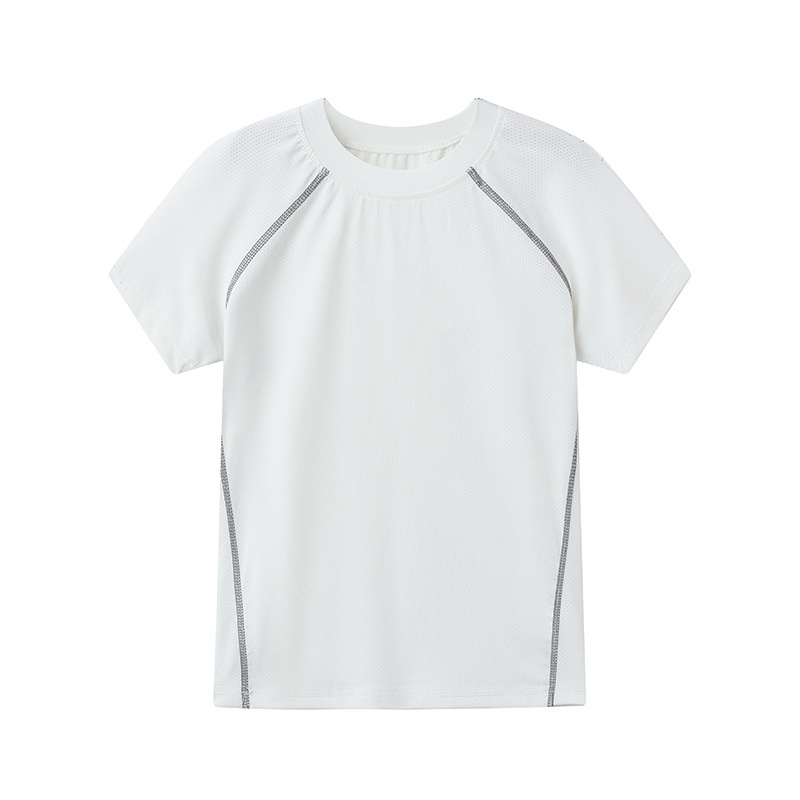
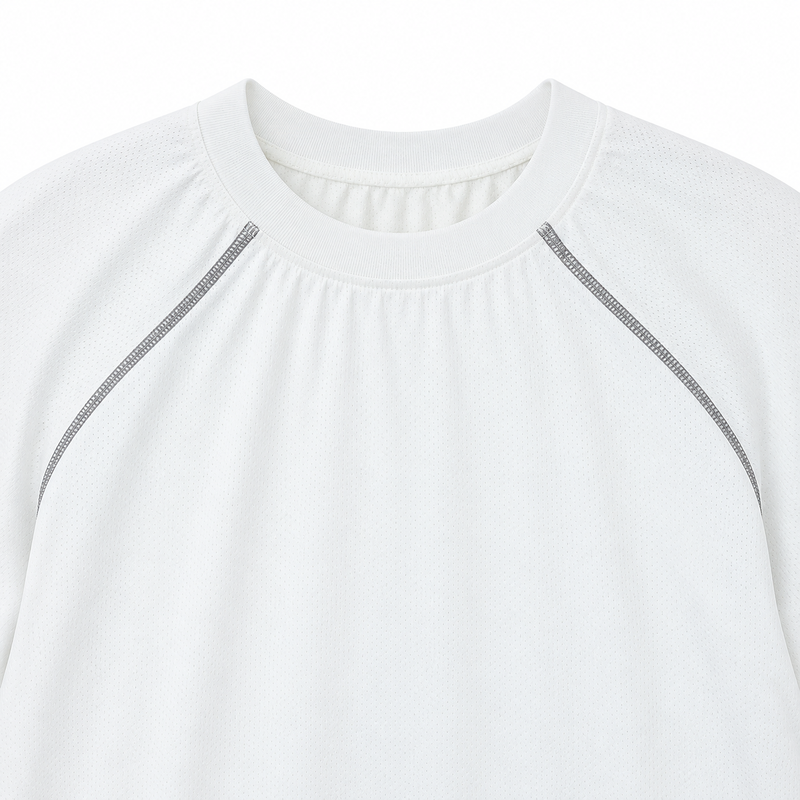
A short-sleeve tee in a 100% recycled polyester knit: a round neck gathered into fine folds, raglan sleeves, a textured eyelet panel across each shoulder, and seams stitched in a dark contrast thread that is left visible down the raglan and the side. White ground.
Four details on this garment are all specification problems rather than decoration. White is a whiteness grade, not an absence of colour. The gather takes stretch out of the neck opening. Two different knits shrink at two different rates. And a contrast seam makes the thread a visible wear part. Each is handled below, in the order they fail.
At a glance

1. Fibre: recycled polyester in a fine-gauge knit
- rPET is the same polymer from a different feedstock. In a fine-gauge knit that means the same wicking behaviour, the same dimensional stability and the same drying speed as virgin polyester; the recycled route changes the certificate file, not the sewing floor.
- It moves moisture rather than absorbing it, which is why a polyester tee feels dry quickly and why it can feel clammy in still air: comfort comes from air moving through the knit and away from the skin, not from the fibre soaking anything up.
- Fine-gauge polyester pills differently from cotton. Short fibres work loose and roll into pills; a filament or compact-spun yarn resists it, so yarn type is specified rather than left to the mill.
- Polyester holds its shape through washing, which matters on a raglan with a gathered neck: a knit that relaxes at the neckline loses the shape the gathering was built on.
- The percentage is a chain-of-custody claim. GRS covers recycled content with processing controls and chemical limits, RCS covers the recycled content alone, and both run on transaction certificates — so the claim holds only while the certificate names the seller, the article and the percentage.
2. White: a grade, not an absence
- White on polyester is made, not left over. It is produced by bleaching and usually by an optical brightener that fluoresces blue and makes the cloth read clean; the amount of brightener is what decides whether the white looks warm, neutral or blue-white.
- It reads differently under different light. A brightened white that looks right in daylight goes blue under shop lighting and yellow under warm light, so approval is taken under two sources rather than one.
- Brighteners are also what yellows first. Under sun and repeated washing the brightener degrades before the fibre does, and the garment turns cream at the neck and the underarm before anywhere else; that is the failure to check for in a wash trial.
- Heat is the other yellowing route. Polyester that is pressed too hot takes a yellow cast that cannot be reversed, which is why the press temperature is set per cloth rather than by operator judgement.
- White is the lowest-protection combination at a given weight, so where a UV claim is wanted it has to be tested on this white, at this weight, not on a darker colourway of the same knit.
- White shows every mark the contrast thread makes. Dark thread on a white ground is the combination where dye transfer is visible, which is why the thread's fastness is tested against the body as a pair.
3. The gathered neck: the gather takes stretch out
- Gathering locks the edge. The stitches that hold the folds also stop the neckline extending, so an opening that measures correctly on a flat table can be too small to pass a head. The opening is therefore sized on a head form, with the gathers in place, at both ends of the size range.
- The band is applied after gathering, not before. Gathers are distributed to marked quarters so the folds sit evenly front and back; a band sewn onto unevenly distributed gathers shows as a heavy side and a flat side at the centre front.
- Bulk at the neck is the comfort risk. Gathers plus a band plus a seam make three layers on the same line, and that line sits against the throat; the seam is pressed away from the skin and the band is kept narrow so the bulk is spread rather than stacked.
- The gather ratio is a number on the tech pack. Too little gather and the neckline reads flat, too much and the folds collapse into a frill; the ratio is fixed per size so the effect stays constant across the range.
- Entry is the constraint, not the look. Because the opening cannot extend, the head circumference at the largest size sets the band length, and that is checked before the gather ratio is finalised.
4. Two knits in one garment
- The eyelet shoulder panel and the body shrink at different rates. Different knit structure and different stitch density mean different relaxation, so the seam between them is where puckering appears after the first wash; both panels are washed and measured before the pattern is released.
- Eyelet is an opening. The holes that give the panel its texture also let light and air through, so the panel is treated as a design feature with its own coverage behaviour rather than as part of the solid body, and it is not counted as protected area in any UV claim.
- Two knits mean two dye lots. On a white ground the mismatch shows as a difference in brightness rather than in hue, which is the harder mismatch to see at the approval stage and the easier one to see on a hanger.
- The panel is cut on the same grain as the body, so the two relax in the same direction; a panel cut across the grain will twist away from the raglan seam in wear.
- Seam bulk at the join is controlled by the stitch, not by trimming: the allowance is pressed open and flat so the eyelet edge does not ridge under the raglan.
5. Contrast seams: the thread becomes a wear part
- An exposed seam is a design decision with a maintenance cost. The stitching is meant to be seen, so the stitch type is what decides how it reads: a flatlock lies flat and stretches with the knit, while an exposed overlock shows its loops and gives a stronger, more technical line at the cost of snagging on anything it touches.
- The thread is the part that wears. Contrast thread on a white ground shows abrasion, fuzzing and dye transfer, so a bonded or core-spun thread is specified and its fastness is tested against the body cloth.
- Crocking is the risk at the seams. Dark thread rubbing against white cloth in wear and in the wash transfers colour at the highest points, which are exactly the seam lines; wet crocking is tested as well as dry.
- The seam has to stretch with the knit. A raglan seam takes the full movement of the shoulder, and a thread with too little extension cracks at the stitch line; the stitch and the thread are chosen as a pair.
- Ends are secured inside the seam, because a visible seam also makes every loose thread end visible.
- Needle control. 100% needle detection on finished pieces, one-for-one exchange at every break with the machine stopped, work within 2.5 m re-screened twice, needle-free area enclosed, 2 m deep, single entry.
6. Size: 2A–8A, and what the block has to hold
- The range steps across two chemical classes. The 2A size is for a child under 36 months and is assessed as Class I; 4A and above is Class II, with the certificate set issued to cover both or the range split into two orders with two limit sets.
- The neck opening is the sizing constraint on this style, so it is graded first and the body follows, rather than the reverse.
- Body length clears the waistband, so the tee stays tucked or untucked without riding when a child reaches up.
- The raglan armhole grades with the shoulder, because a raglan has no shoulder seam to absorb a grading error: a mis-graded armhole shows as a fold running from the neck to the underarm.
- The sample is checked on a head form and on a body, since the two constraints — entry and drape — are judged differently and cannot be read off one try-on.
7. Customization, sampling and what we need to quote
- Neckline. Gathered neck as shown; a plain banded neck; a small keyhole at the back.
- Sleeve. Raglan short sleeve as shown; a set-in sleeve; a flutter sleeve.
- Panel. Eyelet shoulder panel as shown; a mesh back yoke; a solid body throughout.
- Seams. Exposed contrast stitching as shown; tonal flatlock; a clean-finished seam with no visible stitch.
- Colour. White as shown; an off-white with no brightener; other grounds with the thread matched as a pair.
- Packing. Polybag with size sticker; hanger; woven or printed label, satin care label, hangtag.
- Sampling. 3–7 days from a confirmed tech pack, with the neck opening checked on a head form at both ends of the range and a wash trial on both knits; crocking and fastness testing is booked separately and its lead time is added to the schedule.
- Bulk lead time. 30–60 days from approval by quantity and dye lot schedule; rush production is quoted per order.
MOQ: 300 pcs for a custom development — custom fabric, colour, neckline or fit; 50 pcs for a decorative process added to a stock body; 100 pcs for stock fabric with your own logo and label. Mixed colour and size orders are quoted per order. These are standing programme terms, confirmed against the current quotation.
Production runs with our production partner, Suzhou Shelmin Trade Co., Ltd.: 7,200 m² workshop, 8 lines, 200 staff, 6,000 pieces per day. Design confidentiality is held under NDA; buyer patterns and colourways are not re-used.
To quote, we need: target market; whether a UV claim is intended on this white; the whiteness target and whether a brightener is allowed; knit weight and yarn type for body and panel; the gather ratio; thread type and colour; whether the seam is flatlock or exposed overlock; packaging; and whether certification runs in your brand name.