EN


Custom Dinosaur Print Baby Romper for OEM & ODM Brands


- Overview
- Custom Dinosaur Baby Romper Manufacturer
- Recommended Products
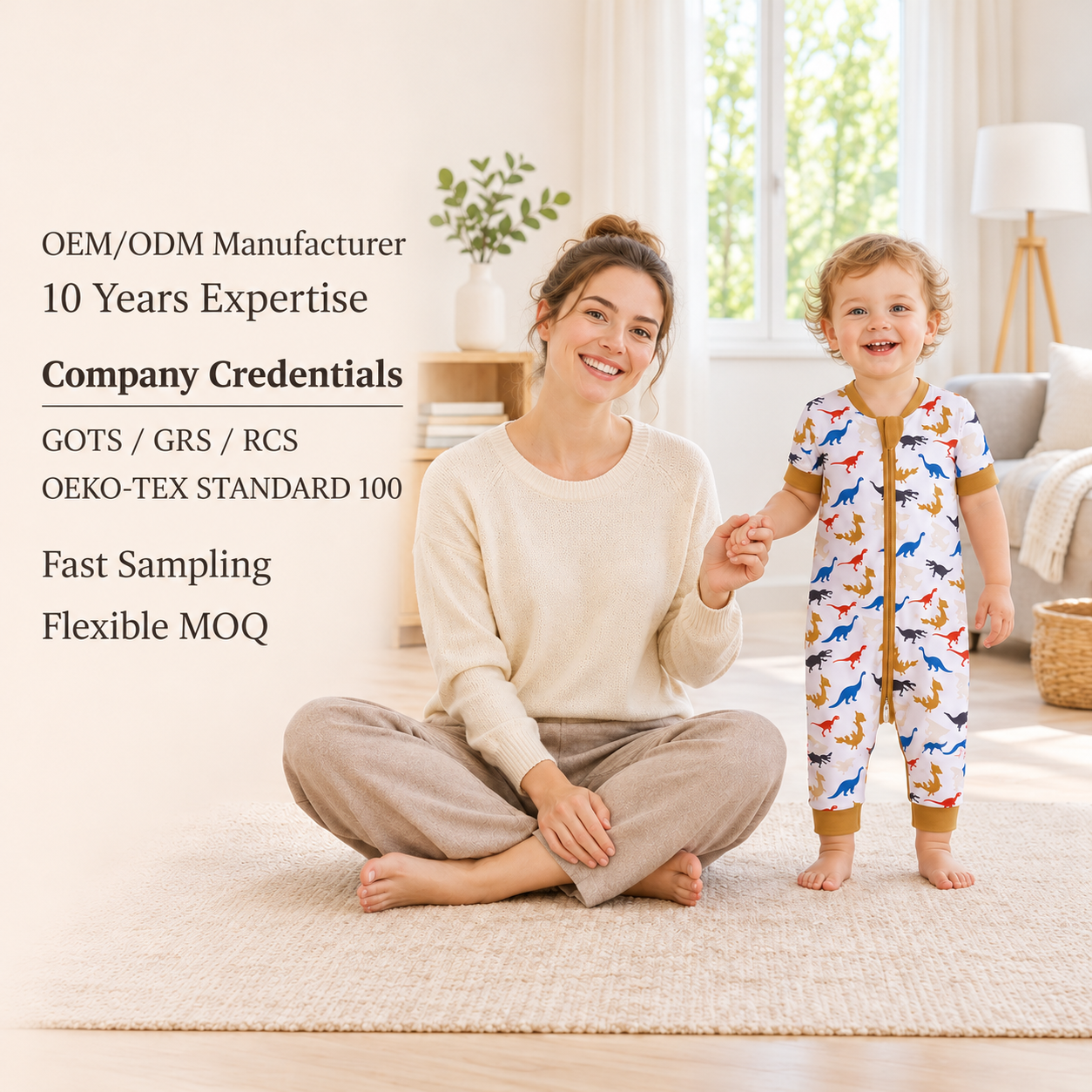
A short-sleeve, short-leg romper in a 220 gsm printed knit: white ground with an allover dinosaur print in cobalt, brick, camel and pale outline, a camel rib neckband, camel rib cuffs at sleeve and leg, and a centre-front zip with a camel tape running from the neck to the crotch.
The garment looks like a sleepsuit and is not one. That distinction decides the test route, the fit and the copy. The second decision is the zip: one slider or two, and whether the print is planned around it or cut through it.
At a glance

1. Fibre: 220 gsm bamboo viscose, and the name on the label
- "Bamboo" is a source, not a fibre. Almost all bamboo textile is viscose made from bamboo pulp, a regenerated cellulose fibre. EU Regulation 1007/2011 requires it declared viscose, the US FTC requires rayon. Only mechanically processed bamboo, a coarser and stiffer product, may carry "bamboo" as a fibre name.
- 220 gsm with a short sleeve is a transitional piece. The weight is the same as a winter sleepsuit; the cut is summer. That combination sells in spring and early autumn, and in air-conditioned rooms in between — the same block at 160–180 gsm is the high-summer romper.
- White ground, printed. A white ground is where print opacity is easy and where every mark shows; on a garment that sits in a pram, in a nappy and on a floor, that is the trade the buyer is making when they choose this colourway.
- Viscose is weak when wet and shrinks by finishing route. The body length and the leg length are specified as finished, after-wash measurements; the fabric is pre-shrunk and the sample is approved washed.
- It pills at the cuffs and the seat, the two points where a knit romper rubs against a nappy and a car seat.
2. Size: 0–12M, cut for a nappy
- The rise is measured over a nappy. A romper cut to a body measurement pulls at the crotch the moment the nappy is full, and a baby in a romper is usually sitting or being carried. The allowance is written into the spec.
- Four bands: 0–3M, 3–6M, 6–9M, 9–12M. The whole range is under 36 months, so every size is Class I — one chemical class, one test set, no split.
- Short legs are a crawling decision. A leg that ends mid-thigh stays clear of a crawling knee; a leg cut shorter rides up and exposes the nappy. The camel rib cuff is what keeps the leg where it was cut.
- The cuff is a fit element, not a trim. Cut with negative ease so it sits on a thigh without marking it, and pre-shrunk with the body so the leg does not shorten after the first wash.
- Grading follows length, not width. Babies grow out of a romper at the shoulder and the crotch before they grow out of it sideways; sleeve and body length grade together, and the zip grades with them or it pulls.
3. Construction: the zip, and what it commits you to
- One slider or two is a specification, not a detail. A single slider from neck to crotch means the front opens fully for a change; a two-way slider lets the bottom open on its own so the chest stays closed. Buyers choose on how the garment will be used, and the price differs.
- The slider must not reach the chin. A zip garage at the top — a fabric pocket the pull tucks into — keeps moulded plastic off a baby's neck, and it is part of the neckband construction rather than an add-on.
- A backing runs behind the teeth. A self-fabric facing keeps the coil off skin and stops a nappy catching in the teeth; it is the part a cheap build omits and the first thing a parent notices.
- Zip tape and knit shrink differently. After washing, a tape that shrinks less than the body leaves a wavy front that no amount of pressing fixes. The tape is pre-shrunk against the fabric and the washed sample is measured along the zip line.
- Nylon coil, moulded pull, nothing hanging. No ribbon, charm or loop on the pull — a long pull at the chest of an infant garment is a cord by another name.
- The zip is the single point of failure. A failed slider scraps the romper, so the zip is the last place to accept a substitution, and it is checked at inspection for slider function, top stop and garage.
- Needle control. 100% needle detection on finished pieces; one-for-one exchange at every break with the machine stopped; work within 2.5 m re-screened twice; needle-free area enclosed, 2 m deep, single entry. A zip line plus a print run is a higher-risk combination than a plain body.
4. Print: white ground, five colours, one interruption
- The zip splits the front panel in two. The print is cut in two halves and has to meet at the zip; either the repeat is planned so the join falls in a gap in the motif, or the front is matched piece by piece. This is settled at strike-off and it is a cost line, not a detail.
- The pale outline is the hard colour. A low-contrast beige-grey on a white ground is where registration and tint drift show first — the dark dinosaurs will look right while the outline pattern looks dirty.
- Five colours, five chances to drift. Each colourway is lab-dipped and approved; the camel is the one that goes muddy, and it has to match the cuff and the zip tape as well as the print.
- Crocking shows at the cuffs and the seat. Wet rub and perspiration fastness at grade 3-4 or better, tested on the finished printed panel — a romper is dragged, sat on and washed hard.
- Strike off on the actual cloth. A 220 gsm ground takes print differently from a lighter test fabric, and the hand at the cuff matters as much as the colour on the body.
5. Category and compliance: daywear, and it has to stay daywear
- Daywear is the category, and the copy has to agree. This romper was designed and is quoted as daywear: no sleepwear claim, no "sleep" in the title, no nightwear imagery. If a buyer markets it as sleepwear, the US route becomes 16 CFR 1615/1616 and the EU route EN 14878, and the tight-fitting option constrains the fit and the measurements.
- As apparel, the US general wearing-apparel flammability rule 16 CFR 1610 is the relevant test and its scope is confirmed per order with the laboratory; no claim is made on this page and no report is held for this article.
- Children's product duties. Lead limits of 100 ppm in the substrate and 90 ppm in a surface coating, phthalates where a plasticized part exists, a children's product certificate and a tracking label where the US route applies.
- Zip and small parts. Slider, pull and top stop are checked for attachment and for pinch points; the neck garage is part of that check. No toggles, no charms, no cords anywhere on the garment.
- Chemical class and labelling. Class I across 0–12M. OEKO-TEX Standard 100 certificate 23.HCN.45112 is held for the fabric; the class and the specific article — print, zip tape, cuff rib — are confirmed against the certificate scope before a claim is listed. Care label with the fibre content in the legal name, size and origin.
6. Customization scope
- Sizing. Four bands as quoted; preemie and 12–18M on the same block.
- Leg and sleeve length. Short as shown; long sleeve with cuffs; long leg with or without feet; a bubble leg with a gathered cuff.
- Closure. One-way zip as shown; two-way zip for nappy access; snap placket instead of a zip for buyers who will not carry a zip.
- Trim. Camel as shown, or self-colour; rib or self-fabric cuffs; a contrasting neckband.
- Print. Dinosaur allover as shown, a smaller repeat, a placement print on the chest only, or a solid with contrast trim. Colour count drives cost.
- Sets and packing. Two-piece set with a matching hat or bib; three-pack; gift box; polybag with header. Woven or printed label, satin care label, hangtag.
MOQ: 300 pcs for a custom development — custom fabric, print, colour or trim; 50 pcs for a decorative process added to a stock body; 100 pcs for stock fabric with your own logo and label. Mixed colour and size orders are quoted per order. These are standing programme terms, confirmed against the current quotation.
7. Sampling, lead times and what we need to quote
- Sampling. 3–7 days from a confirmed tech pack and fabric availability, including a print strike-off, a zip approval and a neck garage approval. A new repeat adds a round; rush sampling is quoted at a surcharge.
- Wash the sample before approving it. Zip tape behaviour, leg length after shrinkage and the print at the cuffs only appear after one wash.
- Sample cost. USD 30–100 per set, refunded against a bulk order of USD 5,000; development fee USD 50–200, refunded at USD 5,000.
- Bulk lead time. 30–60 days from approval by quantity, print and zip lead time; rush production is quoted per order.
- Quality standard. AQL 2.5 for major defects and AQL 1.0 for critical; third-party inspection accepted, with the zip function, the neck garage and print registration at the zip checked as fit and safety items.
- Payment. New customers 50% deposit and 50% before shipment; repeat customers can move to 30% / 70% against the bill of lading.
Production runs with our production partner, Suzhou Shelmin Trade Co., Ltd.: 7,200 m² workshop, 8 lines, 200 staff, 6,000 pieces per day. Design confidentiality is held under NDA; buyer patterns and colourways are not re-used.
To quote, we need: target market and whether the garment will be sold as daywear or sleepwear; size bands and the nappy allowance you work to; zip type, one-way or two-way, and tape colour; sleeve and leg length; print artwork with repeat size and colour count; whether it is sold alone or in a set; packaging; and whether certification runs in your brand name.