EN



OEM/ODM All-Over Crocodile Kids T-Shirt | Eco-Friendly 220gsm Bamboo Soft Toddler Short Sleeve Tee | Custom Sustainable Breathable Crewneck Children Summer Top | Wholesale Premium Private Label Boutique Apparel


- Overview
- OEM/ODM 220gsm All-Over Crocodile Printed Bamboo Kids Tee
- Recommended Products
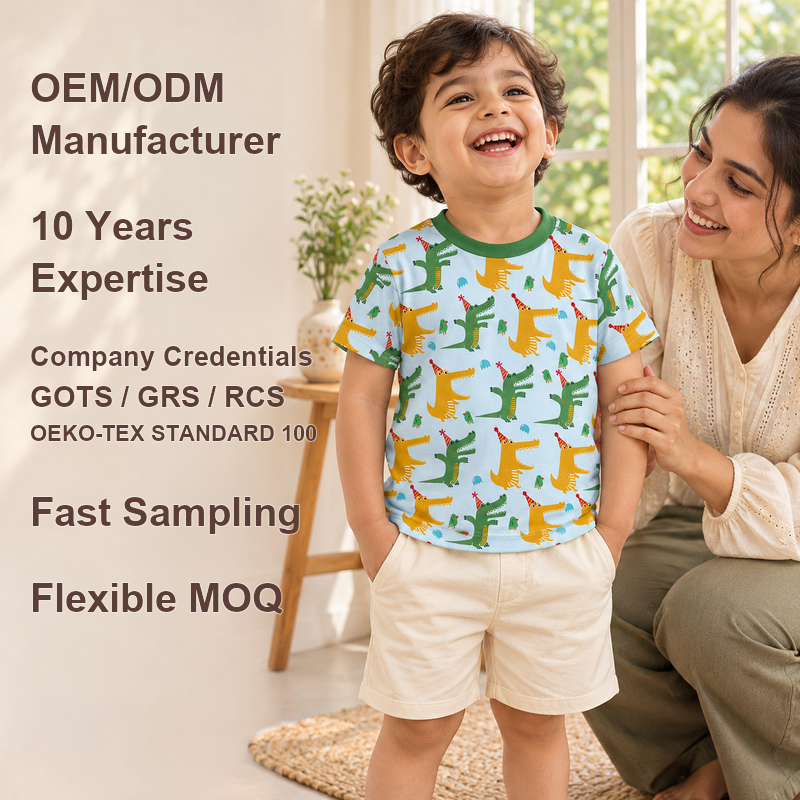
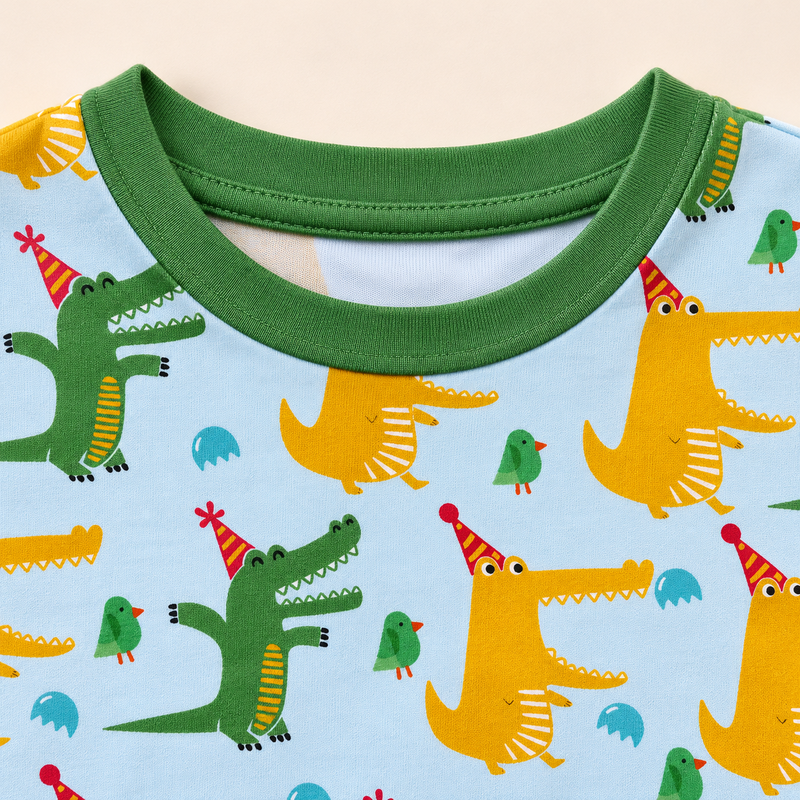
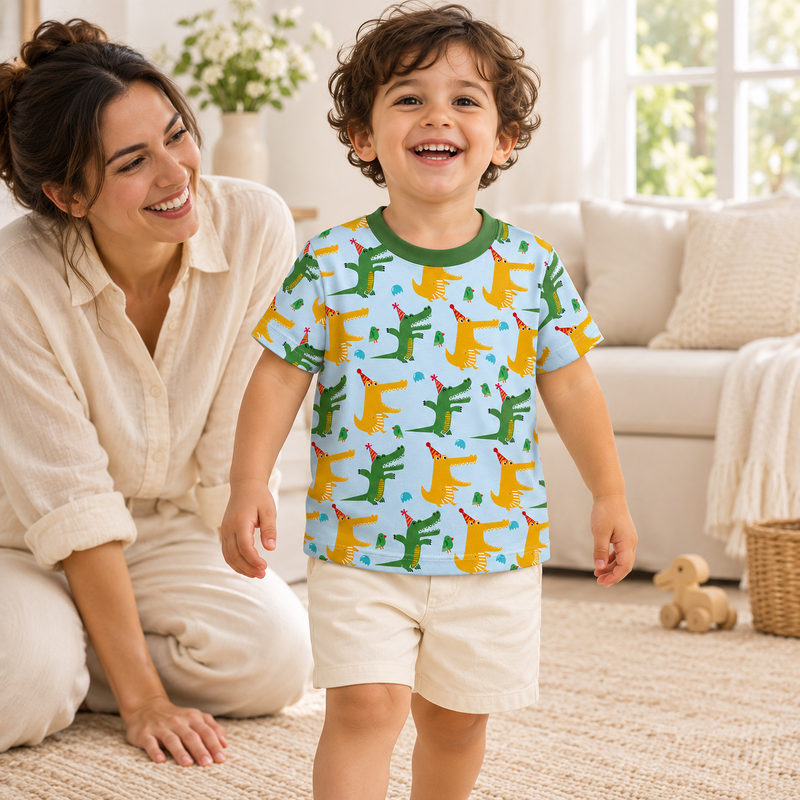
A short-sleeve crew tee in a 220 gsm printed knit: pale blue ground with an allover crocodile print in yellow-green and mustard, red and blue party hats, a deeper green rib neckband, turned and coverstitched sleeve hems and a straight coverstitched body hem.
Two greens sit on this garment and they are not the same green: the print green comes from a pigment or reactive paste, the neckband green comes from a dyed rib. Getting them to agree — or deciding not to try — is the first conversation on this tee.
At a glance
1. Fibre: 220 gsm bamboo viscose, and the name on the label
- "Bamboo" is a source, not a fibre. Almost all bamboo textile is viscose made from bamboo pulp, a regenerated cellulose fibre. EU Regulation 1007/2011 requires it declared viscose, the US FTC requires rayon. Only mechanically processed bamboo, a coarser and stiffer product, may carry "bamboo" as a fibre name.
- At 220 gsm a short-sleeve tee has body. It holds its shape at the shoulder, does not cling to the nappy and carries a five-colour print without the ground showing through. In a hot climate this is the spring and autumn weight; the same block at 160–180 gsm is the summer tee.
- Pale shades are a dyeing problem before they are a print problem. Pale blue on viscose shows levelness faults — cloudiness, streaks, a selvedge-to-selvedge shade change — that a deep colour would hide. The ground is approved as a lab dip on the actual cloth, not from a screen colour.
- Viscose is weak when wet and shrinks by finishing route. Body length is specified as a finished, after-wash measurement; the fabric is pre-shrunk and the sample approved washed.
- It pills at the underarm and along the hem fold, the two places a knit tee takes friction from a carrier strap and a car seat.
2. Size and fit: 0–12M, with room for a nappy
- Body width carries the nappy, not the body. A tee worn over a nappy needs the width allowance at the waist and the seat, and that allowance is the difference between a tee that sits flat and one that rides up at the back.
- Length is measured after wash. A 220 gsm viscose body loses length before it loses width; the finished length on the spec is the washed length, and the sample is approved on that basis.
- Four bands: 0–3M, 3–6M, 6–9M, 9–12M. The whole range is under 36 months, so every size is Class I — one chemical class, one test set.
- Sleeve length grades with the arm, not the body. A short sleeve that is cut long catches on the hand when the tee goes over the head; one cut short reads as a cap sleeve. The hem position is set on the 0–3M sample and graded from there.
- Shoulder width is the constraint at the top of the range. Babies grow out of a tee at the shoulder before the chest; if the grading is flat across the range, the 9–12M shoulder is the first thing a buyer will query.
3. Neckband, sleeve and hem: three finishes that decide the price
- The neckband is a different fabric and a different dye lot. A deeper green rib against pale blue means a second knit, a second minimum and a second colour to control. Its composition — with or without elastane — decides whether the collar recovers after being pulled over a head.
- The band ratio decides whether the collar lies flat. Neckband length relative to the neckline it is sewn to is fixed on the sample, measured before and after repeated stretching over a head-size form, then written into the tech pack.
- Two greens will not match by accident. Print green and rib green come from different colour systems; either the rib is dyed to a Pantone agreed against the printed green, or the difference is accepted deliberately and shown in the range plan. Left undecided, it becomes a bulk dispute.
- The sleeve hem is turned and coverstitched, as shown: a clean finish with no band, which keeps the sleeve light on a small arm. A banded sleeve is a different look and a different cost.
- The body hem is a straight coverstitch that extends with the knit when the tee is pulled over a nappy; a plain lockstitch or a twin needle without stretch thread cracks along the fold.
- Seams and needle control. Four-thread overlock pressed flat, narrow allowance so the print does not grin through at the seam; 100% needle detection on finished pieces, one-for-one exchange at every break with the machine stopped, work within 2.5 m re-screened twice, needle-free area enclosed, 2 m deep, single entry.
4. Print: pale blue ground, five colours, crocs at scale
- The motifs are large for the panel. A crocodile at this scale does not fit a 0–3M body twice across; the repeat is set so the animals are not decapitated at the side seam or the sleeve seam, which means the artwork is planned around the pattern pieces rather than printed and cut.
- Five colours, and the fine white detail is the risk. Eyes, teeth and hat pom-poms are knocked out of the print; at a millimetre of drift those gaps fill in and the expression changes on every crocodile.
- Crocking and wash fastness are checked on the finished panel at grade 3-4 or better, including wet rub — a short-sleeve tee is worn against skin all day and washed more often than any other garment in the range.
- The pale blue ground shows print faults that a dark ground hides: a skip, a drag mark or a tint shift in the ground reads as dirt on a pale garment.
- Strike off on the actual cloth. A 220 gsm ground takes paste differently from a lighter test fabric, and the sleeve is where the difference shows first because the motif crosses a seam.
5. Category and compliance
- A tee is daywear, and the copy should say so. No sleepwear claim, no nightwear imagery; if a buyer markets it as sleepwear the US route becomes 16 CFR 1615/1616 and the EU route EN 14878, with the fit consequences that follow.
- As apparel, the US general wearing-apparel flammability rule 16 CFR 1610 is the relevant test and its scope is confirmed per order with the laboratory; no claim is made on this page and no report is held for this article.
- Children's product duties. Lead limits of 100 ppm in the substrate and 90 ppm in a surface coating, phthalates where a plasticized part exists, a children's product certificate and a tracking label where the US route applies.
- No cords, ties or toggles. Nothing hangs from the neck, the sleeve or the hem, and anything added — a snap at the shoulder, a decorative button — is attachment-tested at 70 N and enters the small-parts control plan.
- Chemical class and labelling. Class I across 0–12M. OEKO-TEX Standard 100 certificate 23.HCN.45112 is held for this fabric at Class I. Care label with the fibre content in the legal name, size and origin.
6. Customization scope
- Sizing. Four bands as quoted; preemie and 12–18M on the same block.
- Sleeve. Short as shown with a turned hem; short with a banded cuff; long sleeve; a dropped shoulder for a looser fit.
- Neck. Green contrast rib as shown, self-colour rib, or a bound neckline.
- Print. Crocodile allover as shown, a smaller repeat that fits the smallest panel, a chest placement print, or a solid with contrast trim. Colour count drives cost.
- Ground. Pale blue as shown, or a deeper ground where the same motifs gain contrast and lose the pale-shade risk.
- Sets and packing. Matching shorts, romper or headband; three-pack; gift box; polybag with header. Woven or printed label, satin care label, hangtag.
MOQ: 300 pcs for a custom development — custom fabric, print, colour or trim; 50 pcs for a decorative process added to a stock body; 100 pcs for stock fabric with your own logo and label. Mixed colour and size orders are quoted per order. These are standing programme terms, confirmed against the current quotation.
7. Sampling, lead times and what we need to quote
- Sampling. 3–7 days from a confirmed tech pack and fabric availability, including a print strike-off, a neckband ratio approval and a sleeve length approval. A new repeat adds a round; rush sampling is quoted at a surcharge.
- Wash the sample before approving it. Length after shrinkage, neckband recovery and any transfer between the green rib and the pale blue body only appear after one wash.
- Sample cost. USD 30–100 per set, refunded against a bulk order of USD 5,000; development fee USD 50–200, refunded at USD 5,000.
- Bulk lead time. 30–60 days from approval by quantity, print and trim lead time; rush production is quoted per order.
- Quality standard. AQL 2.5 for major defects and AQL 1.0 for critical; third-party inspection accepted, with neckband recovery, print at the seams and the absence of cords checked as fit and safety items.
- Payment. New customers 50% deposit and 50% before shipment; repeat customers can move to 30% / 70% against the bill of lading.
Production runs with our production partner, Suzhou Shelmin Trade Co., Ltd.: 7,200 m² workshop, 8 lines, 200 staff, 6,000 pieces per day. Design confidentiality is held under NDA; buyer patterns and colourways are not re-used.
To quote, we need: target market; size bands and the nappy allowance you work to; neckband composition and its colour reference; sleeve length and finish; print artwork with repeat size and colour count; whether the tee is sold alone or in a set; packaging; and whether certification runs in your brand name.