EN


Custom Organic Cotton Baby Clothing Set | Printed Long Sleeve Baby Bodysuit and Pants Two-Piece Outfit | OEM/ODM Private Label Babywear Manufacturer


- Overview
- Organic Cotton Baby Bodysuit and Pants Set
- Recommended Products
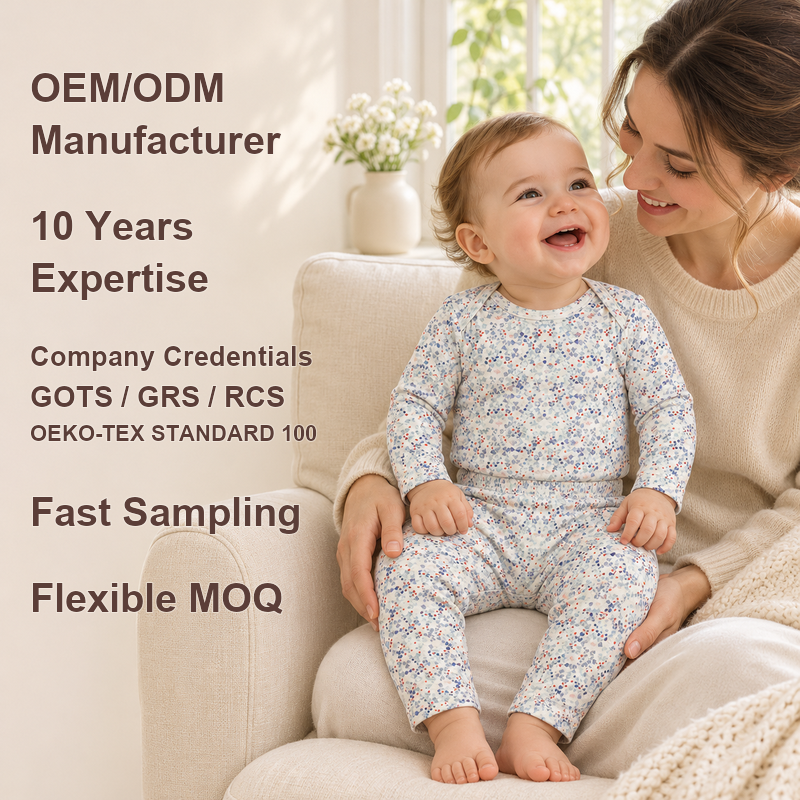
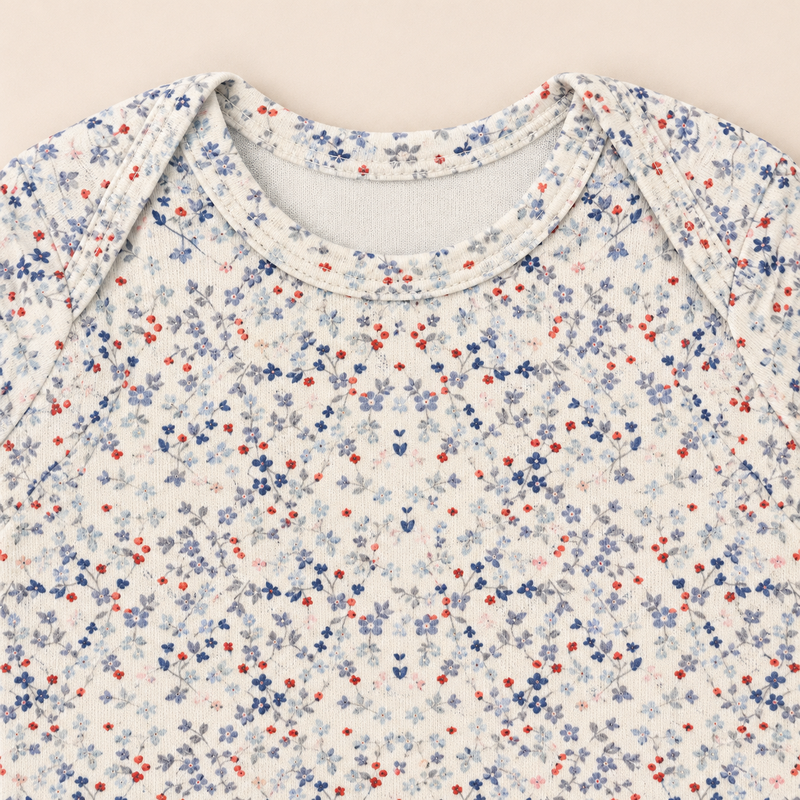
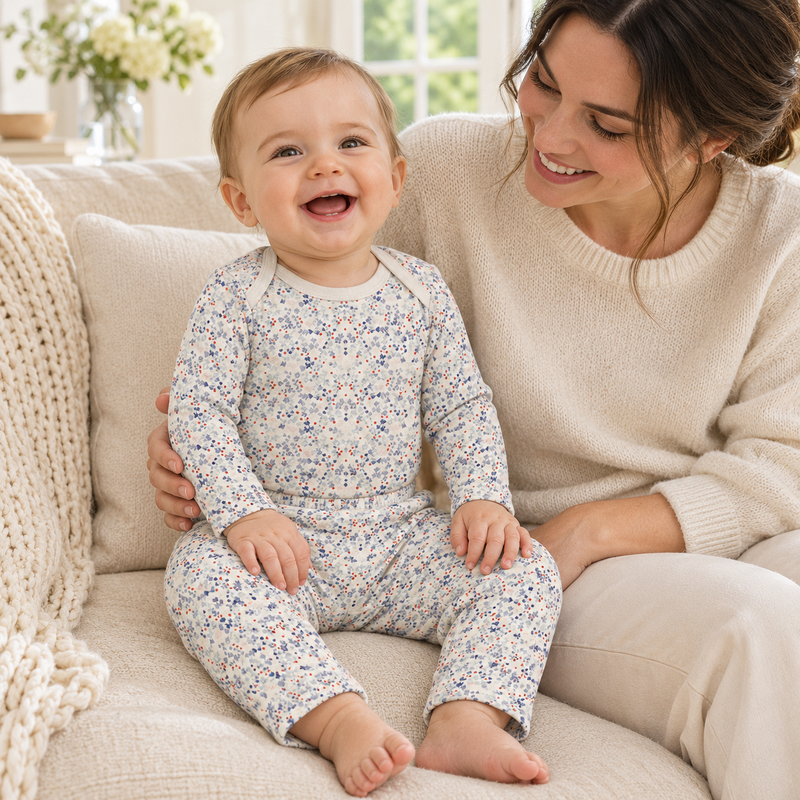
A two-piece set in an organic cotton jersey: a long-sleeve bodysuit with lap shoulders, an envelope neckline and snaps at the crotch, and a straight-leg pant with a covered elastic waist, both printed with the same fine floral speckle on a white ground.
A set is two garments that have to look like one, and this one carries three loaded details: the neckline construction, the snaps at the crotch, and a print fine enough that registration is measured in fractions of a millimetre.
At a glance
1. Fibre: organic cotton, and what a print does to the certificate
- Organic cotton is a chain-of-custody claim. It is verified through a scheme — GOTS for fibre and processing, OCS for content — and the certificate must name the seller and list the product category. A mill's own statement is not a certificate, and this page makes no certification claim.
- The print is where the scheme bites on this garment. An organic article with an allover print is not just organic fibre: the scheme restricts the print system, which inks are permitted and which are not, and whether a plastisol or PVC-based route is allowed at all. That is confirmed with the printer before the artwork is costed.
- Weight decides whether it is a bodysuit or a vest. A baby bodysuit usually quotes 160–200 gsm single jersey; below that the garment is transparent under a print and the snaps pull through the cloth, above it the bodysuit stops being a base layer.
- Cotton shrinks more than a regenerated fibre and less predictably. Both pieces are pre-shrunk and both are measured after wash; a bodysuit that loses length moves the crotch snaps up, which is a fit change, not a measurement quibble.
- It pills less than viscose but wears at the snap placket — the point where the fabric is folded, stitched and opened several times a day.
2. The bodysuit: lap shoulders and crotch snaps
- Lap shoulders are the construction that solves the head problem. The front and back shoulder panels overlap, so the neckline opens wide enough to pass a head that, at 0–3M, is close to chest circumference. It also removes the need for a snap or a cord at the neck — nothing hard sits against a chin.
- The overlap width is the specification. Too little and the shoulder will not open on a large newborn; too much and the panel gapes and the print no longer lines up across the lap. It is fixed on the sample, on the 0–3M size.
- Crotch snaps: three is the practical number. Two leaves the placket open at the leg; four is slow to do up at three in the morning. Spacing is set against the crotch curve so the placket lies flat when closed.
- The placket is reinforced, and the snaps sit off the seam. A snap set on a seam allowance pulls the seam open and wears through the print; the placket is a double layer with the snap barrels set into the flat.
- Snap testing. Attachment at 70 N, with a nickel-release check on plated parts. The snaps are the only hard components on the garment and the first thing an inspector checks.
- Seams and needle control. Four-thread overlock pressed flat; 100% needle detection on finished pieces, one-for-one exchange at every break with the machine stopped, work within 2.5 m re-screened twice, needle-free area enclosed, 2 m deep, single entry.
3. The pants: a waistband with no cord
- Covered elastic, no drawstring. For 0–12M the compliant and the practical answer is the same: elastic inside a self-fabric casing, with nothing hanging free at the waist. It is also what the image shows, and it removes an argument at the drawing stage.
- The elastic has to be anchored. A free ring twists inside the casing after a wash or two; it is stitched through at the side seams or fixed in a channel, and the width is set so it spreads pressure across a nappy rather than marking the tummy.
- Leg width clears a nappy, leg length clears a crawler. A straight leg that ends at the ankle stays put; a wide leg with a plain hem can drag. The hem is a narrow turned finish with a stretch stitch so it does not crack when pulled over a foot.
- The rise is measured over a nappy, like every other bottom in this range — a pant that fits on bare skin will not fit over a full nappy in the afternoon.
4. Two pieces, one print
- A printed set has two matching problems, not one. The dye lot has to match, and the print has to match: same repeat, same scale, same registration, or the bodysuit and the pant read as two products bought separately.
- The repeat is planned across both panels. The bodysuit is a small panel with sleeves; the pant is a long panel with two legs. A repeat that works on one can drift on the other, and the difference is visible the moment the set is folded together in a box.
- Small motifs are unforgiving. At 3–6 mm, a ditsy print depends on mesh count and ink film: too much ink and the flowers merge into noise, too little and the white ground shows through as a pale haze. The strike-off is approved at the final scale on the actual cloth.
- A busy print hides what a solid cannot. Marks, a nappy leak, a food stain — the reason this pattern sells is also the reason it survives a baby's day, and it belongs in the copy rather than in a disclaimer.
- Ground and print fastness are tested together on the finished panel at grade 3-4 or better, including wet rub at the crotch placket and the waistband, where a set rubs hardest.
5. Category and compliance
- Daywear. No sleepwear claim, no nightwear imagery; marketed as sleepwear, the US route becomes 16 CFR 1615/1616 and the EU route EN 14878, and the fit of both pieces is constrained.
- As apparel, the US general wearing-apparel flammability rule 16 CFR 1610 is the relevant test and its scope is confirmed per order with the laboratory; no claim is made on this page and no report is held for this article.
- Children's product duties. Lead limits of 100 ppm in the substrate and 90 ppm in a surface coating, phthalates where a plasticized part exists, a children's product certificate and a tracking label where the US route applies.
- Cords and small parts. No cord at the waist and none at the neck; the lap shoulder is what replaces a neck closure. The crotch snaps are attachment-tested at 70 N and checked for pinch points.
- Chemical class and labelling. Class I across 0–12M. OEKO-TEX Standard 100 certificate 23.HCN.45112 is held for this fabric at Class I. Care label with fibre content in the legal name — organic cotton declared as such only where the certificate supports it — plus size and origin.
6. Customization scope
- Sizing. Four bands as quoted; preemie and 12–18M on the same block.
- Pieces. Set as shown; bodysuit only in a three-pack; pant only; a footed pant; a short-sleeve bodysuit for summer.
- Neck and closures. Lap shoulder as shown; envelope neck with a shoulder snap; a round neck with a two-snap placket.
- Crotch. Three snaps as shown; two; a snap placket with a gusset.
- Waist. Covered elastic as shown; a rib waistband; a paperbag waist with the tie stitched down.
- Print and trim. Ditsy floral as shown at the quoted scale, a larger repeat, a placement print, or a solid with contrast trim; woven or printed label, satin care label, hangtag, gift box or polybag with header.
MOQ: 300 pcs for a custom development — custom fabric, print, colour or certification programme; 50 pcs for a decorative process added to a stock body; 100 pcs for stock fabric with your own logo and label. Mixed colour and size orders are quoted per order. These are standing programme terms, confirmed against the current quotation.
7. Sampling, lead times and what we need to quote
- Sampling. 3–7 days from a confirmed tech pack and fabric availability, including a print strike-off at final scale, a lap shoulder approval and a snap approval. An organic programme adds certificate and ink review before the fabric is booked; rush sampling is quoted at a surcharge.
- Wash the sample before approving it. Shrinkage, placket behaviour and whether the bodysuit and pant still match after washing only appear after one wash.
- Sample cost. USD 30–100 per set, refunded against a bulk order of USD 5,000; development fee USD 50–200, refunded at USD 5,000.
- Bulk lead time. 30–60 days from approval by quantity, printing and trim lead time; rush production is quoted per order.
- Quality standard. AQL 2.5 for major defects and AQL 1.0 for critical; third-party inspection accepted, with snap attachment, lap shoulder recovery and print matching between the two pieces checked as fit and safety items.
- Payment. New customers 50% deposit and 50% before shipment; repeat customers can move to 30% / 70% against the bill of lading.
Production runs with our production partner, Suzhou Shelmin Trade Co., Ltd.: 7,200 m² workshop, 8 lines, 200 staff, 6,000 pieces per day. Design confidentiality is held under NDA; buyer patterns and colourways are not re-used.
To quote, we need: target market; the organic scheme and whose name the certificate runs in; size bands and the nappy allowance you work to; fabric weight; the print at final scale with colour count; snap count and spacing; whether the set is sold as one SKU or two; packaging; and whether certification runs in your brand name.