EN


Girls' Cotton Spandex Striped Tank Top, Sleeveless Summer Vest for Kids | Custom Children's Clothing Manufacturer OEM ODM Private Label


- Overview
- Girls' Cotton Spandex Striped Tank Top
- Recommended Products
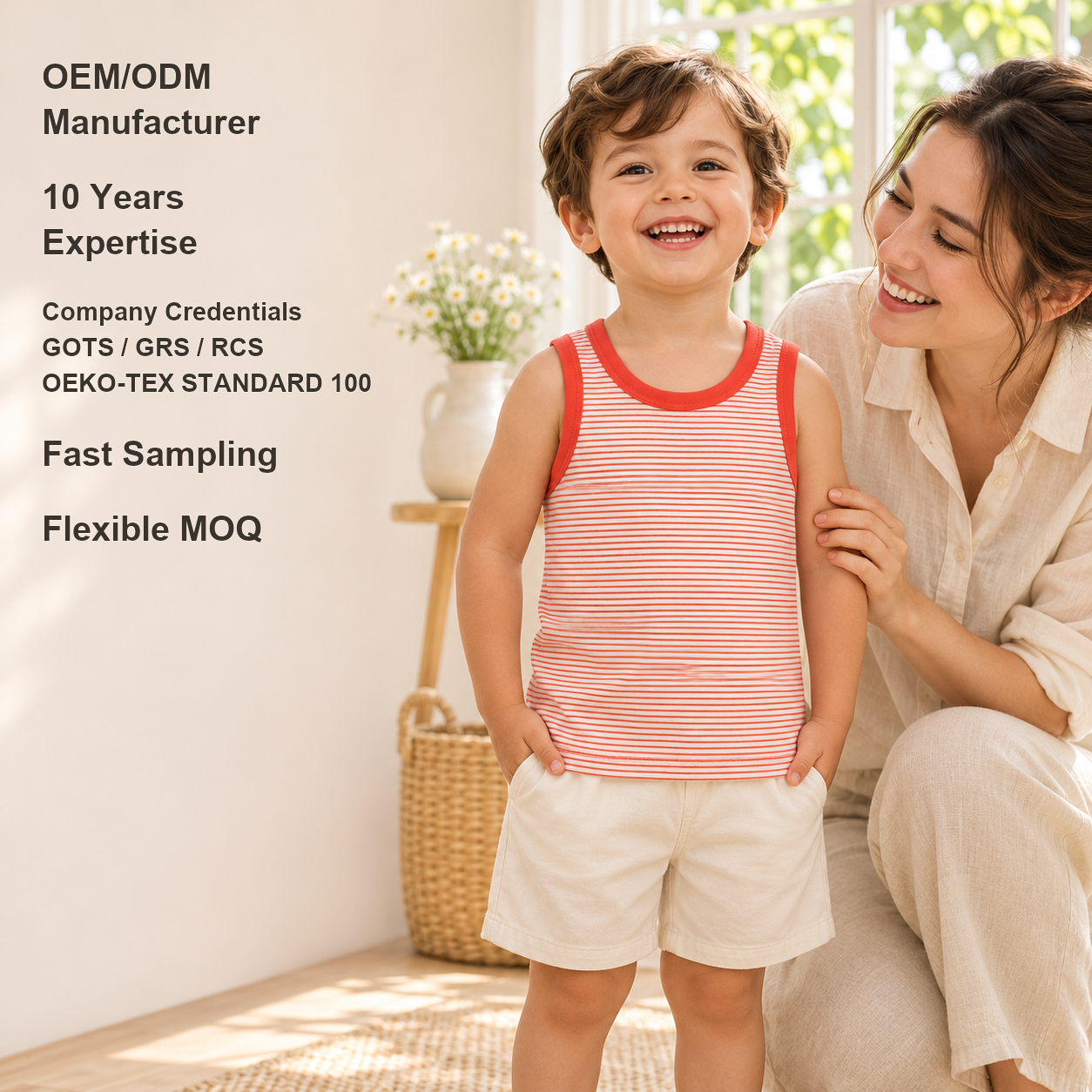
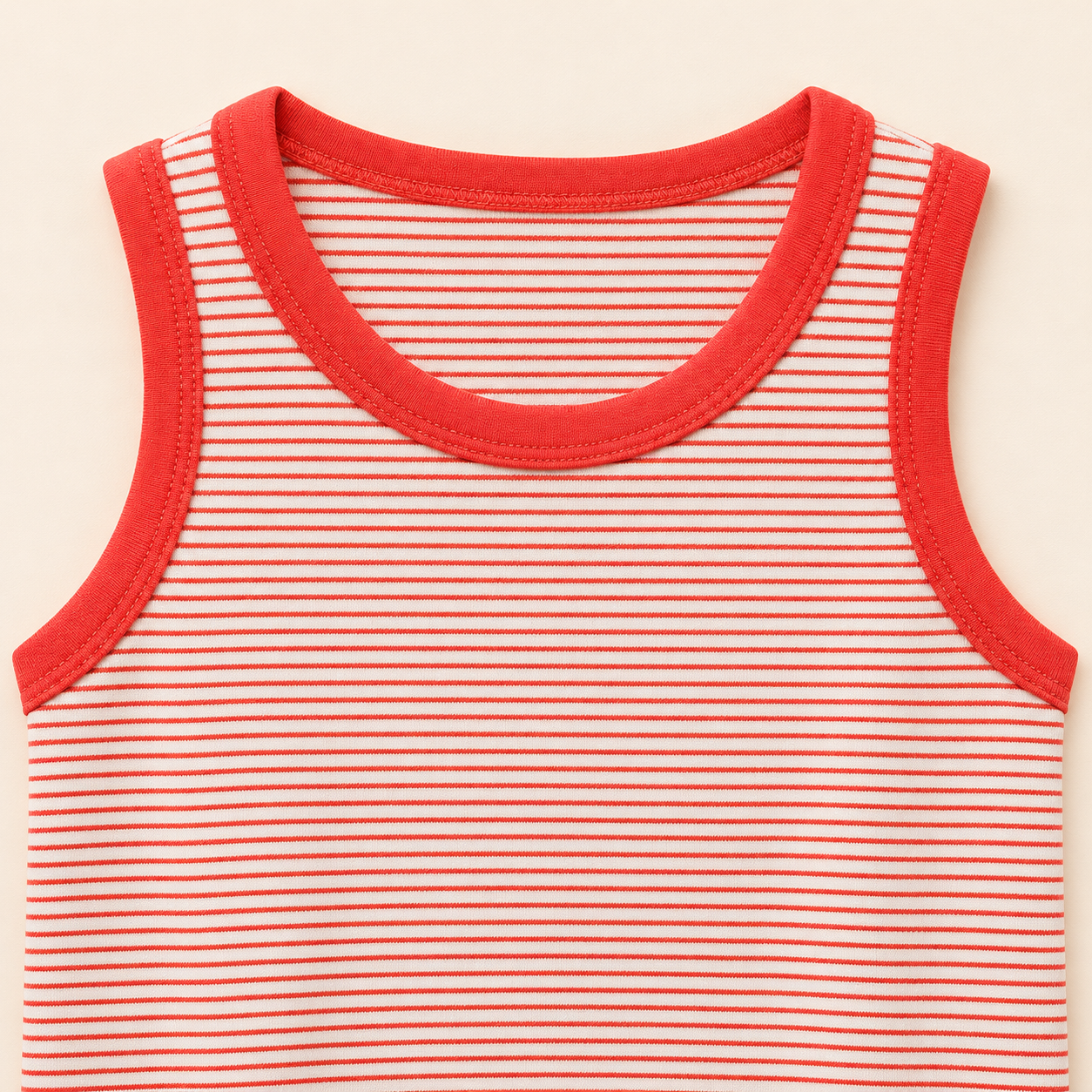
A sleeveless tank in a fine red-and-white yarn-dyed stripe: a scoop neck bound in red rib, armholes bound in the same red, a gentle A-line body and a straight coverstitched hem.
A stripe is not a print, and this garment carries two reds that come from two different colour systems — the stripe red in the yarn and the binding red in the dye bath. Getting them to agree, or deciding not to, is the first conversation.
At a glance

1. Fibre: cotton with spandex, and what a stripe changes
- The spandex percentage is the fit. A kids' knit usually runs 4–6% spandex; below that the garment grows after a wash and the binding rolls, above it the tank pulls. The figure is written on the tech pack and stays there.
- Two names, one fibre. The EU declares elastane, the US FTC declares spandex, and the percentage is declared in both. The word matters as much as the number on a care label.
- In a striped knit the elastane is plaited in, so it does not appear in the stripe: the face is the coloured yarn and the elastane sits behind it. That is why a striped cotton-spandex reads as cotton and still recovers.
- Spandex is heat- and chlorine-sensitive. Hot washing, tumble drying and chlorine bleach attack the elastane before the cotton, so the care instruction is stricter than on a 100% cotton vest.
- Cotton shrinks in length. On a tank the length shrinkage is the visible one, and it is measured on the washed sample against the graded spec.
2. Stripe: yarn-dyed, and why that is a different process
- A yarn-dyed stripe is not a print. The pattern lives in the yarn, so what gets approved is a stripe layout — width, repeat and colour sequence — not a lab dip of a ground colour. Changing the stripe after approval means new yarn, not a new screen.
- Stripe matching at the side seam is the visible defect. The front and back panels are cut so the stripe meets at the seam; if it lands half a stripe out, the garment reads as badly made from a metre away. Matching consumes fabric, and that is a costing line the buyer should see.
- The stripe has to be designed for a knit. A stripe drawn for a woven looks ragged on a jersey, because the stitch structure distorts the stripe edge by a fraction on every course. Fine stripes are the least forgiving version of this.
- Where the stripe starts is a decision. The layout is set from the hem up, so the hem band or the binding falls on a clean line rather than on a half stripe.
- Yarn lots change the red. A second lot of red yarn reads as a shade shift inside the stripe, more visibly than a piece-dyed lot does, so the yarn is booked as one lot for the run.
3. Size: 2–6 years, and a line at 36 months
- The range straddles two chemical classes. The 2A sizes are for a child under 36 months and are assessed as Class I; 3A and up is Class II. The certificate set covers both, or the range is split into two orders with two limit sets.
- Age is merchandising, height is the spec. In the EU a kids' size is a height in centimetres, in the US an age band; both appear on the graded spec.
- A tank is outgrown in length first, then at the armhole. Body length and armhole depth grade together; a tank that grades only in length cuts into the underarm at 6A.
- No closure, so the neckline has to pass a head. The scoop is sized on the 2A sample against a head form; the binding tension is what keeps it from growing afterwards.
4. Construction: binding, armhole and the seam that has to match
- The binding is the whole fit. Neckline and armhole are bound in red rib cut as a ratio of the opening: too long and the armhole gapes, too short and it cups and drags the shoulder seam. The ratio is fixed on the sample and repeated per size.
- Binding is cut across the rib so it follows the curve without a ridge, and joined with a narrow seam that sits under the arm rather than on the shoulder line.
- Armhole depth is the underarm measurement, not a styling number: it is set so the tank clears the chest at 6A and does not gape at 2A.
- The side seam carries the stripe. Four-thread overlock, pressed flat, narrow allowance — a wide allowance lifts the stripe out of line at the seam.
- The hem is a straight coverstitch that extends with the knit; a twin needle without stretch thread cracks along the fold after a few washes.
- Needle control. 100% needle detection on finished pieces; one-for-one exchange at every break with the machine stopped; work within 2.5 m re-screened twice; needle-free area enclosed, 2 m deep, single entry.
5. Two reds, one cloth: colour is the real test here
- The stripe red and the binding red come from different systems. One is dyed in the yarn, the other in the piece; they will not match by accident. Either the binding is dyed to a reference agreed against the stripe, or the difference is accepted deliberately and shown in the range plan.
- Red on white is where bleeding shows. The red stripe and the white ground are in the same cloth, so a poorly fixed red bleeds into the white in the first washes — the defect is inside the fabric, not at a seam. Fastness is tested on the finished garment, and the test piece is washed with white cotton to catch staining.
- Red also crocks. Wet rub and perspiration fastness at grade 3-4 or better, checked at the binding and under the arm, where a tank rubs against skin all day.
- The white reads the damage. Any tint the red gives the ground shows up on a white stripe immediately, which is why the ground is inspected after wash, not only before.
- Trim is matched to the stripe, not to a card. The binding, the thread and any label are set against the stripe red under defined light; a binding that is a shade hotter than the stripe is the first thing a buyer sees on a flat-lay.
6. Customization scope
- Sizing. 2–6Y as quoted; a 2–8Y extension; a 12–24M version quoted separately under Class I.
- Stripe. Fine stripe as shown; a wider stripe; a two-colour or three-colour sequence; a stripe width chosen to suit the smallest panel.
- Trim. Red binding as shown; self-colour binding; a contrast neck only.
- Silhouette. A-line as shown; straight; a longer tunic length; a racer back.
- Neckline. Scoop as shown; a crew; a square neck.
- Packing. Sold alone or in a two-pack; matching shorts or a skirt; polybag with header, hanger card, gift box; woven or printed label, satin care label, hangtag.
MOQ: 300 pcs for a custom development — custom fabric, stripe, colour or trim; 50 pcs for a decorative process added to a stock body; 100 pcs for stock fabric with your own logo and label. Mixed colour and size orders are quoted per order. These are standing programme terms, confirmed against the current quotation.
7. Sampling, lead times and what we need to quote
- Sampling. 3–7 days from a confirmed tech pack and fabric availability, including a stripe layout approval, a binding ratio approval and a red reference approval. A new stripe means new yarn and adds a round; rush sampling is quoted at a surcharge.
- Wash the sample before approving it. Stripe alignment after washing, binding recovery and any red transfer into the white only appear after one wash.
- Sample cost. USD 30–100 per set, refunded against a bulk order of USD 5,000; development fee USD 50–200, refunded at USD 5,000.
- Bulk lead time. 30–60 days from approval by quantity, yarn and dyeing lead time; a new stripe adds yarn lead time; rush production is quoted per order.
- Quality standard. AQL 2.5 for major defects and AQL 1.0 for critical; third-party inspection accepted, with stripe matching at the side seam, binding tension and the class marking per size band checked as fit and safety items.
- Payment. New customers 50% deposit and 50% before shipment; repeat customers can move to 30% / 70% against the bill of lading.
Production runs with our production partner, Suzhou Shelmin Trade Co., Ltd.: 7,200 m² workshop, 8 lines, 200 staff, 6,000 pieces per day. Design confidentiality is held under NDA; buyer patterns and colourways are not re-used.
To quote, we need: target market; the spandex percentage you require and whether the 2A sizes stay in the range; the stripe layout or a reference swatch; the binding colour reference; silhouette and neckline; whether the tank is sold alone or in a pack; packaging; and whether certification runs in your brand name.