EN

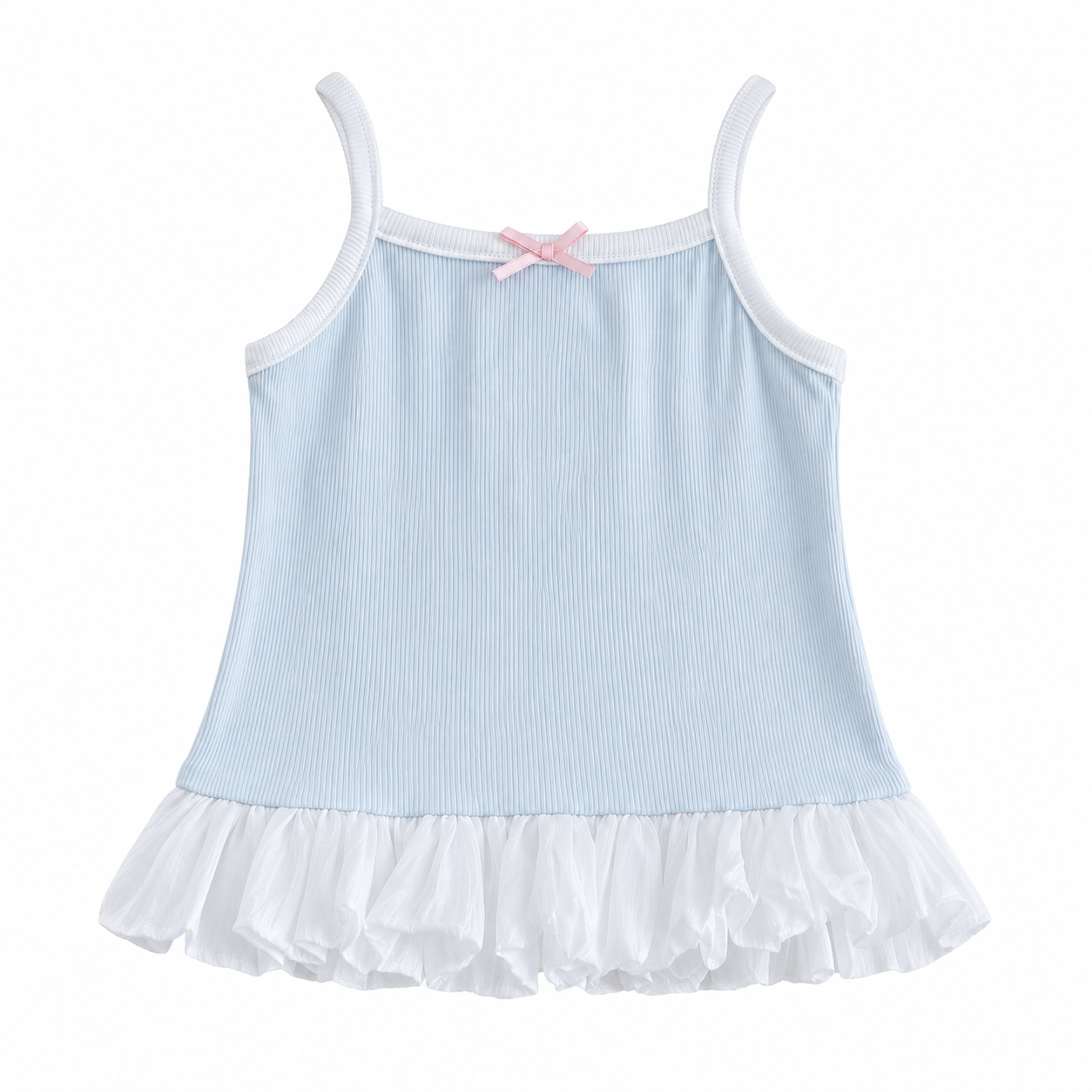
Girls' Cotton Spandex Tank Top with Ruffle Hem, Ribbed Sleeveless Summer Top for Kids | Custom Girls Clothing Manufacturer OEM ODM Private Label


- Overview
- Girls' Cotton Spandex Ruffle Hem Tank Top
- Recommended Products
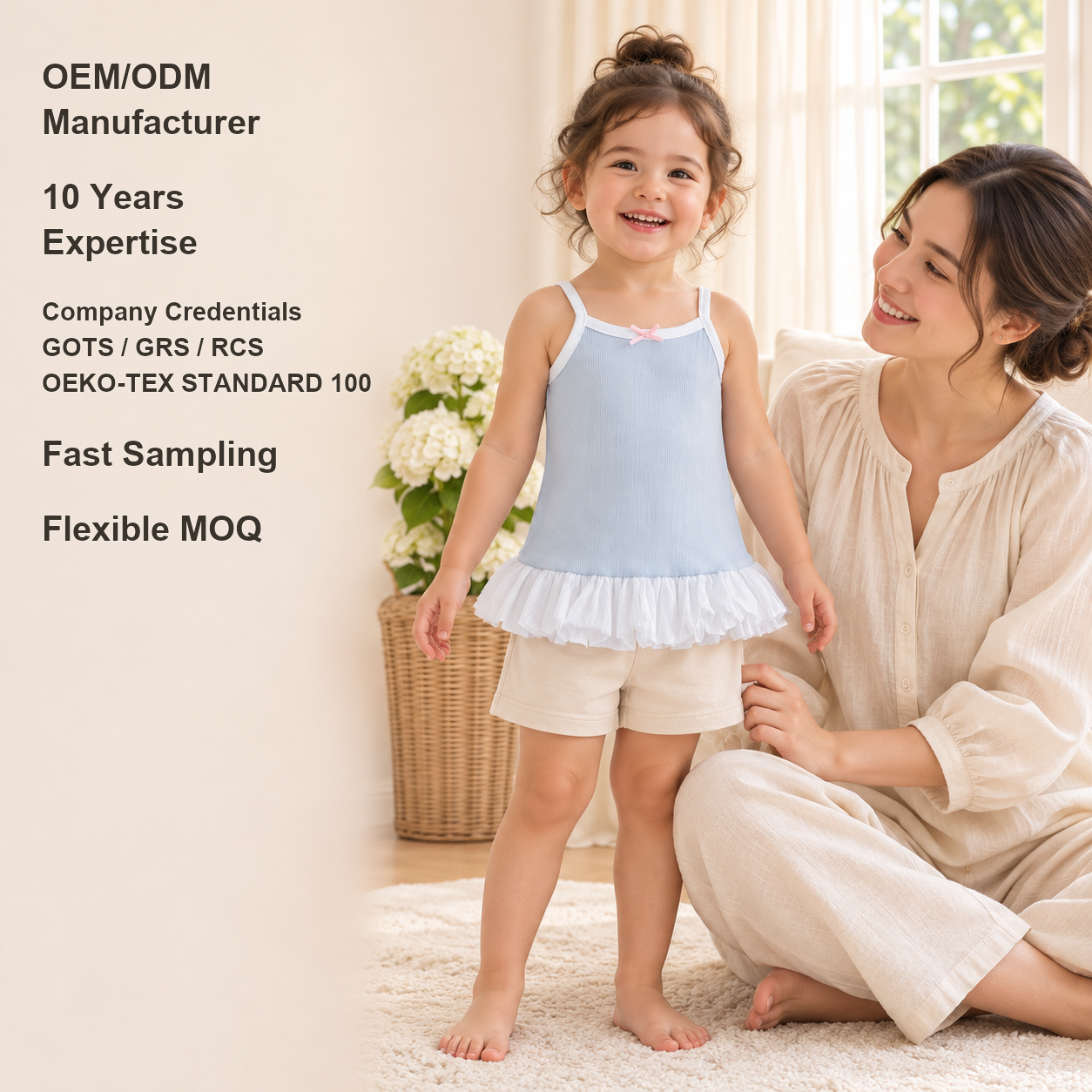
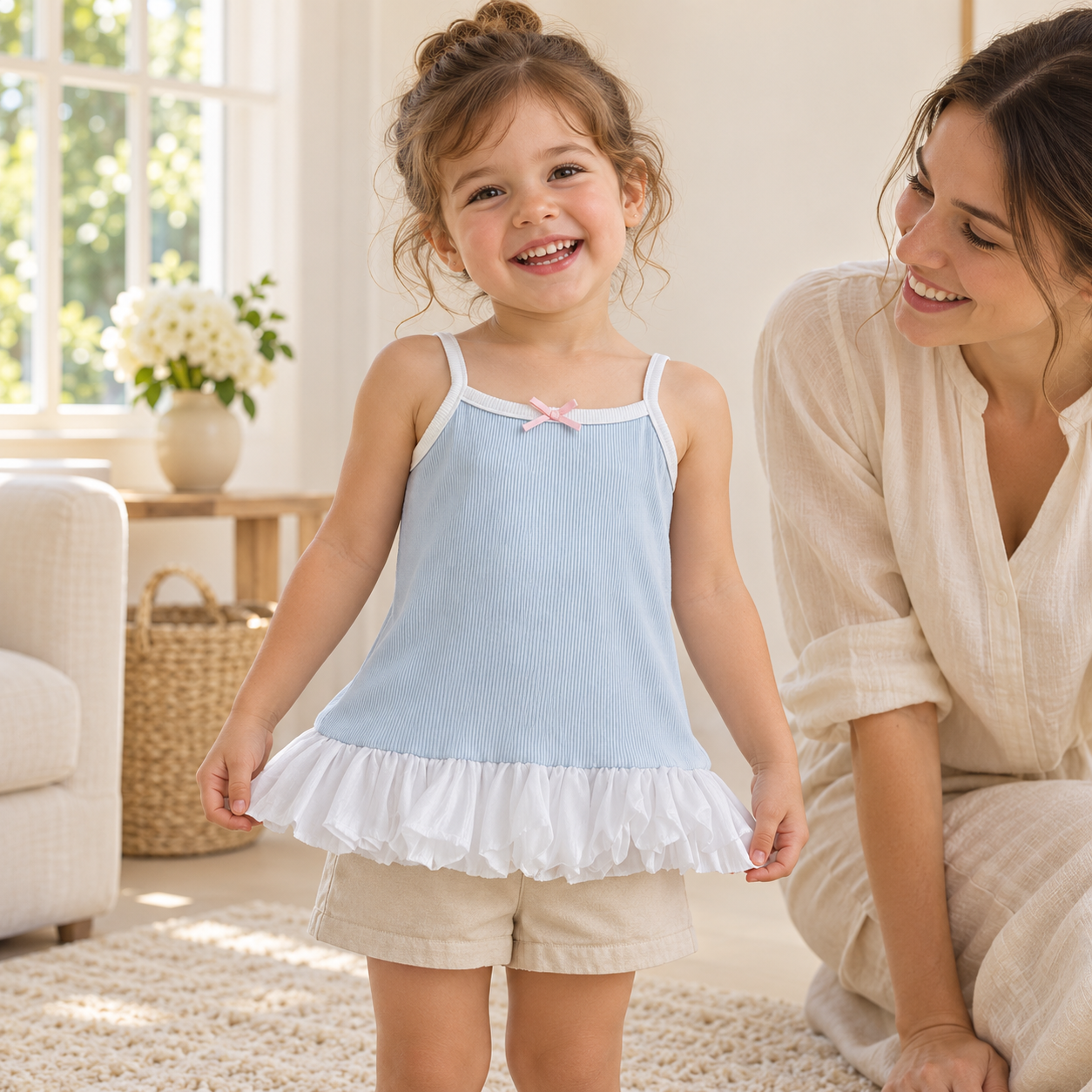
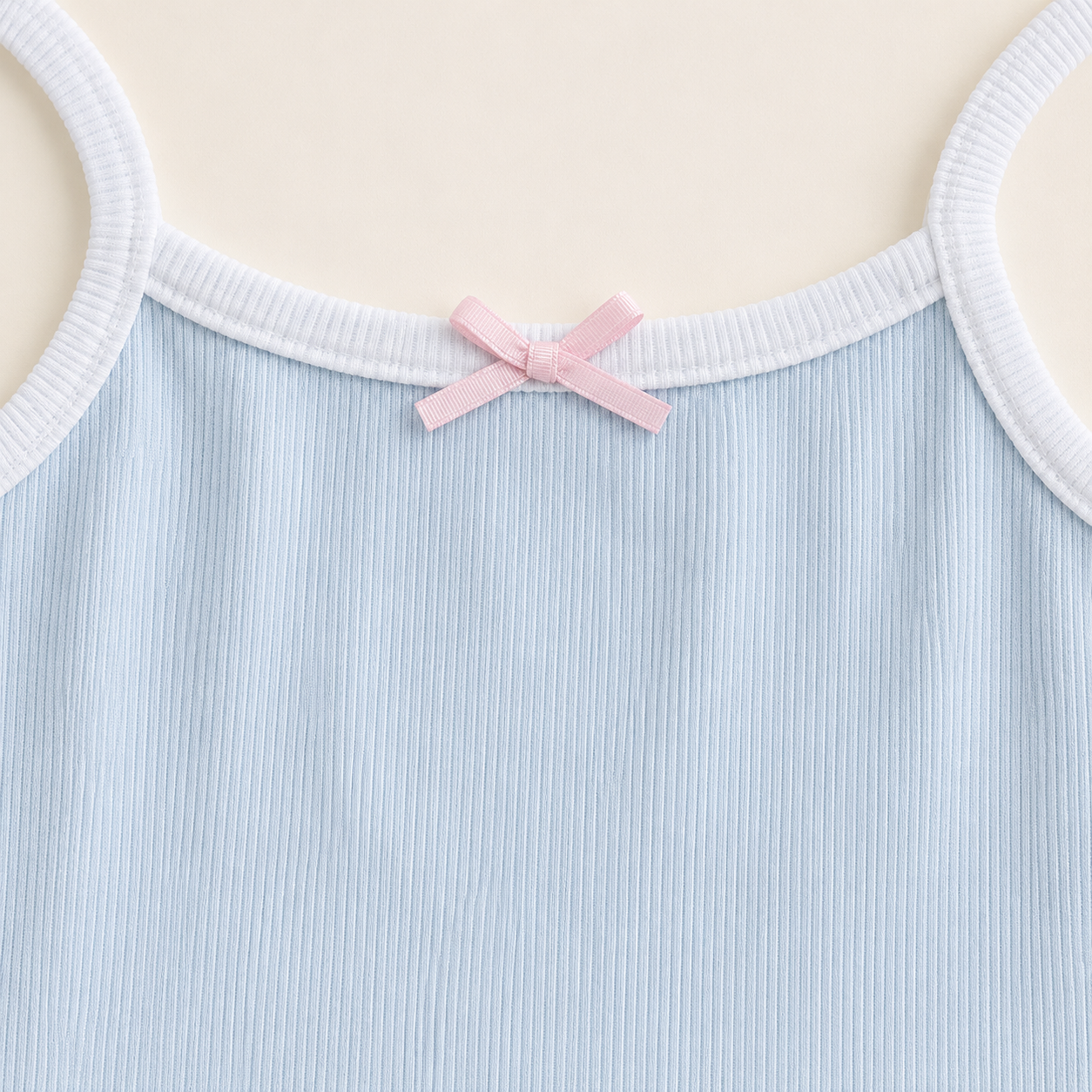
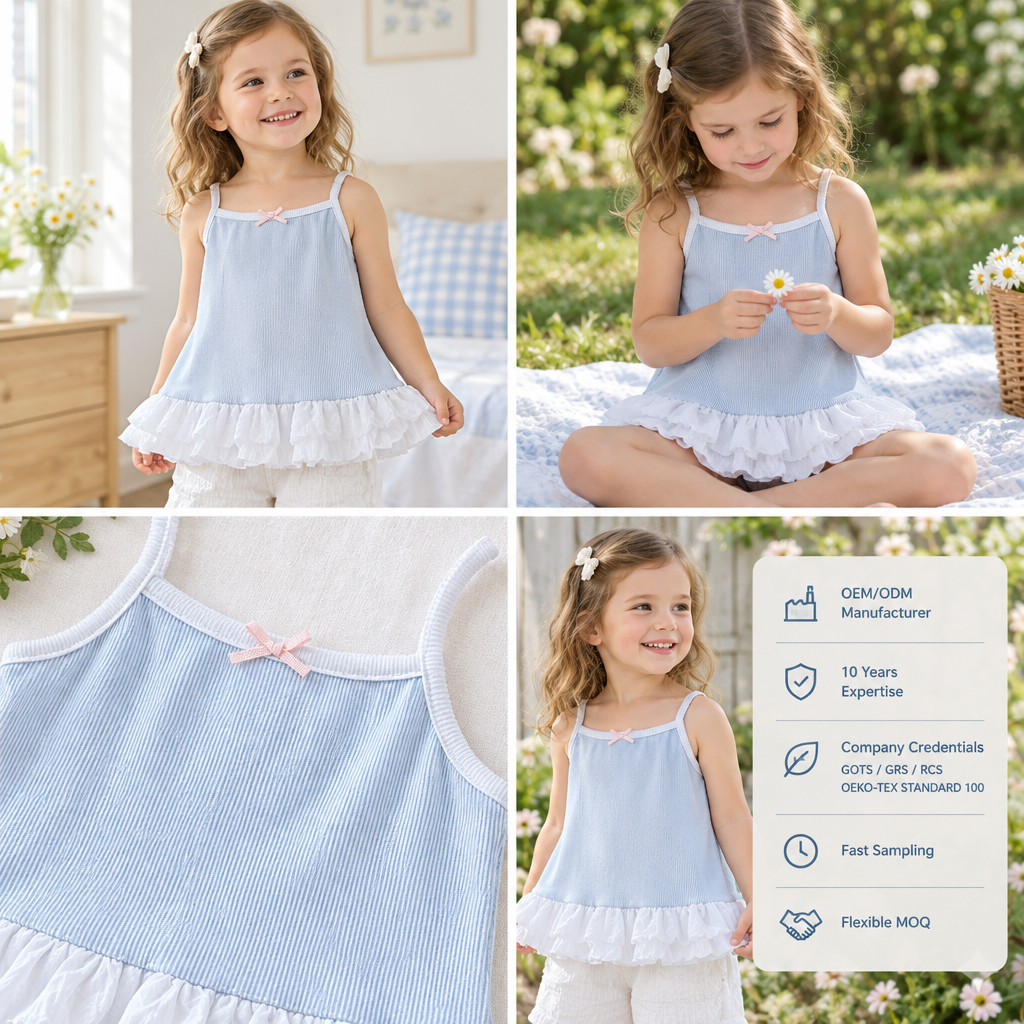
A camisole in a pale blue cotton-spandex rib: narrow straps, white rib binding around the neckline and armholes, a small pink ribbon bow at the centre front, and a gathered white woven ruffle at the hem.
Three materials meet on this garment — a rib knit, a woven ruffle and a ribbon — and each brings its own shrinkage, its own care rule and its own compliance item. The fit is carried entirely by the rib, because there is no closure anywhere on it.
At a glance
1. Fibre: cotton with spandex, and what the percentage decides
- The spandex percentage is the fit, not a detail. A kids' rib usually runs 4–6% spandex; below that the rib stops recovering after a wash and the camisole grows, above it the garment pulls and the binding rolls. The figure is written on the tech pack and does not drift between orders.
- The two markets name it differently. The EU declares elastane, the US FTC declares spandex; the percentage is declared in both. Getting the word wrong on a care label is the same class of error as writing "bamboo" for viscose.
- Spandex is heat- and chlorine-sensitive. Hot washing, tumble drying and chlorine bleach attack the elastane before they attack the cotton, which is why the care instruction on this garment is stricter than on a 100% cotton tee.
- Rib is a structure, not a stretch additive. The ribs run vertically and must stay in the length direction when the panel is cut; cut across the rib and the body loses the width stretch the fit depends on.
- Cotton shrinks, the rib narrows. Length shrinkage is the visible one on a camisole, and it is measured on the washed sample against the graded spec.
2. Size: 2–6 years, and a line at 36 months
- The range straddles two chemical classes. A 2A garment is for a child under 36 months and is assessed as Class I; 3A and up is Class II. The certificate set has to cover both, or the range is split into two orders with two limit sets.
- Age is merchandising, height is the spec. In the EU a kids' size is a height in centimetres, in the US an age band; both appear on the graded spec so the two agree across a 2–6Y run.
- A camisole is outgrown in length first. Body length grades faster than chest width at this age; a range that grades flat in length is short at 6A.
- Fit is carried by the rib, because there is no closure. No zip, no buttons, no elastic — the garment goes on over the head and the rib's recovery holds it. That makes the rib quality a sizing decision, not a fabric preference.
- Straps do not adjust. Strap length and position are fixed on the sample against a head-and-shoulder form; adjustable sliders are hardware and would bring a small-parts file with them.
3. Construction: straps, binding and a knit-to-woven seam
- Strap position decides whether it stays on the shoulder. The strap is set inboard of the shoulder point and its length is measured on the 2A and 6A samples; a strap that is right at 2A slips off a 5-year-old's narrower shoulder line.
- The binding is rib, and its length ratio is the whole tension. Neckline and armhole binding are cut as a ratio of the opening they are sewn to: too long and the armhole gapes, too short and it cups and pulls the strap out of shape. The ratio is fixed on the sample and repeated per size, not scaled by eye.
- A woven ruffle on a knit body is a seam between two different behaviours. The poplin shrinks differently from the rib and does not stretch at all, so the join is sewn with a stretch stitch and the ruffle's gather is set to absorb the difference. Without that, the seam ripples after the first wash and the hem hangs uneven.
- The ruffle's gather ratio sets the flare. A fuller gather uses more fabric and gives the swing in the photo; a flatter one reads as a straight hem. Rolled hem on the woven edge, cut on grain, or the ruffle twists.
- Seams and needle control. Four-thread overlock pressed flat; 100% needle detection on finished pieces, one-for-one exchange at every break with the machine stopped, work within 2.5 m re-screened twice, needle-free area enclosed, 2 m deep, single entry.
4. The bow: a small part and a loop at the same time
- A ribbon bow at a child's neckline is two compliance items in one object. It is an attachment (tested, not assumed) and a loop in a neck area (which is why it is tacked closed rather than tied loose).
- Build. The bow is made up and sewn closed, the loops are bar-tacked to the body, and the tails are cut short and finished. Attachment tested at 70 N, with the bow position set above the binding seam so it does not pull the neckline out of shape.
- It is the only loose-looking element on the garment, which is why it gets its own line in the inspection report rather than being covered by "trims checked".
- Ribbon quality. A narrow polyester satin ribbon holds its shape through washing better than a cotton one, but the colour is the part that moves; the ribbon is matched to the approved reference and tested with the garment, not separately.
5. Colour and care: pale blue against white
- Three components, one colour conversation. The pale blue body, the white binding and the pink bow are approved as a group; white rib next to a pale blue body is where dye transfer shows first, so both are washed together before bulk.
- Pale blue shows levelness. On a fine rib, cloudiness and streakiness read as texture rather than as a fault, but they still fail an approval; the ground is approved as a lab dip on the actual rib.
- Colour fastness tested on the finished garment at grade 3-4 or better, including wet rub at the binding, where a camisole rubs against skin all day.
- Care follows the most sensitive component, not the largest. Cool wash, no chlorine bleach, no tumble dry: that protects the elastane, the ribbon and the ruffle's gather at once.
- Trim dyes are approved against the body, not chosen from a card — a white binding that reads blue-grey next to the body is the first thing a buyer sees on a flat-lay.
6. Customization scope
- Sizing. 2–6Y as quoted; a 2–8Y extension; a 12–24M version quoted separately under Class I.
- Strap. Narrow as shown; a wider strap; a straight or a crossed back.
- Ruffle. Single gathered ruffle as shown; a double tier; a knit ruffle instead of woven for a softer fall; a plain hem with no ruffle.
- Trim. White binding as shown; self-colour binding; a picot edge.
- Bow. Pink satin ribbon as shown; a self-fabric bow; an embroidered motif instead of a bow, if the buyer wants no separate component at all.
- Colour and packing. Pale blue as shown or any lab-dipped shade; sets with a matching brief or short; polybag with header, gift box, hanger card; woven or printed label, satin care label, hangtag.
MOQ: 300 pcs for a custom development — custom fabric, colour, trim or certification programme; 50 pcs for a decorative process added to a stock body; 100 pcs for stock fabric with your own logo and label. Mixed colour and size orders are quoted per order. These are standing programme terms, confirmed against the current quotation.
7. Sampling, lead times and what we need to quote
- Sampling. 3–7 days from a confirmed tech pack and fabric availability, including a lab dip, a binding ratio approval, a ruffle gather approval and a bow approval. A new ribbon colour adds a round; rush sampling is quoted at a surcharge.
- Wash the sample before approving it. Rib recovery, the knit-to-woven seam and whether the white binding picks up blue all appear after one wash.
- Sample cost. USD 30–100 per set, refunded against a bulk order of USD 5,000; development fee USD 50–200, refunded at USD 5,000.
- Bulk lead time. 30–60 days from approval by quantity, dyeing and trim lead time; rush production is quoted per order.
- Quality standard. AQL 2.5 for major defects and AQL 1.0 for critical; third-party inspection accepted, with binding tension, bow attachment and the class marking per size band checked as fit and safety items.
- Payment. New customers 50% deposit and 50% before shipment; repeat customers can move to 30% / 70% against the bill of lading.
Production runs with our production partner, Suzhou Shelmin Trade Co., Ltd.: 7,200 m² workshop, 8 lines, 200 staff, 6,000 pieces per day. Design confidentiality is held under NDA; buyer patterns and colourways are not re-used.
To quote, we need: target market; the spandex percentage you require and whether the 2A sizes stay in the range; the size bands; the binding colour reference; ruffle type and gather; whether the bow stays; packaging; and whether certification runs in your brand name.