EN

OEM/ODM 100% Cotton Double-Layer Wrinkled Gauze Baby Girl Skirt | Eco-Friendly Plant-Dyed 135gsm Toddler A-Line Mini Skirt | Sustainable Custom Organic-Feel Kids Boutique Summer Apparel Wholesale


- Overview
- OEM/ODM 135gsm Plant-Dyed Cotton Baby Skirt
- Recommended Products
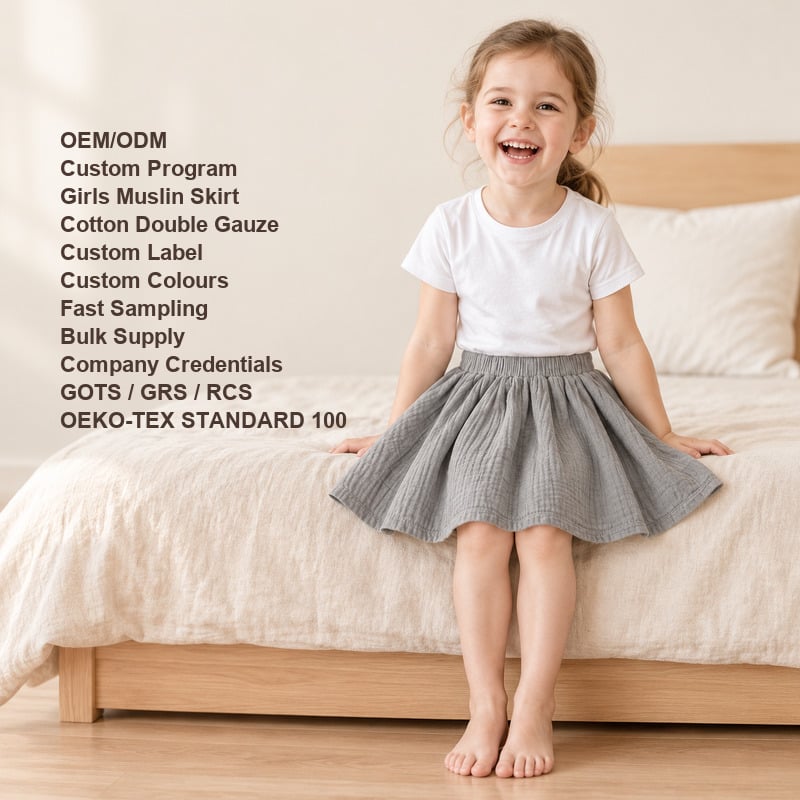
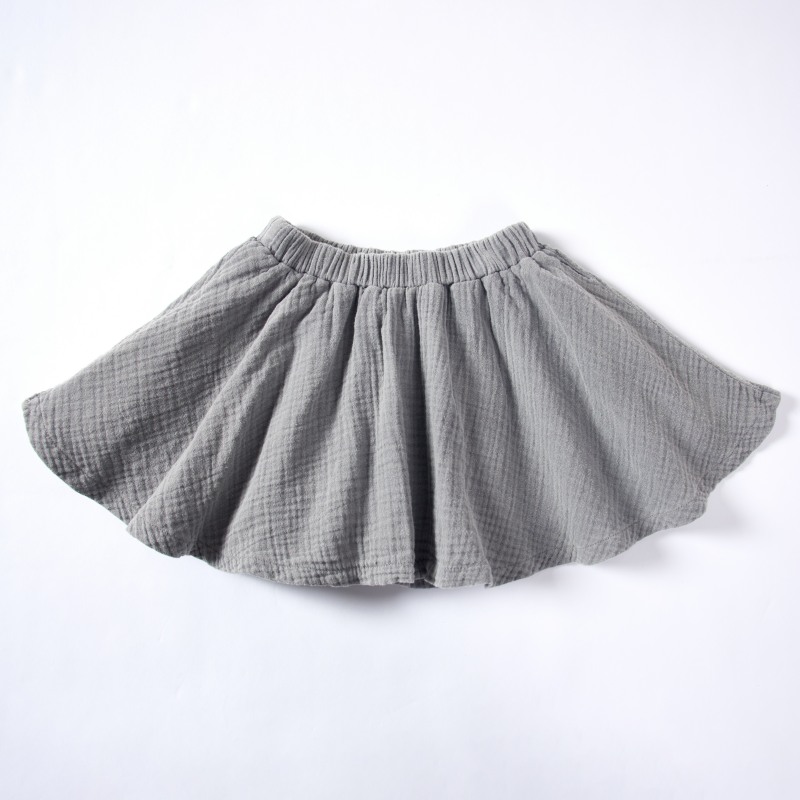
A gathered baby skirt in a double-layer crinkled cotton, 135 gsm, dyed to a pewter grey with gallnut (五倍子) and pomegranate rind (石榴皮) and finished in a ferrous second bath: a gathered elastic waist, a flared body, a narrow hem, and no ties, cords or fastenings anywhere on the garment.
A skirt asks a different question of this cloth than a pair of bloomers does. There is nothing to hold it in place except one gathered seam, and everything below that seam hangs, swings and — on a baby — reaches the floor. So the page is about geometry: what the waist carries, how the hem behaves after it has hung, and what a hem does to a texture when you finish it.
At a glance
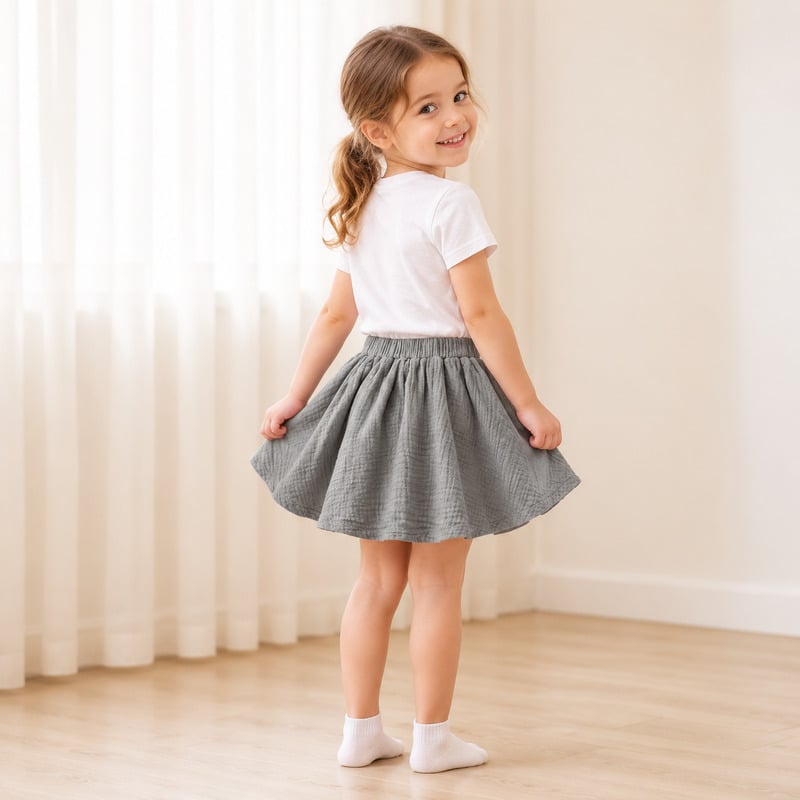
1. One gathered seam carries the whole garment
- There is no second support point. A skirt holds itself up at the waist and nowhere else, so the waist seam takes the mass of the entire body of cloth plus whatever a baby does to it.
- A crinkle is light for its bulk, which helps, but it is also springy: the gathers push back, so the seam has to be built for a cloth that resists being gathered rather than one that lies down.
- The waist is a self tunnel with elastic inside, so the strain path runs through two plies of gathered cloth before it reaches the elastic; the tunnel is stitched to keep the elastic from rolling, and the stitching is set for the bulk.
- Elastic is specified by relaxed and stretched circumference per size, with recovery checked after repeated washing, because a waist that relaxes is a skirt that ends up around the ankles rather than a skirt with a fitting issue.
- The waist sits high on the body, above the nappy line, so the skirt hangs from the smallest part of a baby's torso and does not work its way down as the child moves.
2. Hem level is a measurement, not an impression
- A flared skirt has grain in every direction, so different parts of the hem behave differently under gravity: some drop, some do not.
- A double-layer crinkle amplifies this, because each ply takes up the drop at its own rate and the texture hides the early signs of it.
- So the garment hangs before it is hemmed. The body is joined, hung for a defined period, and the hem is marked on the hanging garment rather than on the table.
- Level is checked at marked points around the hem, not judged by eye, and again after the wash sequence, because the drop that matters happens after the first wash rather than before.
- This is also why the length is specified in the hanging state, and why a re-order is measured the same way as the first order instead of being cut to the same pattern length.
3. A skirt on a crawling baby is a hem on the floor
- Between about six months and walking, the hem is the part that touches the world. It drags, it picks up what is on the floor, and it abrades against it while the child moves.
- The hem is therefore finished and tested as a wear part, not as a decorative edge: abrasion at the hem is checked against an unrubbed specimen, and soiling behaviour is stated honestly in the care wording rather than left to the customer to discover.
- A skirt also rides up when a baby crawls, because nothing holds it down; that is a property of the shape rather than a fault in the make.
- So the garment is presented as a layer over a nappy cover or bloomers, which is how it is worn and how it is sampled: the fit check is done with a nappy in place and with the layer it is meant to sit over.
- This is also why there are no cords or ties on it. A skirt that reaches the floor and is worn by a crawling child does not need anything hanging from it, so the design carries no drawstring, no tie and no fastening at all.
4. The grey is read on the hanger, not on the table
- A tannin-iron grey keeps developing for days after drying, and on a crinkle the amount of iron varies with the fold, so the colour is not uniform in the way a flat cloth is.
- A skirt changes its folds when it is hung. Gathers fall into new lines, and the banding that a flattened garment showed is not the banding the customer will see.
- So the resting read is taken with the garment hanging, inside its resting period, under D65 and against the sealed piece, with the sealed piece itself hung rather than folded.
- A garment approved flat can still be rejected on a hanger, which is why the buyer's approval is asked for on the hanging state as well as on the flat one.
- The rest period sits inside the lead time, and it starts when the inside of the cloth is dry rather than when the surface looks dry, since a double layer dries from the outside in.
5. What the fold does to the iron, and to the cloth
- The tannin loads the cloth and the iron develops the grey, in that order, because the iron needs tannin already in the fibre to complex with; reversed, the result is patchy and does not recover.
- A compressed crease is where the iron bath arrives last, so the inside of a fold can read as a cooler, less developed grey rather than simply a lighter one.
- The bath is built for penetration rather than concentration, with a full wet-out before the iron, cloth opened rather than packed, and longer immersion with movement; adding iron to lift a pale fold darkens the ridge and leaves the valley as it was.
- Iron-tannin chemistry also firms cellulose, and overdosed it embrittles it, with the damage appearing first where the cloth flexes — which on a crinkle is every fold and, on a skirt, the hem.
- So the iron dose is capped as a ratio to the tannin measured on the cloth, the rinse is verified before packing, and strength is tested against undyed cloth from the same greige lot, with the hem included.
6. The hem finish is where the texture is decided
- A narrow hem on a curved, crinkled edge is the hardest seam on the garment. The edge is on a curve, the cloth is two-ply and springy, and the feed has to move more cloth on the underside than the upper side without flattening what it is sewing.
- A hem that is pulled flat leaves a band of flat cloth along the bottom. On a mid grey that band catches light differently and reads as a lighter line running around the skirt — a visible seam where the customer expects the texture to continue.
- So the hem allowance, the stitch and the differential feed are specified together, and the result is checked by looking along the hem in raking light rather than from the front.
- The two plies are also checked at the hem turn, since a step between them shows there before anywhere else.
- The hem is pressed under rather than pressed flat, because a pressed-flat hem on a crinkle does not recover its texture in the wash; it stays a smooth band.
7. Tests, sizes, sampling and quoting
- Fabric tests at the shipped depth: light to ISO 105-B02, wash to ISO 105-C06 with a whole garment in the load, rubbing to ISO 105-X12 on flat areas and through creases, perspiration and saliva to ISO 105-E04 plus the destination market's saliva method, with colour read on both plies.
- Strength against undyed same-lot cloth: tensile to ISO 13934-1 and tear to ISO 13937-2, with the hem and the gathered waist included rather than averaged into one body result.
- Hem checks: level at marked points before and after washing, abrasion at the hem against an unrubbed specimen, and a raking-light inspection for a flattened band along the edge.
- Colour is read after the defined resting period, hanging, under D65 against a sealed piece that is also hung, and again flat for the record.
- pH is measured on the garment and held between 4.0 and 7.5; extractable heavy metals are tested on the finished garment, which is the relevant check for this colourway; phenol yellowing is checked to ISO 105-X18 with packaging free of BHT.
- Safety and trim checks: waist elastic relaxed and stretched circumference per size, recovery after repeated washing, tunnel stitching integrity, and confirmation that the garment carries no cords, ties, toggles or small parts.
- Five sizes on a measurement chart: 6-9M, 9-12M, 12-18M, 24M and 36M move on waist, skirt length and hem circumference, measured in the hanging state after the drop and confirmed after washing.
- Sampling: 3-7 days from a confirmed tech pack, covering a dyed strike-off with its bath sequence and resting period stated, a made-up skirt hung for its drop period and hemmed, a wash-and-remeasure with hem level marked, a fit check over a nappy cover on the smallest and largest size, a hem abrasion check, a raking-light hem inspection, a both-ply read at the hem turn, and the hanging resting read.
- Bulk: 30-60 days from approval, planned per dyebath, with cloth released only after both-ply colour, strength, rinse and resting results are in hand.
- MOQ: 300 pcs for a custom development covering cloth, shade, crinkle level, trim or fit; 50 pcs for a decorative process on a stock body; 100 pcs for stock cloth with your own logo and label. Mixed colour and size orders are quoted per order, and terms are confirmed against the current quotation.
Production runs with our production partner, Suzhou Shelmin Trade Co., Ltd.: founded 2017, 7,200 m² workshop, 8 lines, 200 staff, 6,000 pieces per day. Design confidentiality is held under NDA; buyer patterns, shades and prints are not re-used.
To quote, we need: target market and the Class I tests it requires; the crinkle level you want, as crease count and depth per unit; the skirt length you are targeting and whether it is approved in the hanging state after the drop period; the acceptable post-wash length change and hem level tolerance; waist elastic type and relaxed and stretched circumference; whether the skirt is sold alone or as a set with a nappy cover, since the fit check depends on it; gallnut and rind lot certificates with tannin content; the pH target and the dyehouse water specification; packing method, including whether the garment is packed hanging or folded; and whether certification is to run in your brand name.