EN



OEM/ODM All-Over Floral Print Kids T-Shirt | Eco-Friendly 220gsm Bamboo Soft Toddler Long Sleeve Tee | Custom Sustainable Breathable Crewneck Children Autumn Top | Wholesale Premium Private Label Boutique Apparel


- Overview
- OEM/ODM 220gsm All-Over Floral Printed Bamboo Kids Tee
- Recommended Products
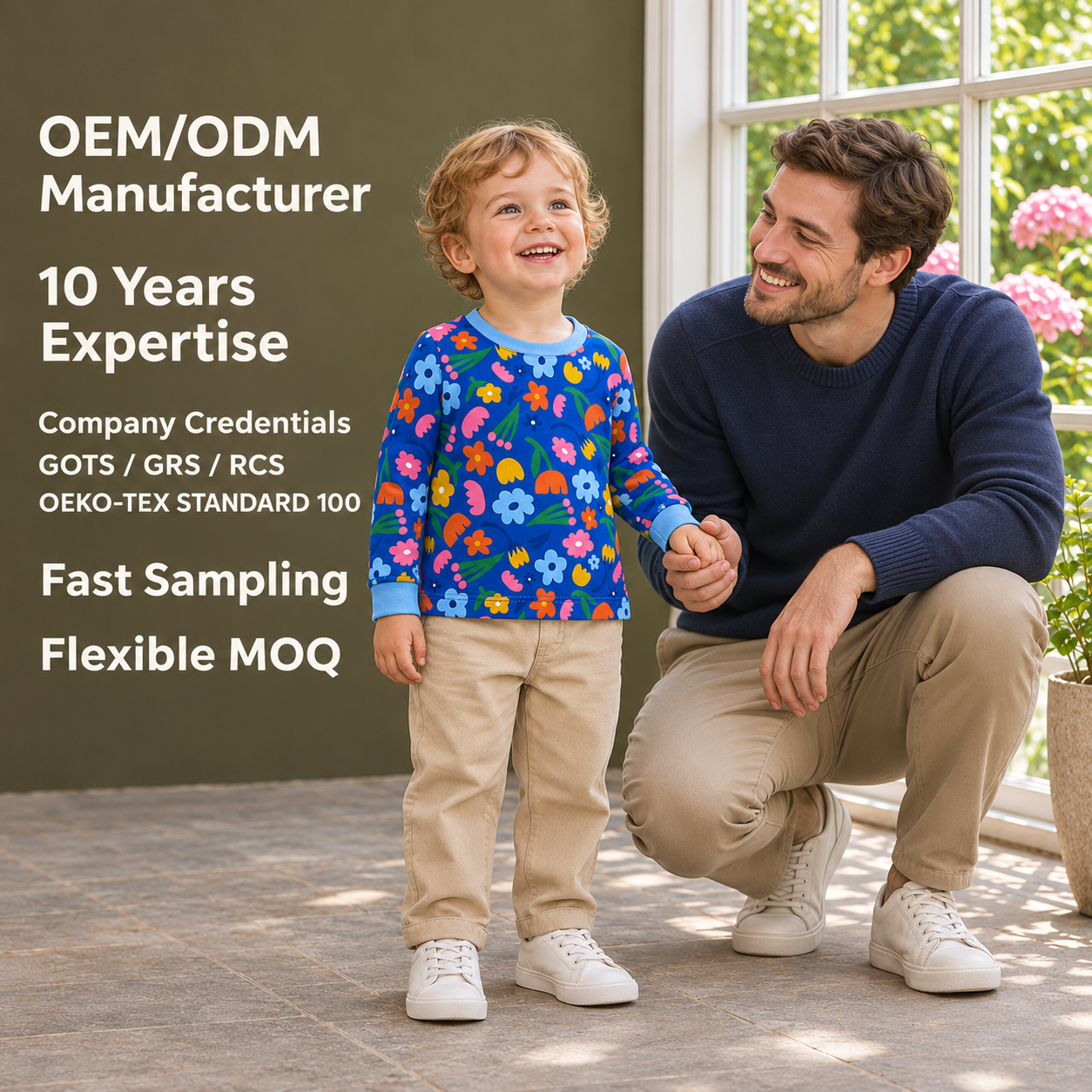
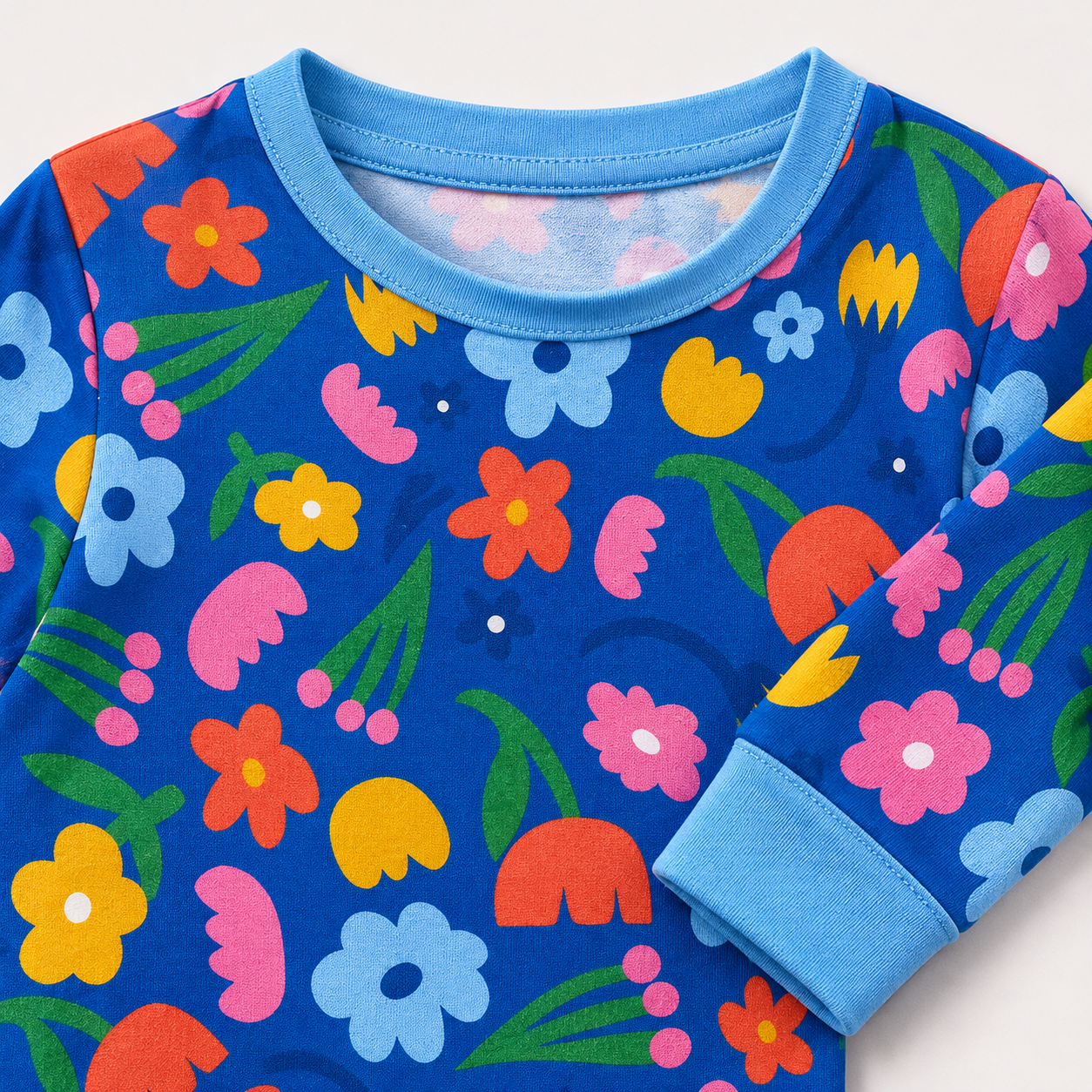
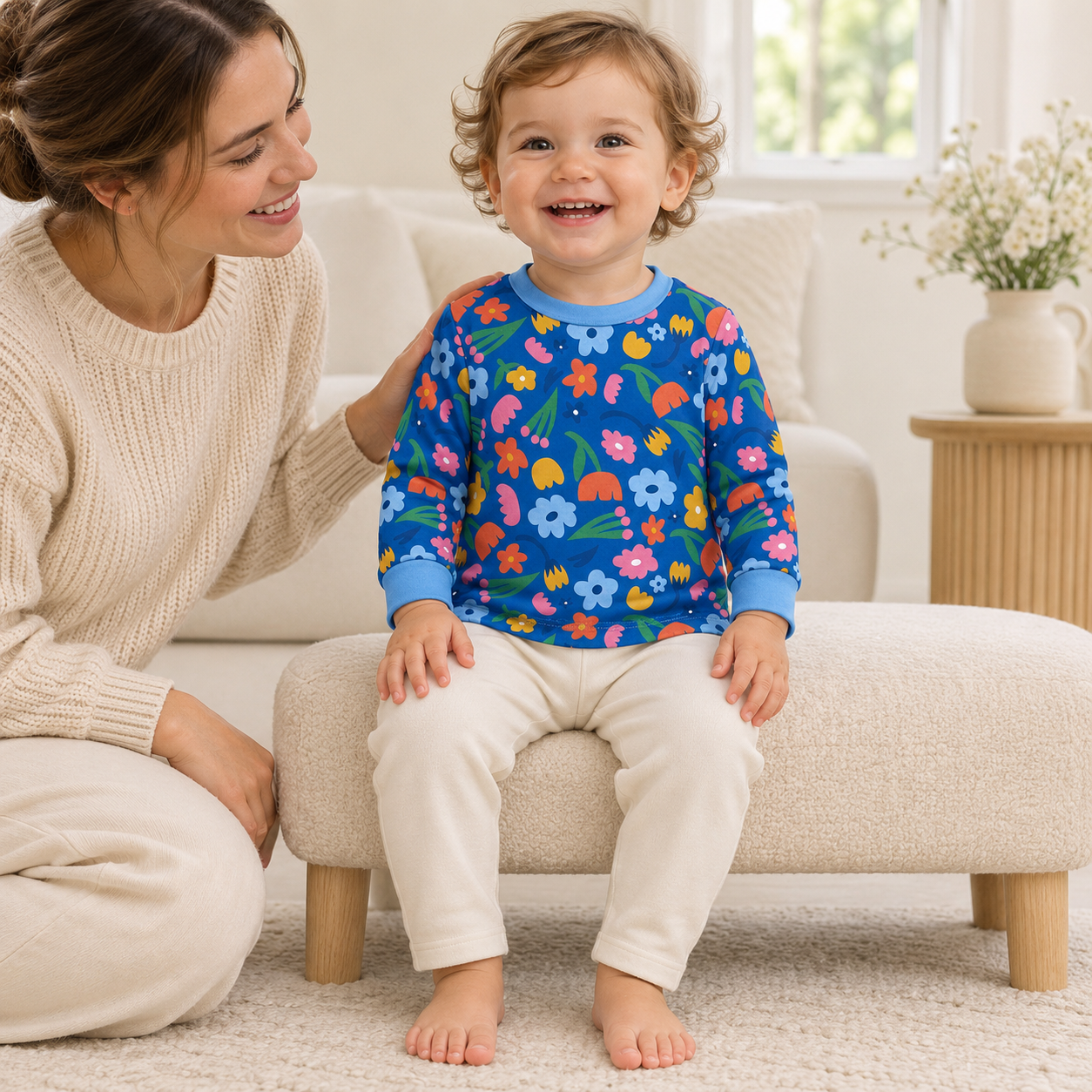
A long-sleeve crew tee in a 220 gsm printed knit: deep cobalt ground with an allover floral print in pink, red, yellow, orange and pale blue, a light-blue rib neckband, contrast rib cuffs and a straight coverstitched hem.
A baby tee is judged on one measurement that never appears on the drawing: the neck opening has to pass a head that is, at three months, roughly as big around as the chest. Everything else on this garment — the print, the cuffs, the hem — is easier than that.
At a glance
1. Fibre: 220 gsm bamboo viscose, and the name on the label
- "Bamboo" is a source, not a fibre. Almost all bamboo textile is viscose made from bamboo pulp, a regenerated cellulose fibre. EU Regulation 1007/2011 requires it declared viscose, the US FTC requires rayon. Only mechanically processed bamboo, a coarser and stiffer product, may carry "bamboo" as a fibre name.
- 220 gsm is a spring and autumn tee. It is a substantial jersey: it holds its shape, does not cling, and carries a dark-ground print without show-through. In a hot climate the same block at 160–180 gsm is the summer tee; buyers who order one for the other season notice immediately.
- A deep shade is a fastness decision, not a colour choice. Cobalt on viscose is where wash fastness and colour bleed show first: the ground is dyed to depth, then printed, and the two have to survive the same wash cycle. Fastness is tested on the finished garment, in the darkest colourway.
- Viscose is weak when wet and shrinks by finishing route. A tee loses length before it loses width, which is why the body length is specified as a finished, after-wash measurement and the sample is approved washed.
- It pills at the cuffs and under the arms, the two places a knit tee rubs. Finish reduces it; at this weight it does not disappear.
2. The neckline: a head bigger than the shoulders
- The neck opening is the fit-critical dimension. At 0–3M a baby's head circumference is close to its chest circumference, and it does not compress. A neckline sized to look right on a hanger can be a garment that cannot be put on without a fight — or one that tears at the shoulder seam.
- Rib with elastane, not self fabric. A rib neckband with elastane stretches to pass the head and comes back; a self-fabric band stretches and stays stretched. The band is a different knit from the body for exactly this reason, and its composition is a specification, not a default.
- The band ratio is the hidden number. Neckband length as a proportion of the neckline it is sewn to decides whether the collar sits flat, cups, or recovers. It is fixed on the sample, measured before and after repeated stretching over a head-size form, and written into the tech pack.
- A straight crew has a limit at the smallest size. For 0–3M some buyers specify a lap shoulder or shoulder snaps so the garment goes on without stretching the neck at all; those are different constructions, quoted separately.
- The neck seam has to be flat. Overlocked and pressed flat, or covered with a binding tape, because the neckline sits against a chin and a chest that are in constant contact with the fabric.
3. Body, cuffs and hem: where a knit tee is won or lost
- Cut and sewn with side seams. Four-thread overlock, pressed flat, nothing exposed against skin. On a printed 220 gsm knit, the seam allowance is kept narrow: a wide allowance grins through the print at the seam line when the cloth is stretched.
- Contrast rib cuffs do two jobs. They hold the sleeve at the wrist instead of letting it slide over the hand, and they buy length — a cuff gives a growing baby a few more weeks in the same size.
- Negative ease in the cuff. Cut smaller than the wrist so it stays put without gripping; too tight and it marks, too loose and the sleeve creeps up the arm all day.
- A contrast cuff is a second fabric. Light blue rib against cobalt means a second dye lot to match, a second minimum, and a visible shade difference if it drifts; worth pricing before it is designed in.
- The hem is a coverstitch, not a lockstitch. A straight hem on a knit has to extend when the body is pulled over a nappy; a twin needle without stretch thread cracks along the fold.
- Needle control. 100% needle detection on finished pieces; one-for-one exchange at every break with the machine stopped; work within 2.5 m re-screened twice; needle-free area enclosed, 2 m deep, single entry.
4. Print: cobalt ground, eight colours
- A dark ground needs opacity, and opacity costs hand. Printing eight colours onto cobalt means either a white base under the motifs, which gives clean colour but stiffens a 220 gsm knit, or a discharge and reactive route that keeps the hand and restricts the palette. The route is chosen at strike-off.
- Eight colours are eight registration points. On flowers this size, a millimetre of drift shows at the petal edges and the flower centres — the two places a buyer's eye lands.
- Print on a knit cracks where the knit stretches. The neck opening and the cuffs are pulled every time the garment goes on; check the print there, not only on the flat body panel.
- Crocking is the dark-ground risk. Wet rub and perspiration fastness on the finished printed panel at grade 3-4 or better; a cobalt ground that crocks marks a baby's skin and the inside of a pram.
- Scale the repeat to the panel. A repeat set for a dress cuts motifs at the side seam of a 0–3M body; either it is reduced or the seam is placed through a gap.
5. Compliance: apparel, drawn tight
- Fibre naming. Viscose in the EU, rayon in the US, percentage declared. "Bamboo" may appear as marketing copy where the destination allows it, never as the fibre name on the care label.
- Apparel route. As a worn garment the US general wearing-apparel flammability rule 16 CFR 1610 is the relevant test, confirmed per order with the laboratory; no claim is made and no report is held for this article.
- Cords and ties. None — no neck tie, no waist cord, no sleeve tie. On a garment for under-12M that is a design requirement, not a styling preference.
- Small parts. No buttons or snaps as quoted. Where shoulder snaps are specified, they are attachment-tested — 70 N is the figure worked to — and enter the small-parts control plan with a nickel-release check on the plated parts.
- Chemical class and labelling. Class I across 0–12M. OEKO-TEX Standard 100 certificate 23.HCN.45112 is held for the fabric; the class and the specific article — print, neckband, cuff rib — are confirmed against the certificate scope before a claim is listed. Care label with fibre content in the legal name, size and origin; tracking label where the US route applies.
6. Customization scope
- Sizing. Four bands as quoted; preemie and 12–18M on the same block.
- Neckline. Straight crew as quoted; lap shoulder; shoulder snaps; envelope neck for the smallest sizes.
- Sleeve. Long with contrast rib cuff as shown; short sleeve with a banded hem; raglan construction.
- Cuff and hem. Contrast rib as shown, self-colour rib, or a plain hem; straight or curved hem.
- Print. Floral allover as shown, a smaller repeat, a placement print, or a solid with contrast trim. Colour count drives cost.
- Sets. Matching shorts, leggings, bodysuit or headband; three-pack; gift box; polybag with header. Woven or printed label, satin care label, hangtag.
MOQ: 300 pcs for a custom development — custom fabric, print, colour or trim; 50 pcs for a decorative process added to a stock body; 100 pcs for stock fabric with your own logo and label. Mixed colour and size orders are quoted per order. These are standing programme terms, confirmed against the current quotation.
7. Sampling, lead times and what we need to quote
- Sampling. 3–7 days from a confirmed tech pack and fabric availability, including a print strike-off, neckband ratio approval and a cuff approval. A new repeat adds a round; rush sampling is quoted at a surcharge.
- Pull the sample over a head-size form before approving it. Neckband recovery and the true head clearance are the two things a flat sample hides, and both are the numbers a buyer argues about later.
- Sample cost. USD 30–100 per set, refunded against a bulk order of USD 5,000; development fee USD 50–200, refunded at USD 5,000.
- Bulk lead time. 30–60 days from approval by quantity, print and trim lead time; rush production is quoted per order.
- Quality standard. AQL 2.5 for major defects and AQL 1.0 for critical; third-party inspection accepted, with neckband recovery, print at the stretch points and the absence of cords checked as fit and safety items.
- Payment. New customers 50% deposit and 50% before shipment; repeat customers can move to 30% / 70% against the bill of lading.
Production runs with our production partner, Suzhou Shelmin Trade Co., Ltd.: 7,200 m² workshop, 8 lines, 200 staff, 6,000 pieces per day. Design confidentiality is held under NDA; buyer patterns and colourways are not re-used.
To quote, we need: target market; size bands and the neck opening you require; neckband and cuff composition; print route preference for the dark ground; artwork with repeat size and colour count; whether the tee is sold alone or in a set; packaging; and whether certification runs in your brand name.