EN

OEM/ODM Vintage 100% Cotton Smocked Baby Romper | Eco-Friendly Plant-Dyed Infant Jumpsuit | Custom Sustainable Ruffle Collar Newborn Bubble Bodysuit | Hand-Smocked Boutique Toddler Apparel Wholesale


- Overview
- OEM/ODM Smocked Plant-Dyed Cotton Baby Romper
- Recommended Products
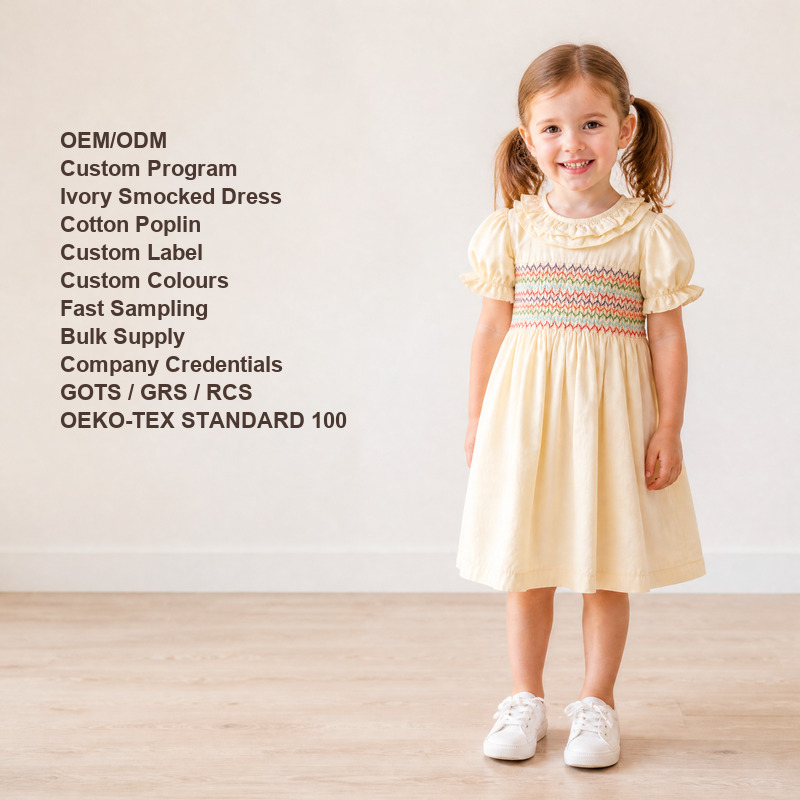
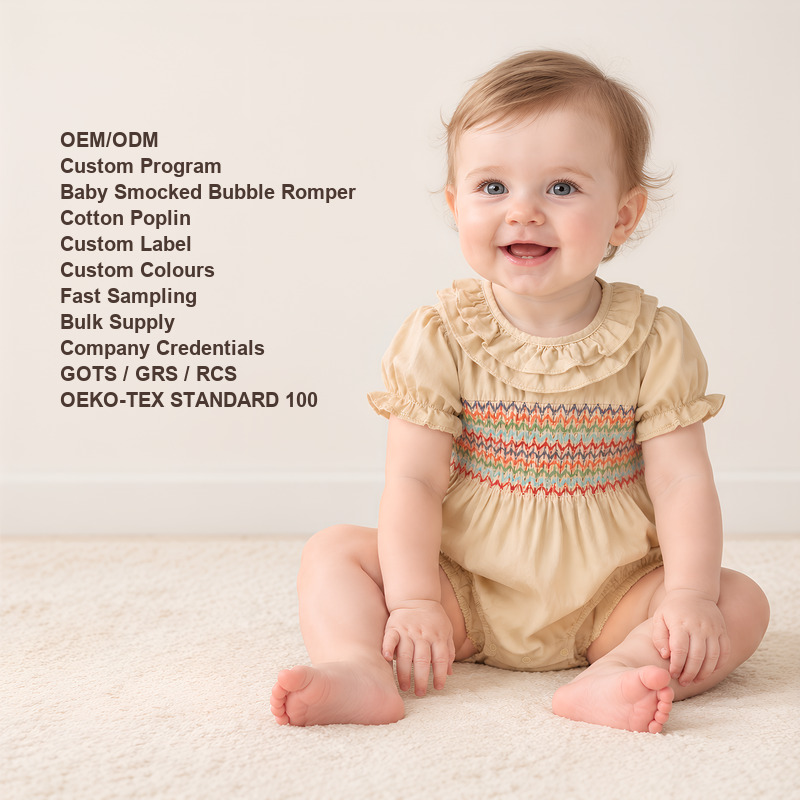
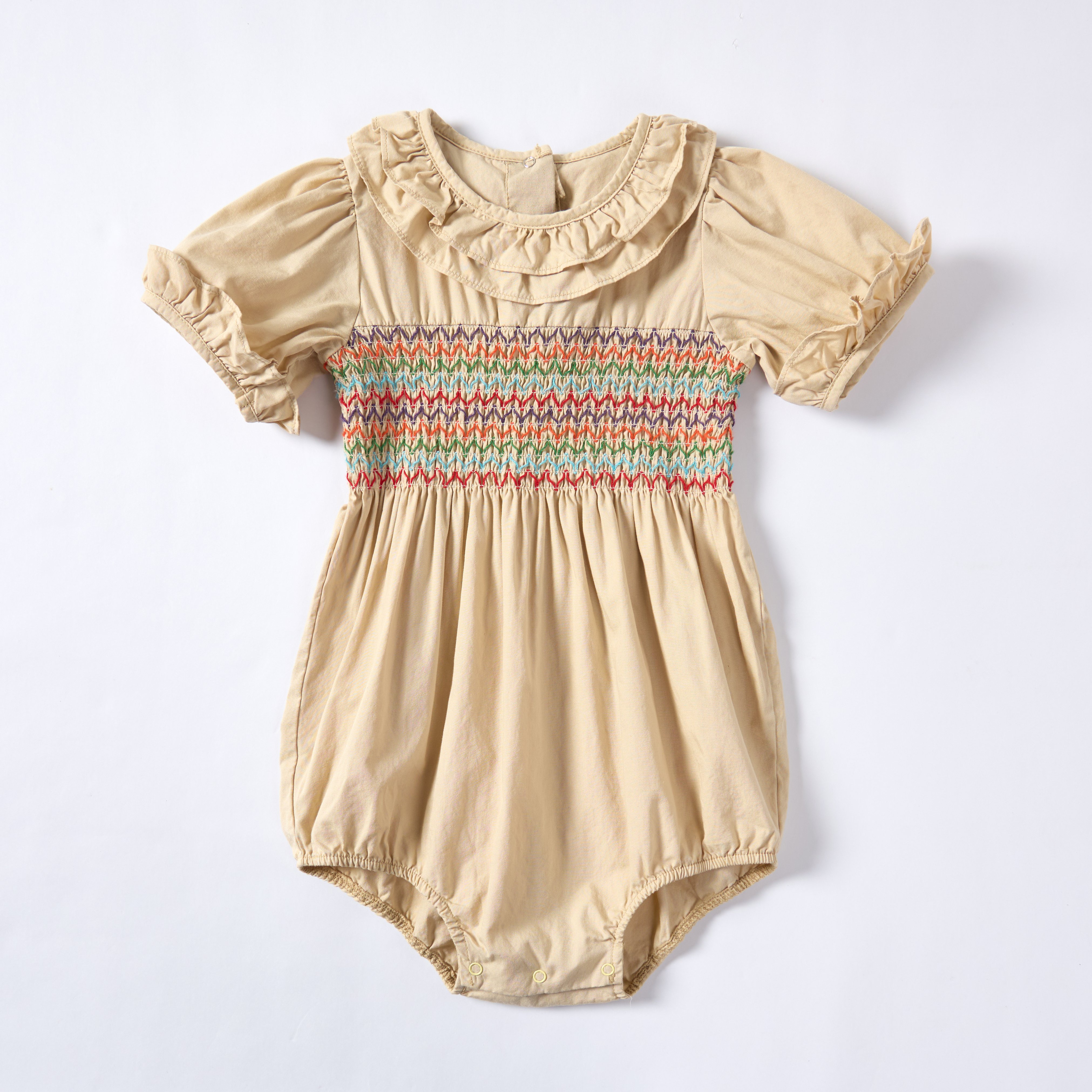
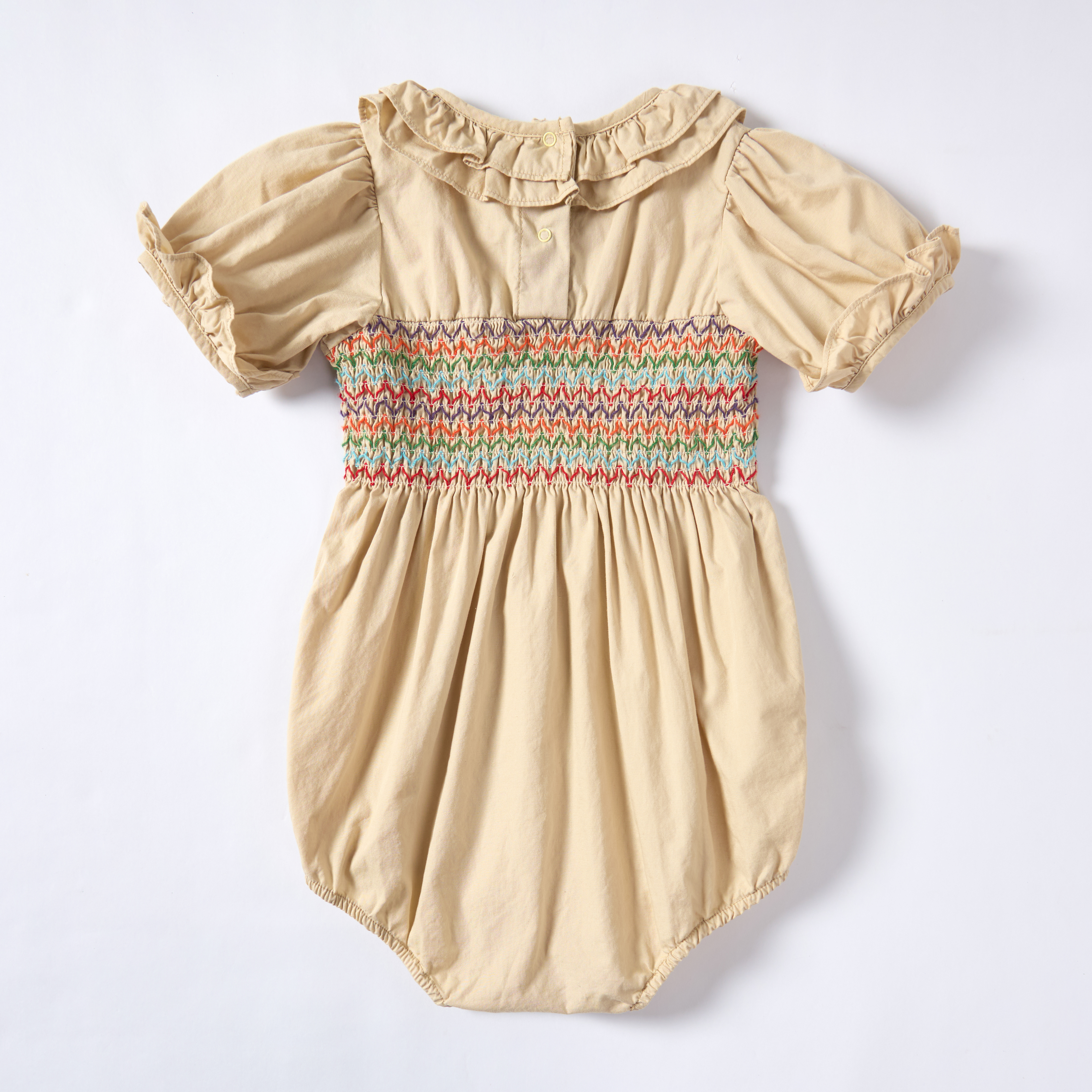
A short-sleeve bubble romper in 125 gsm cotton poplin, dyed to a dune sand with pomegranate rind (石榴皮) and sappanwood (苏木) alone: a ruffle collar, puff sleeves gathered into a ruffle cuff, a smocked bodice worked in rows of wave stitch, a short back placket with one button, and a gathered bubble body closed at the crotch with snaps above elasticated leg openings.
In this recipe one agricultural material supplies almost the whole colour. There is no madder to build red and no iron to push grey — the rind's own tan is the shade, and sappanwood only warms it and keeps it from going olive. That makes the dyestuff a crop rather than a chemical: two rind lots with identical tannin content can give two different sands, and the way that is held is blending, planned in advance, against a retained colour standard.
At a glance

1. Almost all of this colour is one crop
- The rind is the shade. Its ellagitannins give the tan that the whole colour sits on, and unlike a recipe with madder there is no second red to shift it — what the rind gives is what the garment is.
- Sappanwood is the correction, not the colour. A small dose warms the tan and holds it away from olive; pushed further the sand turns pink, held back it goes grey-green, so its role is a narrow adjustment on a shade it did not create.
- That changes what has to be bought. With the crop carrying the colour, the material has to be purchased on colour as well as on tannin content; a certificate of analysis that reports only tannin describes half of what the lot will do.
- It also changes what can be promised. A dyehouse can hold a sand to a standard across seasons; it cannot promise that next year's rind will dry to the same yellow, which is why the standard is a physical piece of cloth rather than a formula written down.
- Depth is set by the rind dose, and the ceiling is fastness, not solubility. More rind gives a deeper, more yellow tan that also reads dirtier; the accepted depth is where the tan is still clean on a dried panel under D65.
2. Buying rind on colour, not only on tannin
- Two lots at the same analysed tannin can differ in yellowness, because tannin content and the colour of the dried rind are two different properties of the same fruit.
- So the incoming check has two parts: tannin analysis, and a dyed strike-off against a retained rind colour standard. A lot that passes the first and fails the second is a lot that will make a sand the buyer did not approve.
- The strike-off is small, quick and repeated per lot. It is the only way to know what a rind lot will do on cotton before it goes into a bulk bath, and it costs a day rather than a batch.
- Rejecting on colour is normal in this recipe. It is not a sign of a bad supplier; it is the expected consequence of dyeing with a crop whose colour varies by season and by drying.
- Both records travel with the order: the tannin certificate and the rind colour standard the lot was matched to, so a shade can be traced to the material that made it.
3. Blending is the tool, and it has to be planned
- The way to hold a crop colour is to blend lots. Rind from several deliveries is combined in a planned ratio so that the average sits on the standard, and single-lot dyeing is avoided for bulk.
- This inverts a common buyer request. "One lot, no blending" sounds like the safer choice and is the riskier one here: a single rind delivery carries its own season, and if it dries yellower than the standard the whole order goes with it.
- A blend plan is written before the first bath. It states the ratio, which lots feed it and how the strike-offs compared, so the blend is a documented decision rather than whatever was in the store that week.
- The plan is what makes a re-order possible. A second order is dyed against the same standard using a new blend, and the buyer compares two garments rather than two harvests.
- Where a buyer insists on a single lot, it is quoted as its own colour with its own sealed standard, because it will sit slightly away from the blended shade and should be approved as such.
4. One material doing two jobs means one unevenness becomes two faults
- The rind is the carrier and the colour at the same time. Where it is heavy the cloth takes more red-free tan and holds dye better; where it is light the ground is paler and the fastness is weaker — the same unevenness shows up twice.
- There is nothing layered over it to hide it. A recipe with a red stage can mask a slightly uneven carrier; here the carrier is the visible colour, so a patchy rind read is a patchy garment.
- So the bath is run for evenness before depth. Liquor ratio, circulation, how the roll is turned and how long the cloth is in are specified, and cloth is not topped up in a bath that has already struck.
- Judgement is on a dried panel, never wet. Wet sand reads darker and warmer than it will dry, and a wet read will always be pulled lighter than the standard.
- Levelness is checked across the width as well as along the length, since a selvage running half a shade deeper shows as a seam-to-seam step once panels are cut and smocked.
5. This is the tone that forgives abrasion and exposes unevenness
- Every shade fails differently, and sand is the forgiving one for wear. Abrasion lifts a pale haze that on cream, coral or grey is obvious; on a mid tan it hides, so the friction at the crotch placket, leg channel and seat is still checked but is not where this colour loses a customer.
- What it does not forgive is unevenness. A cloud, a tide line or a selvage step reads immediately on a flat sand, and because the colour is one crop's colour, there is no pattern for the eye to read it as intentional.
- So inspection emphasis shifts. Every panel is graded for levelness under D65 at the same light, in addition to the abrasion check that a bubble always needs.
- Abrasion is still tested, because hiding is not passing. The placket, leg channel and seat are rubbed against unrubbed counterparts at the same points as any bubble in the range, so a surface that hides the wear does not also hide a construction fault.
- Stains behave differently here too. A greasy mark on sand reads as a darker patch and dries back, where on cream it would read as dirt; care wording still asks for cool washing and no softener, because a waxy deposit sits on a tan as a sheen.
6. The bubble, the band and the hardware
- The band carries a closed volume, so the panel-to-body join is the load path for the whole garment; it is reinforced and checked for puckering, which on a flat sand reads as a shadow line.
- Because the crotch opens, the band only has to pass a head at dressing, so the gathering ratio is set for a snug fit: two and a half to three times finished width, per size against head circumference plus clearance, checked for recovery on the sample and after five washes.
- Band and body read as one colour or not at all. Pleats hold shadow, so the band reads deeper than the flat body, and on sand the step is subtler than on cream — which is why the colour is still approved with the two side by side rather than from a single panel.
- Snaps are tested as a small part: retention and pull before and after wash cycles, plating specified, and staining of the ground around the stud counted as a fault; nickel release is confirmed for the EU from the supplier's report and travels with the lot.
- Leg elastic is encased with no free ends and specified as relaxed and stretched circumferences per size, with clearance checked on 24M and 36M first; the back button is tested at 70 N with a check against 16 CFR 1501.
7. Tests, sizes, sampling and quoting
- Fabric tests at the shipped depth: light to ISO 105-B02, wash to ISO 105-C06 with the smocked panel in the load, rubbing to ISO 105-X12 across the smocked area, the crotch placket and the leg channel, perspiration and saliva to ISO 105-E04 plus the destination market's saliva method.
- Levelness grading on every panel under D65, recorded against the sealed standard rather than judged by eye alone, since a crop colour is where a shade argument starts.
- Trim tests: snap retention and pull before and after wash cycles, corrosion and contact staining, leg elastic recovery after repeated washing, button retention at the back neck.
- pH is measured on the garment and held between 4.0 and 7.5; phenol yellowing is checked to ISO 105-X18 on a specimen carrying the actual packing fold, with packaging specified free of BHT.
- Five sizes on a measurement chart: 6-9M, 9-12M, 12-18M, 24M and 36M move on chest, body length, crotch depth, leg circumference and head clearance; the panel is re-set per size because stretch does not grade like a seam.
- Sampling: 3-7 days from a confirmed tech pack, covering a dyed strike-off with its rind lot and blend ratio stated, one smocked panel with its body beside it, a fit check on the smallest and largest size with a nappy in place, snap and elastic checks before and after five washes, and a bubble-shape check after washing.
- Bulk: 30-60 days from approval, planned per dyebath, per blend and per snap lot, with cloth released only after levelness, pH and fastness results are in hand.
- MOQ: 300 pcs for a custom development covering cloth, shade, smocking, trim or fit; 50 pcs for a decorative process on a stock body; 100 pcs for stock cloth with your own logo and label. Mixed colour and size orders are quoted per order, and terms are confirmed against the current quotation.
Production runs with our production partner, Suzhou Shelmin Trade Co., Ltd.: founded 2017, 7,200 m² workshop, 8 lines, 200 staff, 6,000 pieces per day. Design confidentiality is held under NDA; buyer patterns, shades and prints are not re-used.
To quote, we need: target market and the Class I tests it requires, including nickel release if the snaps are sold in the EU; whether you accept a blended rind plan or require a single lot; the shade target against a sealed standard, with a reference garment if one exists; the snap type and plating; leg elastic type and the relaxed and stretched circumferences you want; the thread palette; smocking row count and stitch; the rind tannin certificate together with a rind colour standard, and the thread certificate; the pH target and the dyehouse water specification; packing method; and whether certification is to run in your brand name.