EN



Custom Organic Cotton Baby Clothing Set | OEM/ODM Baby Sweatshirt and Jogger Pants Two-Piece Outfit for Private Label Kidswear Brands


- Overview
- Organic Cotton Baby Sweatshirt and Jogger Set
- Recommended Products
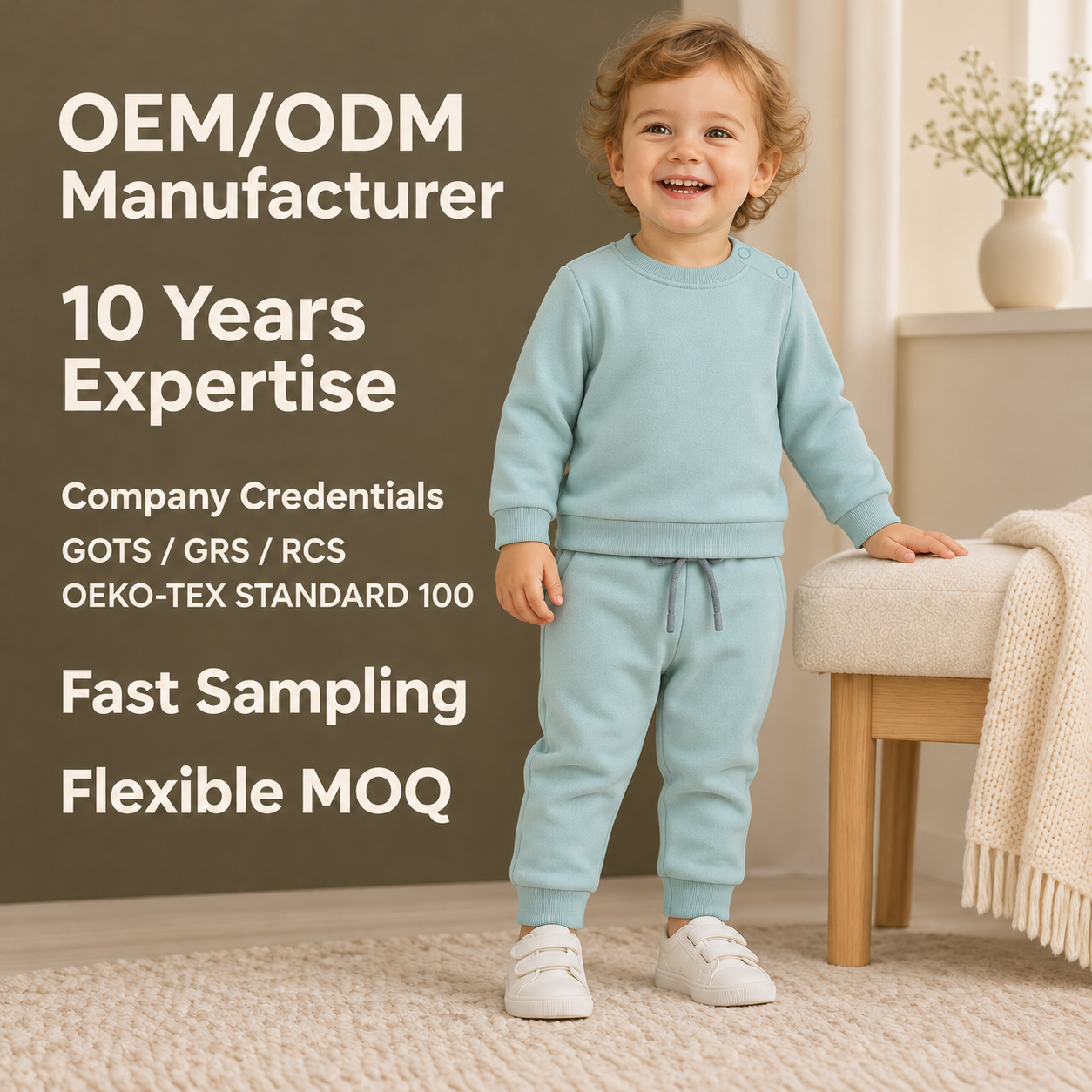
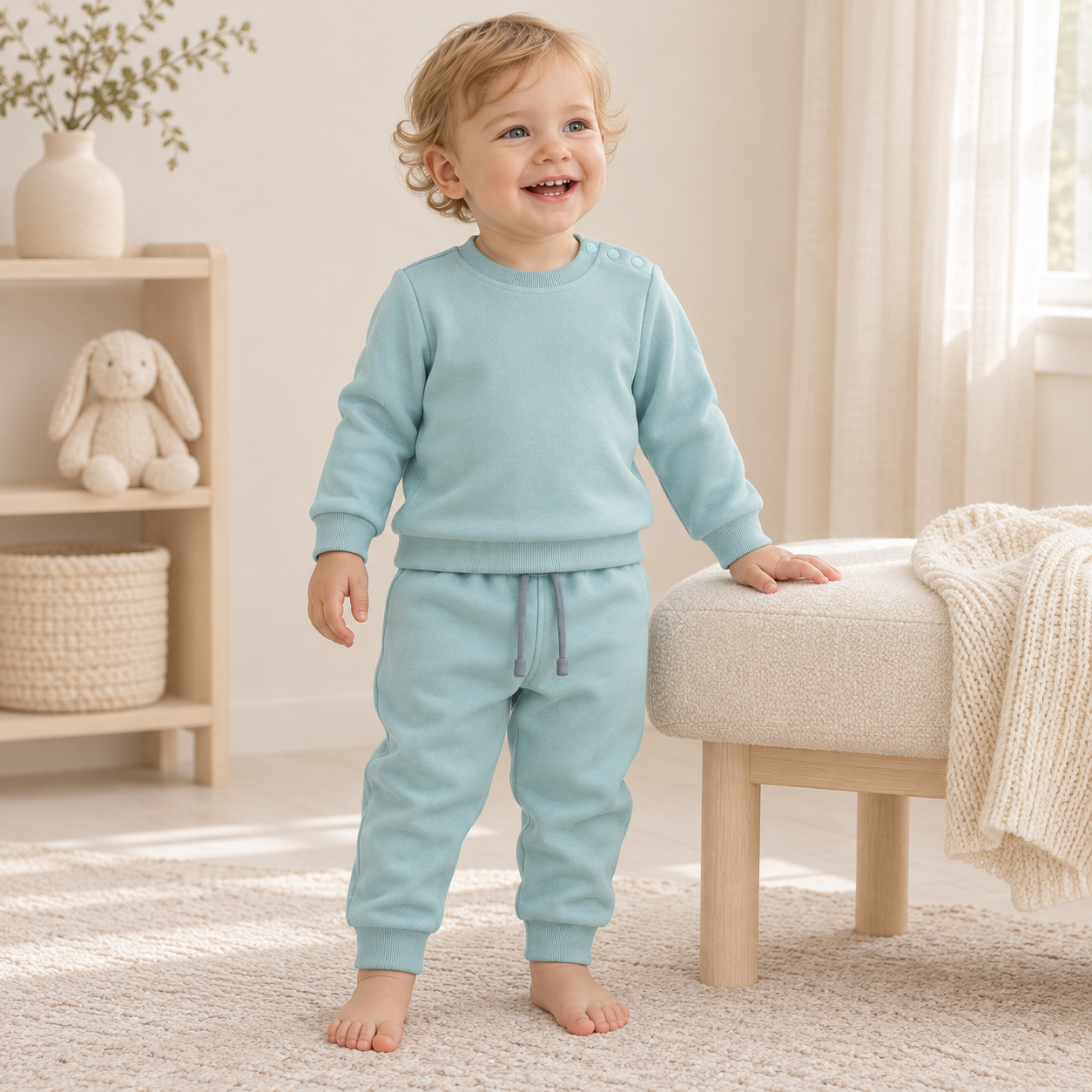
A two-piece set in a solid pale blue organic cotton sweat fabric: a crew sweatshirt with a rib neck, one snap at the shoulder, rib cuffs and a rib hem band, and a jogger with a rib waistband and draw, rib ankle cuffs, cut to sit over a nappy.
A sweatsuit is bought as a look and returned as a set — which makes two things matter more than on a single garment: whether "organic" is backed by a certificate that names the seller, and whether the top and the bottom came from the same dye lot.
At a glance
1. Fibre: what the word "organic" has to be standing on
- Organic cotton is a chain-of-custody claim, not a fibre description. It is verified through a scheme — GOTS for fibre and processing, OCS for content — and the certificate has to name the seller and list the product category. A mill's own statement is not a certificate.
- The certificate set is confirmed per order, and this page makes no certification claim. We quote organic cotton; whether the order runs GOTS, OCS or a buyer's own scheme is decided before sampling, because it changes which mills can be used and what the trims may contain.
- Organic does not mean untreated. Reactive dyes, softeners and an elastane content in the rib are all normal in an approved organic article; what the scheme changes is which inputs are permitted and how each batch is traced from fibre to finished piece.
- Cotton behaves differently from a regenerated fibre. It is stronger wet, so it survives washing better than viscose, but it shrinks more and less predictably: a sweat fabric that is not pre-shrunk can move several percent in the first wash, and a set that shrinks unevenly stops looking like a set.
- Weight decides the season. A baby sweatsuit usually runs 240–280 gsm in french terry or loopback; below that it is a light pullover, above it a winter layer. The weight is fixed on the tech pack, not assumed from a photo.
2. Fit: 0–12M, two garments that have to match
- Both pieces are measured over a nappy. The jogger needs rise and seat allowance; the sweatshirt needs body width that clears a nappy without hanging loose at the shoulder. Both figures belong in the graded spec.
- Four bands: 0–3M, 3–6M, 6–9M, 9–12M. The whole range is under 36 months, so every size is Class I — one chemical class, one test set.
- The top and the bottom are graded together. A set is worn as one garment; if the jogger grades two centimetres longer than the sweatshirt grades, the proportion drifts across the range and the 9–12M looks like two different products.
- Shrinkage is measured per piece, not per set. Both are pre-shrunk and both are measured after wash; a top that loses a centimetre more than the bottom is the most common reason a set reads as mismatched on the shelf.
- Jogger length is a crawling decision. A cuffed ankle sits clear of a crawling knee; an open hem drags. The cuff is cut with negative ease so it stays on the ankle without marking it.
3. Construction: rib does the fitting, the snap does the dressing
- The rib neck, cuffs, hem band and waistband are one system. Each is cut with negative ease and pre-shrunk with the body, so the garment holds its shape at every opening instead of stretching out at one. Rib without elastane recovers slowly and eventually not at all.
- One snap at the shoulder is the reason a 0–3M baby can be dressed. At that age the head is close to the chest in circumference and does not compress; the snap opens the neckline instead of stretching it. It is attachment-tested at 70 N and plated parts get a nickel-release check.
- The draw at the waist is a specification, not a styling extra. As photographed the jogger carries a functional draw with free ends. For 0–12M the practical build is a flat draw, bar-tacked and trimmed short, or an internal elastic with the draw stitched down as decoration — the cord rule of the destination market is checked at the drawing stage, before sampling, because retrofitting it changes the waistband construction.
- A rib waistband with a draw needs the draw anchored. A cord that runs free inside the casing pulls through in the wash; it is stitched at the centre back and the ends are finished so they cannot fray into a cord.
- Seams. Four-thread overlock pressed flat at the side seams and the sleeve; flat seams at the crotch and inner leg where a nappy and a car seat rub.
- Needle control. 100% needle detection on finished pieces; one-for-one exchange at every break with the machine stopped; work within 2.5 m re-screened twice; needle-free area enclosed, 2 m deep, single entry.
4. Colour: one dye lot, two garments
- A solid set is a colour match before it is a garment. If the top and the bottom are cut from different dye lots, they will differ under retail lighting even when they match in the sample room. The lot is reserved for the set and the two pieces are cut together.
- Pale solids show shade variation across a panel, not just between panels: a sleeve cut from the end of a roll can read a shade lighter than the body. Shade banding is checked at cutting, not at packing.
- Reactive dyeing on cotton gives a flat, even result and is the normal route for a pale solid; it also means the shade lives or dies with the dyehouse's levelness, which is why a lab dip on the actual fabric is approved before bulk.
- Colour fastness is tested on the finished garment, including wet rub at the cuffs and the waistband, at grade 3-4 or better — a pale blue that crocks onto a white vest is a complaint, and a set is worn with other whites.
- Trims have to match the lot. Rib, drawcord and any thread are matched to the body, not chosen from a trim card; a draw that is visibly whiter than the waistband is the first thing a buyer sees on a flat-lay.
5. Category and compliance
- A sweatsuit is daywear. No sleepwear claim, no nightwear imagery; marketed as sleepwear, the US route becomes 16 CFR 1615/1616 and the EU route EN 14878, and the tight-fitting option constrains the fit of both pieces.
- As apparel, the US general wearing-apparel flammability rule 16 CFR 1610 is the relevant test and its scope is confirmed per order with the laboratory; no claim is made on this page and no report is held for this article.
- Children's product duties. Lead limits of 100 ppm in the substrate and 90 ppm in a surface coating, phthalates where a plasticized part exists, a children's product certificate and a tracking label where the US route applies.
- Cords and small parts. The draw is the item to resolve before bulk; the shoulder snap is the only hard part on the garment and is checked for attachment and pinch points. No toggles, no charms, no cords at the neck.
- Chemical class and labelling. Class I across 0–12M. OEKO-TEX Standard 100 certificate 23.HCN.45112 is held for this fabric at Class I. Care label with fibre content in the legal name — organic cotton declared as such only where the certificate supports it — plus size and origin.
6. Customization scope
- Sizing. Four bands as quoted; preemie and 12–18M on the same block.
- Pieces. Set as shown; sweatshirt only; jogger only; a romper version with a crotch opening.
- Fabric. French terry or loopback at the quoted weight; a brushed-back version for winter; a lighter single jersey for a summer set.
- Neck and closures. Rib neck with a shoulder snap as shown; envelope neck; a two-snap shoulder for a wider opening.
- Waist. Rib waistband with a stitched-down draw; internal elastic with no cord; a paperbag waist.
- Colour and branding. Solid pale blue as shown or any lab-dipped shade; tonal or contrast rib; woven or printed label, satin care label, hangtag, gift box or polybag with header.
MOQ: 300 pcs for a custom development — custom fabric, colour, trim or certification programme; 50 pcs for a decorative process added to a stock body; 100 pcs for stock fabric with your own logo and label. Mixed colour and size orders are quoted per order. These are standing programme terms, confirmed against the current quotation.
7. Sampling, lead times and what we need to quote
- Sampling. 3–7 days from a confirmed tech pack and fabric availability, including a lab dip, a rib approval and a snap approval. An organic programme adds certificate review before the fabric is booked; rush sampling is quoted at a surcharge.
- Wash the sample before approving it. Shrinkage per piece, rib recovery and any shade difference between top and bottom only appear after one wash.
- Sample cost. USD 30–100 per set, refunded against a bulk order of USD 5,000; development fee USD 50–200, refunded at USD 5,000.
- Bulk lead time. 30–60 days from approval by quantity, dyeing and trim lead time; rush production is quoted per order.
- Quality standard. AQL 2.5 for major defects and AQL 1.0 for critical; third-party inspection accepted, with rib recovery, the waist draw and the shade match between the two pieces checked as fit and safety items.
- Payment. New customers 50% deposit and 50% before shipment; repeat customers can move to 30% / 70% against the bill of lading.
Production runs with our production partner, Suzhou Shelmin Trade Co., Ltd.: 7,200 m² workshop, 8 lines, 200 staff, 6,000 pieces per day. Design confidentiality is held under NDA; buyer patterns and colourways are not re-used.
To quote, we need: target market; the organic scheme and whose name the certificate runs in; size bands and the nappy allowance you work to; fabric weight and whether it is terry or loopback; how the waist draw should be built for your market; the shade reference; packaging; and whether the set is sold as one SKU or two.